Signs Your Tree Needs Removal
Dangerous trees demand immediate attention. Our ISA-Certified Arborists — serving Tampa Bay since 2000. Identify key warning signs: a dead or visibly dying canopy, severe trunk decay, significant crown dieback, hazardous lean toward structures, major storm damage, or roots compromising foundations. Any single sign warrants professional evaluation before catastrophic failure occurs.
Key Takeaways
- A tree leaning at an unusual angle signals structural instability and requires immediate professional evaluation.
- Dead or dying trees near structures pose direct danger and demand removal before the next storm.
- Hollow trunks, fungus growth, and crown dieback are 3 visible signs a tree is actively failing.
- Trees planted in wrong locations or blocking structures often need removal to protect surrounding property.
What Makes a Tree Immediately Dangerous to Remove?
Hazardous trees — those with structural defects that compromise their physical integrity — pose an immediate risk of injury to people and damage to property. Structural defects demand prompt evaluation by a certified arborist, not a wait-and-see approach.
Trees become immediately dangerous when one or more of the following conditions are present:
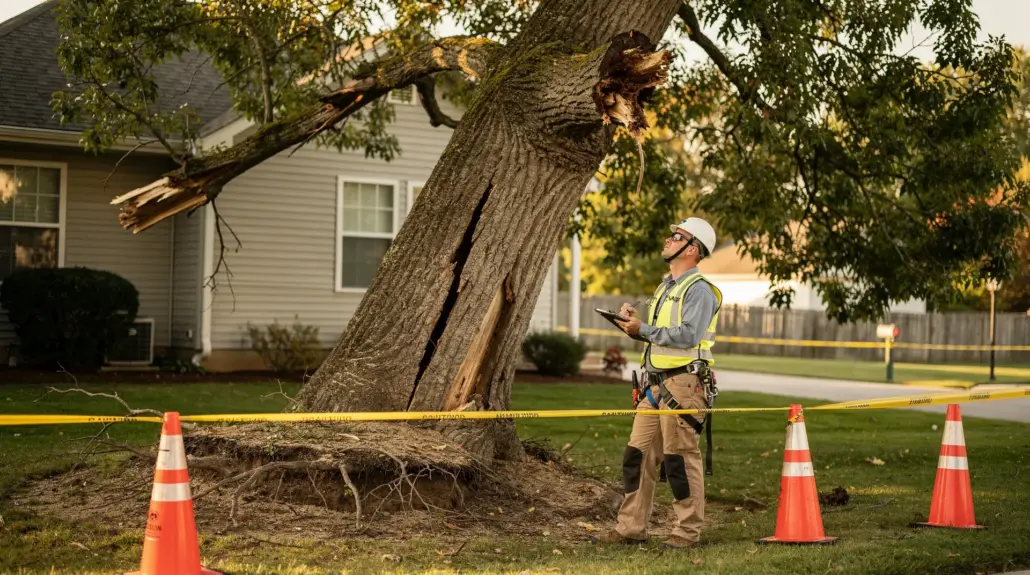
- Severe trunk cracks or splits that compromise the tree’s load-bearing structure
- Large dead branches suspended overhead, known as “widow makers” in arboriculture
- Significant lean that developed suddenly, indicating root failure rather than natural growth
- Hollow or decayed trunk sections that eliminate the structural core
- Visible root damage caused by construction, soil compaction, or disease
Why Does Tree Condition Affect Removal Risk?
Removing a dying or structurally compromised tree carries significantly greater risk than removing a healthy one. Decayed wood behaves unpredictably under chainsaw pressure, and weakened root systems can shift without warning during cutting operations. Professional assessment is essential precisely because the tree’s instability is what makes it dangerous in the first place.
When Should a Certified Arborist Evaluate a Tree Immediately?
Any tree displaying structural defects near a home, walkway, or power line warrants immediate professional evaluation. Our ISA-Certified Arborists have specialized in hazardous tree removal across Tampa Bay since 2000, bringing the technical expertise needed to assess failure risk accurately. Waiting to schedule an evaluation after a storm or visible crack appears increases the likelihood of an uncontrolled failure.
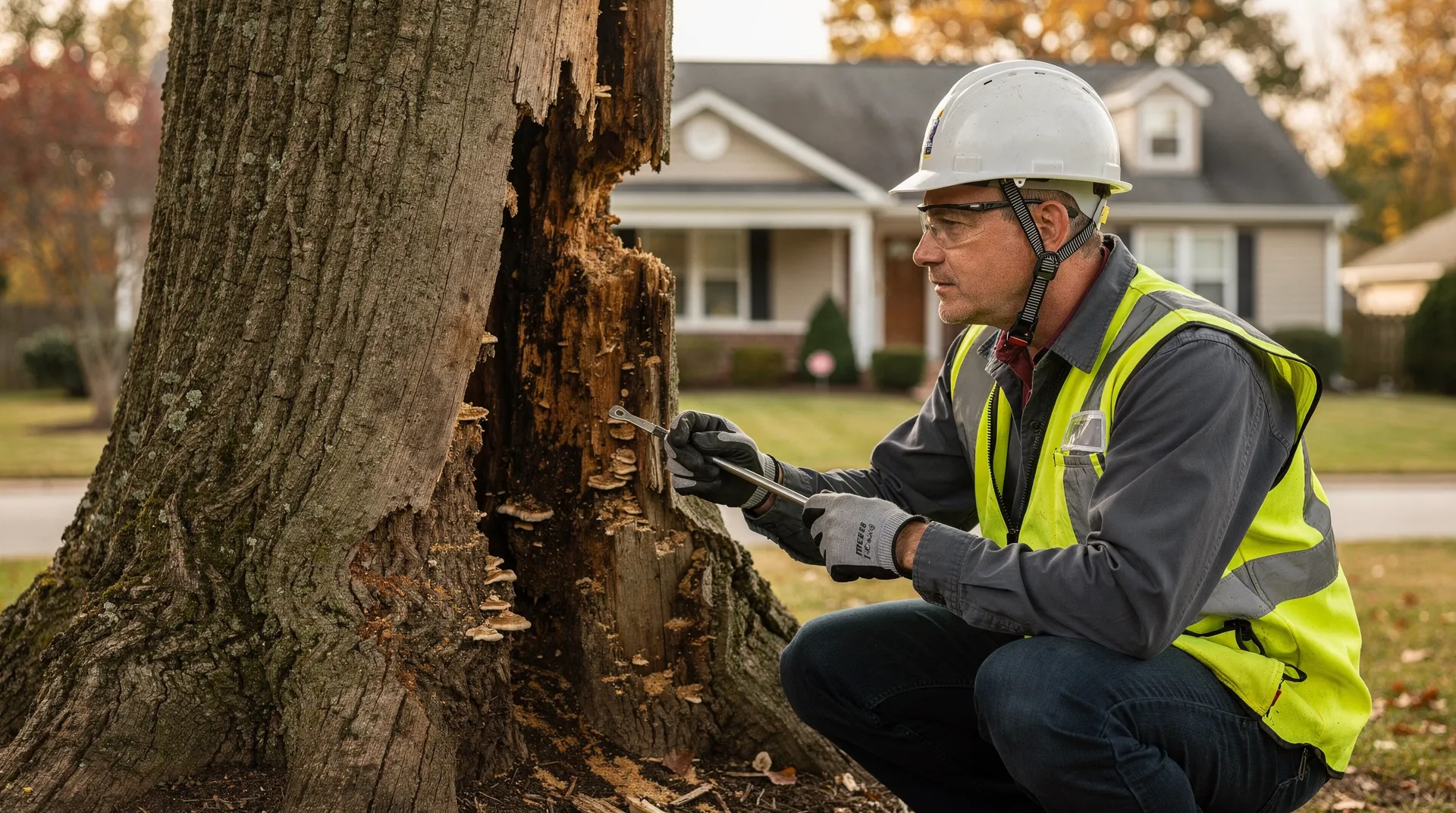
Does Structural Damage Signal Urgent Tree Removal?
Structural damage is one of the clearest indicators that a tree requires immediate removal. A damaged or decaying tree has compromised structural integrity, and keeping that tree standing places nearby people and property at serious risk.
What Physical Signs Indicate a Tree Is Structurally Unsafe?
Several visible warning signs point to a tree that can no longer support its own weight safely. Our ISA-certified arborists consistently identify these as the most urgent red flags:
- Cracked or rotting trunk — Internal decay weakens the core, leaving the tree prone to sudden collapse
- Large dead branches — Heavy limbs that have died lose flexibility and break without warning
- Unstable lean — A tree that leans noticeably, especially after a storm, has likely lost its root anchorage
- Compromised structural integrity — Any combination of decay, splits, and crown dieback signals the tree’s load-bearing capacity is failing
A single one of these conditions warrants a professional assessment. Multiple signs together demand urgent action.
How Does Decay Inside the Trunk Affect Removal Urgency?
Decay is deceptive. A tree can appear healthy from the outside while the interior has hollowed significantly, leaving only a thin shell of living wood. Once structural integrity is compromised to that degree, even moderate wind loads become dangerous. The longer a structurally unsound tree remains standing near a structure or high-traffic area, the greater the potential for catastrophic failure.
Panorama Tree Care addresses these situations using advanced crane technology and zero-impact removal methods, protecting surrounding structures throughout the process. Our company-owned fleet — including 75-foot bucket lifts, grapple trucks, and commercial stump grinders. Ensures rapid deployment when a hazardous tree demands immediate attention. Speed and precision matter when structural failure is imminent.
Can Disease and Decay Require Immediate Tree Removal?
Disease and decay absolutely require immediate attention — fungal growth, hollow trunks, and internal rot compromise a tree’s structural integrity to the point where even a moderate storm can cause catastrophic failure. Waiting to address these warning signs puts property and people at serious risk.
What does fungus on a tree actually mean?
Visible fungal growth on a trunk or root flare is rarely a surface-level problem. Fungus signals active internal decay that hollows out the wood from within, silently eroding the structural strength that keeps a tree standing. A tree weakened by internal rot can topple during a windy afternoon — no major storm required.
How do you know if decay is serious enough to warrant removal?
The challenge is that decay is not always visible from the outside. A tree can appear outwardly healthy while harboring significant internal deterioration. The signs that do appear — soft or discolored bark, mushroom-like conks at the base, unusual crown dieback. Each point toward conditions that a homeowner cannot reliably assess alone.
The following indicators suggest disease or decay has reached a critical threshold:
- Fungal conks or mushrooms growing at the base or along the trunk
- Hollow or soft sections detected by tapping the bark
- Crown dieback where large sections of canopy lose foliage without seasonal explanation
- Discolored or oozing bark indicating bacterial or fungal infection beneath the surface
A certified arborist — specifically one holding ISA certification and TRAQ qualification — provides the diagnostic precision these situations demand. Our ISA-Certified, TRAQ-qualified arborists at Panorama Tree Care have evaluated tree health across more than 24,000 projects in Hillsborough, Pinellas, Manatee. Sarasota Counties, bringing that depth of field experience to every assessment.
Does Tree Location Determine Whether Removal Is Necessary?
Tree location is one of the most decisive factors in determining whether removal is the right course of action. A tree that poses no threat in an open field carries an entirely different risk profile than the same species growing directly over a roofline or utility line.
When Does a Tree’s Position Make Removal Obvious?
Some situations leave little room for debate. Trees that are dead or clearly dying, physically obstructing a structure. Planted in a location that was never appropriate for their mature size typically require removal. Proximity to a home, driveway, or power infrastructure amplifies every structural defect. A crack that might be tolerable in an isolated woodland specimen becomes an urgent hazard when the tree overhangs a roof.
Location also shapes the legal dimension of the decision. Navigating Tampa’s Grand Tree Ordinances carries genuine legal risk. Our ISA-Certified Arborists assist property owners with permits and HOA compliance before any removal work begins.
Can a Dying Tree Ever Stay in Place?
Location determines this answer more than any other variable. Dying trees situated in natural areas — away from structures, foot traffic, and utilities. Can sometimes be allowed to decline in place without human intervention. Dead standing trees, known as snags, provide habitat value for wildlife. Pose no meaningful threat when no people or property are nearby.
The key factors that guide our assessment include:
- Proximity to structures — rooflines, fences, outbuildings
- Overhead utility lines — power, cable, and communication infrastructure
- Foot traffic zones — walkways, driveways, play areas
- Regulatory status — protected species or grand tree designations under local ordinance
As an A+ Rated BBB Accredited Business serving Tampa Bay, Panorama Tree Care evaluates all four factors before recommending removal, ensuring every decision is grounded in both safety science and local compliance requirements.
When Should You Call an Arborist for Emergency Removal?
What are the signs that my tree needs to be removed immediately? Calling a certified arborist becomes urgent the moment a tree poses a direct threat to people, structures, or utility lines. Delaying professional evaluation after visible damage or severe weather increases the risk of catastrophic failure.
Storms are particularly deceptive. Severe weather leaves hidden structural damage — fractured root systems, internal decay. Split branch unions — that makes trees progressively more dangerous over time. A tree near your home or power lines that looks weakened after a storm warrants professional evaluation without delay, even if no branches have fallen yet.
Signs that demand immediate professional attention include:
- Large dead branches hanging over occupied areas
- A sudden, pronounced lean that developed after a storm
- Visible cracks or splits running through the main trunk
- Exposed or heaved roots indicating root system failure
- Contact with or proximity to active power lines
What happens when you contact us for an emergency assessment?
Panorama Tree Care is fully licensed, insured, and available for 24/7 emergency tree response by phone. For non-emergency situations, our team aims to respond to all inquiries within 24 hours. Can typically schedule an on-site assessment within 2 to 3 business days.
What should you expect from the estimate process?
Our ISA-certified arborists provide binding written estimates with itemized proposals that define the exact scope of work. From removal methodology to debris disposal. The price quoted is the price paid. There are no hidden fees and no mid-job upsells, giving property owners a clear, trustworthy picture of the work ahead.
FAQ
What are the most urgent physical signs a tree is structurally unsafe?
Cracked or rotting trunks, large dead branches, and an unstable lean are the clearest red flags. Each signals the tree has lost the structural integrity needed to support its own weight safely.
What makes a leaning tree immediately dangerous?
A sudden lean indicates root failure rather than natural growth, meaning the tree has lost its anchorage. Poses a direct risk of uncontrolled collapse onto nearby people or structures.
Why does removing a damaged tree carry greater risk than removing a healthy one?
Decayed wood behaves unpredictably under chainsaw pressure. Weakened root systems shift without warning during cutting, making professional evaluation essential before any removal work begins.