TL;DR: Tree cabling and bracing let you keep valuable Florida shade trees that might otherwise have to come down. By reinforcing weak branches and bad trunk unions, an ISA Certified Arborist can keep that tree standing through storms instead of cutting it down.
The work should follow ANSI A300 Part 3 standards so the support system actually lowers failure risk in our thunderstorms and hurricanes, instead of just looking like it helps.
Key Takeaways
- Tree cabling uses high‑strength cables high in the crown to support weak or splitting limbs. Bracing uses rigid steel rods through the trunk or branch union to hold cracked or opening sections together.
- in Florida, Laurel Oaks, Live Oaks, and Camphor trees are the species I see cabled most often, especially where there are codominant stems and tight, bark-filled unions that like to split.
- Dynamic systems like the Cobra synthetic cable are designed to flex and allow some movement. Static steel strand cable is stiffer and holds more rigidly. The right system depends on tree age, size, condition, and how much is at risk underneath.
- Typical tree cabling cost in Florida runs about $300–$800 per cable, $200–$600 per brace rod, and $800–$2,500+ for complex setups on big multi‑stem trees that need multiple support points.
- Well‑designed cabling can meaningfully cut the hurricane wind load at weak unions and reduce the odds of a major failure during Florida storm events.
- ANSI A300 Part 3 calls for at least annual inspections, with steel components often replaced about every 7–10 years (steel) and synthetics closer to 10–15 years (synthetic), assuming they are still in good condition.
- Cabling is often used as a tree removal alternative on trees that have structural defects but still have solid root systems, good foliage, and real shade or property value.
- Always bring in an ISA Certified Arborist to design and install the system. Poorly chosen hardware and bad placement can increase failure risk instead of reducing it.
What Is Tree Cabling and Bracing?
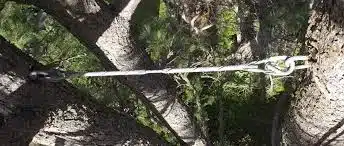
Tree cabling is the practice of installing high‑strength steel or synthetic cables between major limbs or stems high in the canopy, usually around the top two‑thirds of the crown. Those cables tie critical parts of the tree together so the limbs share the load and the weakest points do not take the full hit from wind and gravity.
Tree bracing uses rigid threaded brace rods that run right through the trunk or branch union. Think of it like putting bolts through a cracked beam. The rods hold the split sections together from the inside and keep cracks from opening further under stress.
Used together, cabling and bracing form a supplemental support system. They work alongside structural pruning, good root care, and soil management, and are laid out and installed following ANSI A300 Part 3 Support Systems so everything is sized and positioned correctly for the actual forces involved.
What Is Tree Cabling and Bracing? (How Each System Works)
Tree cabling relies on flexible connections between codominant stems or big limbs high in the crown. Tree bracing relies on rigid steel rods that pass through the weak union or crack closer to the trunk. On real jobs, an ISA arborist usually uses both systems in combination, along with targeted structural pruning under ANSI A300 Part 3, to get the risk down to a level everyone can live with.
At its core, tree cabling and bracing is all about rerouting forces through the tree. Wind, the weight of long wet limbs, and straight gravity like to focus on the weakest spots. A properly designed tree support system spreads that load across stronger wood and keeps suspect unions from flexing as far or as fast. That is what keeps the branch from tearing out of the trunk at 3 a.m. in a thunderstorm.
The two main components have very different jobs:
- Cabling – The arborist installs a static steel cable or dynamic cabling system between selected branches or codominant stems, usually about two‑thirds of the height above the defect or union they are protecting. Correctly placed, this will:
- Let limbs share loads so one weak arm is not carrying everything
- Cut down extreme movement during gusts and storms
- Reduce stress and leverage right where the union likes to split
- Help even out crown weight distribution, especially on lopsided trees
- Bracing – The arborist drills through a cracked or opening union and installs threaded brace rods, tying multiple stems together mechanically. Those rods:
- Reinforce the exact failure point instead of just the area around it
- Keep existing cracks from spreading under repeated loading
- Add internal rigidity where the tree’s own wood has already lost strength
ANSI A300 Part 3 Support Systems spells out how and when to use these tools. It covers things like:
- Minimum cable diameters and hardware specifications so the system is not undersized for the tree
- Where to set the installation height relative to the union or defect
- How far apart to place anchor bolts, what type, and at what angle
- How often the system should be inspected and maintained
- That layout and installation must be done by or under the supervision of an ISA Certified Arborist
Here in Florida, Panorama Tree Care cabling service takes those ANSI rules and adapts them to what our local trees and storms actually throw at us. Laurel Oaks, Live Oaks, and Camphors all fail a little differently, and hurricane wind load is no joke, so that design step matters just as much as the hardware you bolt into the tree.
Which Florida Trees Need Cabling Most? (Species Vulnerability Chart)
Some Florida trees are repeat offenders. Laurel Oaks regularly end up needing cabling because they develop weak unions and interior decay as they age. Live Oaks are tougher but carry huge lateral limbs that sometimes outgrow the strength of the union. Camphor trees like to grow multiple codominant stems that split right at the base of the fork once they hit size.
Not every tree in your yard needs hardware. Far from it. But certain species and certain growth patterns are high‑risk candidates, especially when they hang over houses, driveways, parking lots, or where kids play. Those are the ones that deserve a serious look from an ISA Certified Arborist.
| Florida Tree Species | Common Structural Issue | Typical Failure Mode | Relative Cabling Need | Recommended Support System |
|---|---|---|---|---|
| Laurel Oak (Quercus laurifolia) | Weak unions, interior decay, big overstretched limbs over driveways and roofs | Sudden limb or partial trunk failure in moderate to high winds, often with little warning | Very High | Static steel cables plus brace rods at major included bark unions, combined with structural pruning to shed weight |
| Live Oak (Quercus virginiana) | Massive lateral limbs, very wide crowns, occasional codominant stems | Limb drop or union failure under heavy hurricane wind load, especially on overextended arms | Moderate to High | Dynamic Cobra system between codominant stems on younger trees, static steel for very large, heavy limbs in high‑target areas |
| Camphor Tree (Cinnamomum camphora) | Multiple codominant stems, included bark, very fast growth outpacing structure | Major stem split right at the codominant union, often as the tree reaches maturity | High | Combination of static steel cables and brace rods through the codominant union, possibly staged over time |
| Queen Palm & Other Palms | Palm crown breakage and root plate issues. Crowns are not good candidates for cabling. | Top snapping off or whole tree uprooting in wet soils and strong winds | Low (for cabling) | Root zone care, correct planting depth, and general hurricane tree preparation |
| Maple, Sycamore, other broadleaf shade trees | Codominant stems, over‑extended branches from past topping or bad pruning | Branch union failure or cracking along the shared trunk where stems meet | Moderate | Dynamic or static cables depending on size, with structural pruning to pull weight back toward the trunk |
Two structural red flags show up again and again in Florida’s tree failures:
- Codominant stems – Two or more stems of similar size originating at the same spot. They often lack strong connective wood, and decay can hide deep inside where you cannot see it from the ground.
- Included bark unions – Those tight, V‑shaped crotches where bark is caught between the stems. The bark keeps real wood from forming across the union, which makes the attachment much weaker.
On Laurel Oaks and Camphor trees, these problems are almost standard equipment. A Live Oak codominant stem that has a wide, U‑shaped opening with clean connection wood can hold up very well. But once you see that pinched, V‑shaped included bark and you factor in Florida hurricane wind load, that same union can fail fast and violently.
Whenever these defects hang over structures, an ISA Certified Arborist will usually weigh three paths:
- Structural pruning to thin or shorten limbs and reduce crown weight
- Cabling and bracing as cabling as alternative to removal on trees that still have good overall health
- Full removal if the risk can not be brought down to a reasonable level, even with hardware
Dynamic vs Static Cabling Systems: Which Is Better?
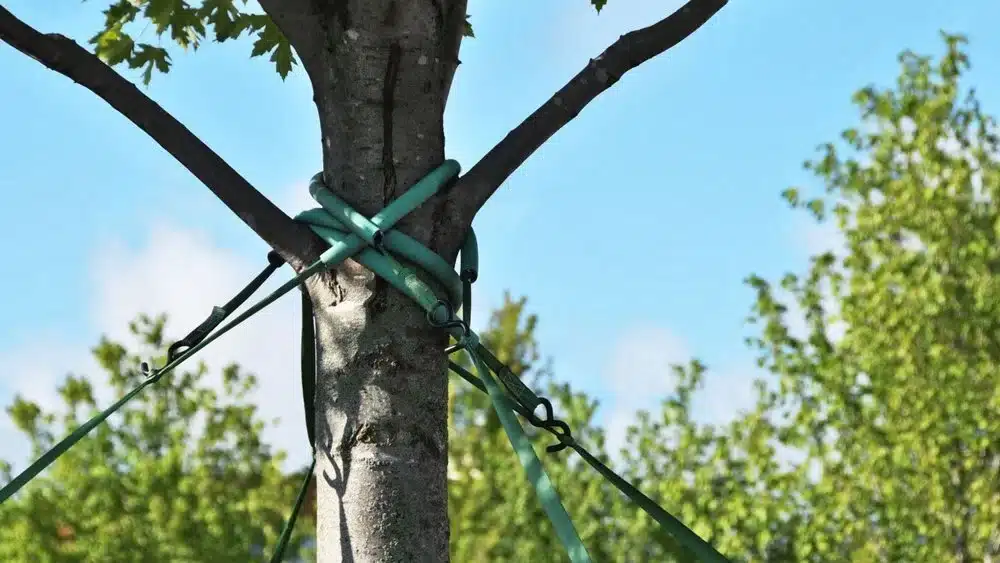
Dynamic systems like Cobra are built to flex with the tree, reduce shock loads, and let the tree keep building its own support wood. Static steel cables take a more rigid approach and are used where you need much more holding power and less movement.
There is no universal “best” in the dynamic vs static cabling debate. The right choice depends on how the tree grows, how big and heavy the limbs are, what kind of defect you are dealing with, and what is sitting under the tree if something goes wrong.
Dynamic Cabling (e.g., Cobra System)
The Cobra dynamic cabling system is built from high‑strength synthetic material with integrated shock absorbers and protective sleeves. It is engineered to:
- Allow a controlled amount of stretch and sway so the tree is not locked in place
- Encourage the tree to keep building reaction wood and improving its own structure over time
- Soften sudden gusts into more gradual loads instead of hard snaps
- Be installed without drilling hardware into the tree, which keeps wounding to a minimum
Dynamic cable is usually the better call when:
- The tree is young to middle‑aged, still putting on good annual growth
- The limbs are moderately sized and not yet carrying extreme mass
- The goal is extra support, not total movement lock‑down
- Long‑term canopy health and smaller wounds matter as much as immediate risk reduction
Static Steel Cable Systems
Static steel cable systems use steel strand cable tied into the tree with J‑lag or eye‑bolt anchors. Compared to synthetics, they offer:
- Much higher rated break strength for big, heavy limbs and wide spans
- Rigid restraint that seriously limits how far critical limbs can move
- A long track record on large trees in both residential and commercial settings
Static systems are usually preferred when:
- The tree is mature with very heavy limbs that already move a lot in wind
- The defect is serious enough that you want tight control of movement
- There are critical targets under the tree like homes, driveways, parking lots, or walkways
- Cabling is part of a broader hurricane risk mitigation plan for the property
Which Is Better in Florida Conditions?
Florida trees deal with a strange mix. We get daily summer thunderstorms with short, intense gusts and, every so often, true hurricane wind load from passing tropical systems.
- Dynamic systems like Cobra are a good fit for moderate‑risk, actively growing trees, especially Live Oaks where you want to support a questionable limb but still let the tree flex and build more wood.
- Static steel cables are usually the choice for very large Laurel Oaks, Camphor trees, and high‑value Live Oaks that stand over roofs or other hard targets and carry serious weight.
An ISA Certified Arborist looks at tree age, decay level, limb size, wind exposure, soil conditions, and target value before picking a dynamic cabling system or a static steel system. On tricky trees, you may even see both on the same specimen. For example, dynamic cables can be placed higher up where the limbs are lighter, and static cables installed lower for the heaviest, most threatening sections.
How ISA Arborists Install Tree Cabling (Step-by-Step Process)

Good cabling work always starts on the ground with a smart plan. An ISA arborist will inspect the tree, choose anchor points around two‑thirds up the crown, decide whether to drill or use non‑invasive wraps, then install and tension the hardware with Florida’s wind and site conditions in mind.
Those quick DIY videos make cabling look like it is just a matter of throwing a wire between two limbs. In reality, a safe system in Florida needs an understanding of tree biomechanics, hardware limits, and ANSI A300 Part 3. Here is the basic approach most ISA Certified Arborists follow.
Step 1: Inspection & Assessment
The job starts with a detailed tree risk assessment from the ground and, often, in the canopy:
- Finding structural issues like codominant stems, included bark unions, old storm damage, cracks, and signs of internal decay
- Evaluating the tree’s overall health, age, species, and any species‑specific weaknesses
- Locating all targets beneath the tree, such as homes, sheds, driveways, vehicles, and play areas
- Looking at wind exposure, especially for trees in open yards or near the coast where Florida hurricane wind load hits harder
From there, the arborist decides whether:
- Structural pruning alone can take enough load off the weak parts. For more detail on that side of the work, see crown reduction pruning.
- Cabling and bracing can drop the failure risk down to an acceptable level, based on your property and tolerance.
- The tree is too far gone, making cabling unsafe or misleading, so removal is the better choice. At that point, tree removal alternative discussions come into play, weighing cost, risk, and what you want from your yard long term.
Step 2: System Design & Hardware Selection
If cabling is justified, the arborist designs a supplemental support system under ANSI A300 Part 3, not just by eye:
- Choosing the support type (dynamic vs static) and deciding whether brace rods are needed along with cables
- Selecting proper cable diameter, anchor bolt size, and brace rod size so the system is strong enough for that particular tree and span
- Planning anchor bolt placement to miss obvious decay pockets, avoid old wounds, and meet height and angle requirements
The standard guideline in ANSI A300 Part 3 is that cables sit at about two‑thirds of the distance from the defect up to the top of the crown. That position gives enough leverage to meaningfully reinforce the failure point and cut down the bending forces during strong wind events.
Step 3: Hardware Installation
For static steel systems, a typical installation looks like this:
- Marking the exact anchor locations on each limb, double‑checking alignment across the span
- Drilling anchor holes with the right bit size and depth for J‑lags or eye bolts, keeping the angle and spacing in line with ANSI recommendations
- Driving or installing anchors to the proper depth so they hold without splitting or crushing wood around them
- Smoothing and treating exposed wood when appropriate to help reduce decay risk around the drilled hole
For the Cobra dynamic cabling system, the arborist usually avoids drilling altogether. Instead, the synthetic line is wrapped around the limb with protective sleeves to keep bark damage down, then tensioned with the built‑in shock absorber elements so it supports without biting into the wood.
When brace rods are called for, the steps include:
- Drilling straight through the weak union or crack at the right angle to hold the split together
- Sliding in a threaded brace rod, typically galvanized all‑thread steel cut to length
- Installing washers and nuts on both sides, then tightening to clamp the stems together without crushing live wood
Step 4: Tensioning & Load Testing
Once the hardware is installed, the system still has to be tensioned correctly. That is where a lot of DIY jobs go wrong.
- Static cables are tensioned using turnbuckles or controlled pre‑tension methods so the cable is snug but not pulling the limbs unnaturally together.
- Dynamic systems are set with a specific amount of sag and pre‑tension according to the manufacturer’s specifications.
After tightening, the arborist will:
- Watch how the tree moves in light wind or under controlled movement from within the canopy
- Make sure the system does not lock the tree rigidly or create loud “popping” noises in small gusts
- Inspect every anchor point to confirm the hardware is seated cleanly and not cutting or crushing bark
in Florida, ISA arborists always have worst‑case hurricane wind load in the back of their mind. The goal is to limit excessive movement at weak spots, not to turn the tree into a cell tower. Systems that are over‑tightened tend to snap or rip out when the big storms actually arrive.
Tree Cabling Cost in Florida (2026 Pricing)
For 2026, homeowners can expect a single cable on a typical residential tree to run roughly $300–$800. Each brace rod usually adds about $200–$600.
When you are dealing with a large, complicated, multi‑stem tree that needs several cables and rods, a full support system often ends up in the $800–$2,500+ range. That still ends up cheaper than taking down and replacing a mature shade tree in many cases.
Several factors affect tree cabling cost on any specific job:
- Tree size and height – Tall trees or very wide crowns require more climbing or lift time and often heavier hardware.
- Number of cables and rods – Each additional span or brace rod adds labor and materials.
- Access and difficulty – Tight backyards, fences, and nearby power lines can slow everything down and sometimes require special equipment.
- Type of system – Dynamic systems and heavier static steel setups have different material costs and install times.
- Timing – Emergency work after a storm or when a crack has just opened tends to cost more than scheduled work planned weeks ahead.
Typical 2026 Price Ranges in Florida
- Single cable installation: $300 – $800
- Brace rod installation: $200 – $600 per rod
- Complex, multi‑stem system: $800 – $2,500+ depending on scope
A very large Live Oak with several codominant stems and long, heavy lateral limbs over a house sits at the upper end of that range. If it needs multiple static steel cables plus brace rods through a bad union, the time in the tree and the hardware involved both creep up.
Cabling vs Removal Cost
Comparing tree cabling vs removal is not just about the bids sitting on your kitchen table.
- Removing a large oak in Florida often comes in around $1,500 – $4,000+ once you account for size, complexity, and clean‑up, especially if cranes or tight‑quarters rigging are involved.
- Stump grinding and debris removal usually add another $200 – $800, depending on how much wood and root mass is involved.
- Replacing that shade and curb appeal is not something you buy back quickly. A newly planted tree will need years, sometimes decades, to match what you just removed.
A well‑thought‑out tree support system can stretch the safe lifespan of a structurally questionable but otherwise healthy tree for many years. That often happens at a cost that is less than full removal and far less than the long‑term value of a mature, healthy canopy tree in the Florida heat.
Panorama Tree Care cabling service usually walks homeowners through both options, pointing out where cabling is a realistic tree removal alternative and where it would only provide false comfort.
How Cabling Protects Florida Trees During Hurricane Season
Cabling helps during hurricane season by controlling how far weak limbs and codominant stems can swing, letting the crown share the load more evenly, and reinforcing the spots where failures usually start. In Florida, that means doing careful pre‑season checks and post‑storm reassessments, not just throwing in a cable once and forgetting about it.
Hurricanes dump enormous wind load into Florida’s tree canopy. Even strong, sound trees can lose limbs. But trees with codominant stems, included bark unions, and decay are much more likely to suffer major breakage or full structural failure when those winds hit for hours instead of minutes.
Wind Load Reduction Through Cabling
Correctly installed cabling helps in several ways:
- It reduces the amplitude of limb movement during gusts, so branches are not whipping around as violently.
- It shares load between stronger and weaker limbs, so that suspect union is not doing all the work.
- When paired with brace rods, it reinforces the failure point itself, giving cracks and weak unions mechanical backup from inside the tree.
No cabling system can promise a tree will survive a worst‑case hurricane. What it can do is lower the probability of catastrophic failure, especially for:
- Laurel Oaks hanging directly over roofs, pools, and driveways
- Live Oaks with extra‑long, heavy side limbs over homes or parking areas
- Camphor trees with known codominant stem problems and past storm damage
Pre-Hurricane Inspection Protocol
Before we move into the thick of storm season, an ISA Certified Arborist should:
- Inspect all installed support systems for wear, corrosion, slack, or stretched connections
- Look for new cracks, decay, or swelling around cable anchors and brace rods
- Evaluate overall tree health, root stability, soil conditions, and crown structure
- Recommend any needed pruning, added cabling, or, if the tree has declined too far, removal
Support hardware is just one part of a solid storm plan. Broader prep work like clearing deadwood, thinning dense crowns, or reducing sail area on specific limbs is covered in more detail on our hurricane tree preparation page.
Post-Storm Reassessment
After a strong tropical storm or hurricane, trees with cabling and bracing should not be ignored. A quick look from the ground is not enough. Reasons include:
- Strong winds may have shifted how the tree carries its weight, changing the forces on the support system.
- Hardware can bend, stretch, or loosen under extreme loads, even if it did not visibly snap.
- New cracks, hidden fractures, or root issues can show up only after the worst gusts pass.
Panorama Tree Care offers pre‑hurricane cabling installation, as well as post‑storm inspections, so homeowners can manage tree risk as part of a long‑term plan instead of just scrambling after every big storm.
Cabling Maintenance: Inspection Schedule & When to Replace
ANSI A300 recommends at least annual inspections of tree support systems. In a place like Florida, that often means more frequent looks for high‑risk sites. Steel hardware generally lasts around 7–10 years if it is not in harsh salt air, and synthetic systems around 10–15 years, though either may need attention sooner if the tree grows fast or conditions change.
Inspection Intervals
Under ANSI A300 Part 3 Support Systems, a minimum annual inspection is required. In Florida’s wind and humidity, ISA arborists often step that up:
- Every 12 months for most typical residential shade trees
- Every 6–12 months for high‑target trees that lean over homes, parking lots, walkways, or play areas
- Immediately after major storms or when you notice new cracks, fresh lean, or dead sections in the crown
Typical Hardware Lifespan
- Static steel cable systems: Commonly 7–10 years before corrosion, tree growth, or fatigue mean the system should be upgraded or replaced.
- Synthetic dynamic systems (e.g., Cobra): Often rated for about 10–15 years, depending on the product, sun exposure, and how much load they carry.
- Brace rods: These can last a very long time, but they still need monitoring. Heavy bark growth, cracking around washers, or visible corrosion are signs they may need attention.
In neighborhoods near the bay or closer to the Gulf, salty air and constant moisture can shorten those lifespans. That is where on‑the‑ground local experience helps more than any chart.
Signs of System Failure or Needed Replacement
Homeowners do not need to diagnose every issue, but you should know when to make the call. Reach out to an arborist if you notice:
- Cables sagging way more than before or obviously hanging slack
- Frayed synthetic lines, rusted steel, broken clamps, or missing nuts and fasteners
- Cracks, bulges, or discoloration right around anchor points or brace rod washers
- Hardware being swallowed by the tree or pressed so tight into the bark that it looks pinched
- New lean, sudden thinning in parts of the canopy, or dieback on key supported limbs
Growth and Hardware Incorporation
Trees never stop trying to grow around what we put in them. A good support system anticipates that natural change instead of fighting it.
- Anchors are placed with enough distance from the trunk edge so there is room for future expansion.
- Regular inspections watch for swelling above and below hardware that might signal pinching, girdling, or internal damage.
- As the tree thickens and load patterns change, hardware may need to be adjusted, extended, or swapped to keep doing its job safely.
One of the biggest problems I see in the field is old cables that were installed correctly years ago, then completely forgotten. Cabling is not a one‑time cure. It is part of a long‑term management strategy for trees that you want to keep, but that need some help staying out of trouble.
Dynamic vs Static Systems & Hardware Specs (EAV Data)
The tables below lay out typical specs and Florida‑style usage notes for common support components. These are general working ranges. An ISA Certified Arborist will size and choose exact hardware based on your specific tree and site.
Dynamic Cabling System (Cobra)
| Attribute | Typical Value / Range |
|---|---|
| Material | Synthetic, usually polypropylene or similar UV‑stable fiber designed for outdoor tree use |
| Elasticity | Roughly 10–15% stretch under working load, letting the tree move in a controlled way |
| Rated break strength | Commonly 2–4 kN or higher, depending on the specific Cobra kit size and configuration |
| Installation height | Typically installed at about 66% (two‑thirds) of crown height above the defect or union |
| Lifespan | About 10–15 years in typical conditions, shorter in harsh sun or high‑load situations |
| Typical cost in Florida | Generally included in cable install pricing, roughly $300–$800 per cable depending on tree and access |
Static Steel Cable System
| Attribute | Typical Value / Range |
|---|---|
| Cable diameter | Commonly 3/16″ – 3/8″ for residential work, sized per tree diameter and load |
| Rated break strength | Often in the 4,000 – 14,000+ lb range, based on cable size and strand construction |
| Anchor bolt type | J‑lag screws for smaller limbs or through eye bolts for larger stems, chosen per ANSI specs |
| Tensioning method | Turnbuckles or other pre‑tension techniques used to bring the cable up to working tightness |
| Inspection interval | Every 12 months at minimum, with more frequent checks in high‑risk or high‑exposure environments |
| Typical cost in Florida | Generally around $300–$800 per cable installed, depending on height, complexity, and number of anchors |
Brace Rod
| Attribute | Typical Value / Range |
|---|---|
| Rod diameter | Usually 1/2″ – 3/4″ for residential trees, with larger diameters on very big stems |
| Material | Galvanized steel for corrosion resistance and long‑term strength |
| Thread type | All‑thread (fully threaded) to allow precise nut positioning and later adjustments |
| Installation point | Through the weak union or crack, drilled perpendicular to the direction of separation |
| Holding force | Typically several thousand pounds in tension, depending on rod size and wood strength |
| Typical cost in Florida | Roughly $200–$600 per brace rod installed, varying with size and height |
Codominant Stem Failure Characteristics
| Attribute | Typical Observation in Florida |
|---|---|
| Included bark indicator | Sharp V‑shaped unions with bark pinched between stems are much higher risk than broad U‑shaped, wood‑to‑wood unions |
| Failure wind speed threshold | Unions with structural defects often start failing at 40–60+ mph winds. Decayed stems can let go even lower. |
| Failure direction | Often unpredictable because of hidden decay pockets and complex load paths inside the trunk |
| Prevention methods | Cables linking stems, brace rods through the union, and structural pruning to pull weight back |
| Assessment frequency | At least every 12 months, more often if the tree is over homes, driveways, or other high‑value targets |
ANSI A300 Part 3 Support Systems Summary
| Attribute | Current Standard Practice |
|---|---|
| Standard version | ANSI A300 Part 3, current industry‑adopted version for supplemental support systems |
| Hardware specification | Sets minimum sizes, strengths, and types of cables, anchors, and rods relative to tree size and span |
| Installation height requirement | Cables generally installed about 2/3 of the distance from the defect up to the top of the crown |
| Inspection requirement | Systems must be inspected at least once a year and after severe weather events |
| Arborist qualification | Design and installation performed by or under the direction of an ISA Certified Arborist |
Common Mistakes with Tree Cabling & Bracing (and How to Avoid Them)
I see a lot of support systems that probably made the homeowner feel better but actually put more stress on the tree. A few patterns come up over and over again with DIY work and untrained contractors.
- Mistake 1: DIY installation without standards
Problem: People use big box store eye screws, light chain, rope, or even ratchet straps. These cut into bark, rust fast, and are not rated for the loads our trees see in storms. They also ignore proper placement, so the union is still at risk.
Fix: Stick with ANSI A300‑approved layouts and materials, and have every system designed by an ISA arborist with the right certified arborist credentials. The hardware and placement matter more than the idea of “just tying it together.” - Mistake 2: Installing cables too low in the crown
Problem: Low cables look helpful but have poor leverage. When they sit far below the recommended two‑thirds crown height, they barely reduce the stress at the actual union.
Fix: Follow ANSI A300 Part 3 guidelines, which set cable height relative to the defect. That is what gives the cable enough mechanical advantage to do real work. - Mistake 3: Over‑tightening static cables
Problem: Cranking a cable until the limbs barely move may feel secure, but it loads anchors and other unions in ways the tree was never designed to handle. That leads to new cracks or sudden failure at the next big storm.
Fix: Tension static systems to industry targets. The goal is controlled movement, not zero movement. Trees need some sway to stay healthy. - Mistake 4: Cabling a tree that should be removed
Problem: Trying to “save” a tree with extensive decay, bad roots, or a mostly hollow trunk by cabling gives a false sense of safety. Hardware can not fix a rotten support structure.
Fix: Use cabling only where the tree still has enough sound wood and root stability to justify support. For trees nearing end of life, weigh the tree removal alternative options and talk honestly with your arborist. - Mistake 5: Never inspecting or updating old systems
Problem: Cables that were perfect 10–15 years ago may now be buried in wood, too tight, undersized, or badly rusted. At that stage they can actually increase the chance of failure.
Fix: Plan on annual inspections and budget for eventual replacement or reconfiguration. Treat the system as part of ongoing tree care, not a one‑time repair. - Mistake 6: Ignoring pruning and relying on cabling alone
Problem: A cable holding a massively over‑heavy limb that never got pruned is still dealing with too much load. All the weight is still there, just redirected.
Fix: Combine support systems with smart crown reduction pruning and deadwood removal so the weight and sail area match what the structure and cables can truly handle.
FAQ: Tree Cabling and Bracing in Florida
Here are straight answers to questions homeowners often ask about tree support systems and how they behave in our climate.
How long does tree cabling last?
On most properties, steel cable systems hold up for around 7–10 years before corrosion, tree growth, or metal fatigue make replacement a smart move. Synthetic dynamic systems like Cobra typically run about 10–15 years under normal use. ANSI A300 still requires annual inspections, and if the tree changes or storms push the system hard, replacement or upgrades may come sooner.
Will cabling or bracing damage my tree?
Installed properly by an ISA Certified Arborist under ANSI A300 Part 3, cabling and bracing create small, planned wounds that trees are usually able to compartmentalize. You are trading minor, controlled injury for a significant drop in the chance of an uncontrolled break. DIY work or cheap hardware is a different story and can absolutely cause serious damage, decay, and early failure.
Can I cable a tree myself?
You could, but you really should not. Proper cabling needs solid knowledge of tree biomechanics, load paths, decay patterns, and hardware ratings. A wrong move can overload a different part of the tree or cause a limb to snap right at the anchor point. On top of that, climbing work at those heights is dangerous without pro training and gear. Always hire an insured tree bracing service in Florida that has ISA‑certified staff handling the design.
Does cabling guarantee my tree will not fail in a hurricane?
No system can promise survival in a direct hit or extreme Florida hurricane wind load. Cabling and bracing are risk‑reduction tools, not guarantees. They work best paired with good pruning, careful root and soil care, and broader hurricane tree preparation. A good arborist will talk openly about how much risk remains even after the cables are in.
When does a tree need cabling instead of removal?
Cabling makes the most sense when the tree is otherwise healthy, roots are stable, and the structural problem is localized and manageable. That might be a single weak union, a moderate crack, or one overgrown limb. If the trunk is mostly hollow, major roots are rotten, or decay is widespread, even the best support system is just buying a short amount of time. In those cases, removal belongs on the table.
Is cabling covered by homeowners insurance?
Policies vary a lot. Some insurers will help with documented risk‑reduction work, while others only step in after damage occurs. Having written reports and recommendations from an ISA Certified Arborist can show that you took reasonable steps to manage risk. Your best move is to ask your insurance agent directly and share those reports when you do.
How does tree cabling work, biomechanically?
Cabling works by transferring and sharing loads between limbs or stems so no single weak point carries the full force. When you connect a questionable limb to a stronger one near the top of the canopy, the cable limits how far that weak limb can swing and how much leverage reaches the defect. Brace rods then address the defect itself, locking the split or crack together from the inside.
Can cabling fix a leaning tree?
Not in any reliable way. Cabling a leaning tree only stabilizes limbs and unions, not the whole trunk. If a tree is leaning heavily, the problem is often down at the roots or in the soil. In those cases, cabling the crown will not fix the real issue, and removal or other options are usually safer.
Is tree cabling always visible?
Most residential cabling sits high in the canopy. Once it is in, neighbors usually forget it is there unless they go looking for it. Smaller‑diameter static cables and dark synthetic systems blend in well against bark and foliage. Brace rods are more visible at the union, but as the tree grows and bark thickens, they tend to stand out less.
Final Summary: Is Cabling Right for Your Florida Tree?
Tree cabling and bracing, designed by an ISA Certified Arborist and installed to ANSI A300 Part 3 standards, can safely extend the life of many Florida trees that have structural issues but are still worth keeping. From aging Laurel Oaks with decaying unions to broad Live Oaks with oversized lateral limbs, a properly designed tree support system can be a practical cabling as alternative to removal and can lower your hurricane‑season risk.
If you have a tree with codominant stems, included bark, or large limbs hanging over your roof or driveway, do not wait for the next big storm to force your hand. Get a professional ISA Arborist assessment and find out whether cabling and bracing, structural pruning, or removal gives you the safest outcome for your property and budget.
Ready to protect your trees? Contact Panorama Tree Care to schedule an ISA Certified Arborist evaluation and get tree cabling and bracing recommendations tailored to your Florida landscape and storm exposure.
Contact Florida tree service company for a free assessment and estimate.