TL;DR: Tree topping is not recommended, goes against national pruning standards, and can land homeowners in hot water with their HOA or Hillsborough County if a protected tree is damaged.
Smarter, legal options like crown reduction and thinning keep your property safer and your trees stronger for the long haul.
Key Takeaways
- Tree topping means cutting main leaders and big branches back to rough stubs just to knock a tree down in height. Professional arborists across the board condemn it.
- The ANSI A300 pruning standard and the International Society of Arboriculture (ISA) both formally list topping as an unacceptable pruning practice.
- Topping leads to starvation, sunscald, decay, epicormic sprouting, structural weakness, and higher storm failure risk for Florida trees that already face rough hurricane seasons.
- Many Florida HOAs prohibit topping in their CC&Rs and tie any pruning work to ANSI A300. Break the rules and you can end up with warnings, fines, and required restoration work.
- The Hillsborough County tree ordinance can treat topping of protected trees as unauthorized removal or severe damage, which can trigger fines and headaches with permits.
- Utility companies work under separate right-of-way rules near power lines. Even they are slowly shifting away from crude topping cuts toward directional pruning.
- Crown reduction, crown thinning, and drop-crotch pruning are ANSI-compliant pruning methods that manage tree size and clearance while keeping the structure intact.
- Some topped trees can be partially restored over 3–5 years by a certified arborist, but badly topped trees often end up with permanently shortened lifespans.
Quick Definition: What Is Tree Topping?
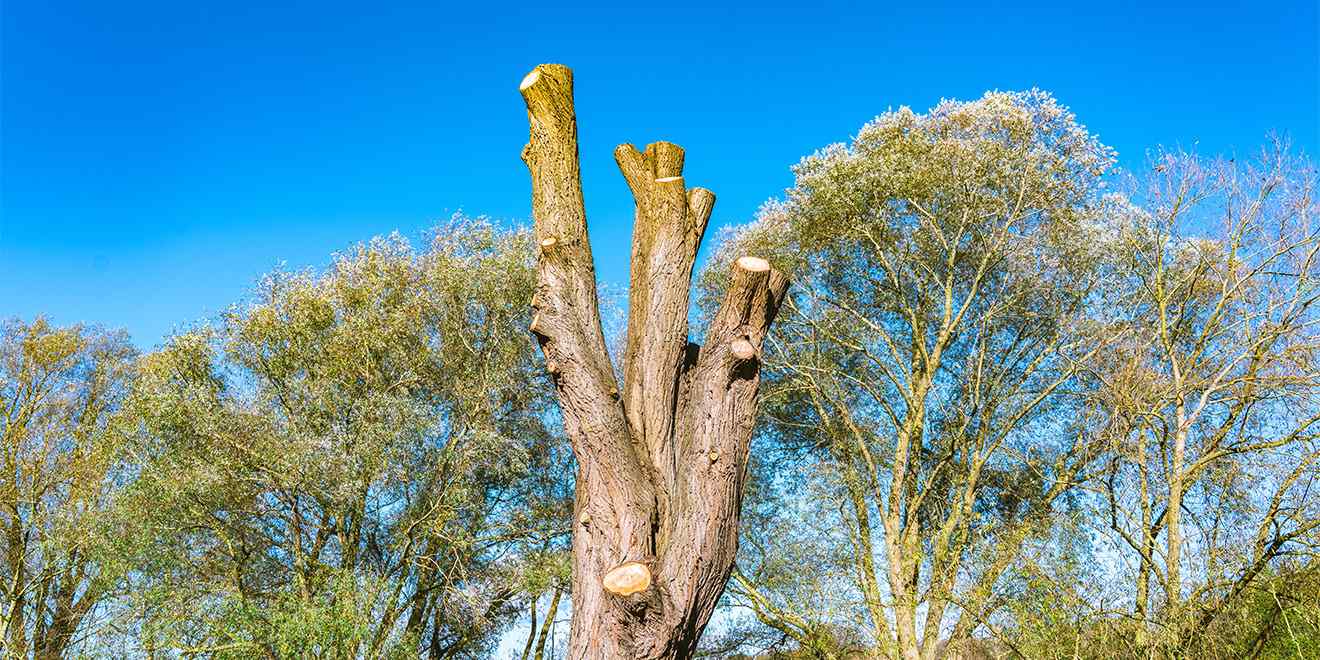
Tree topping is the rough cutting back of a tree’s main leaders and large branches to blunt stubs, usually to knock down height or overall size.
Instead of pruning back to natural branch unions, topping leaves big, flat wounds. The tree responds with weak, frantic sprouting that sets it up for long-term structural and health problems.
What Is Tree Topping? (Definition & Why Companies Still Do It)
Tree topping is the practice of chopping the main leader and major branches back to random points, leaving a row of 2–6 inch stubs across the top or sides of the canopy. The short-term goal is simple. Take a tall tree and make it shorter fast.
On paper that sounds appealing if you’re staring at a big live oak hanging over your roof. In practice you end up with a stressed, ugly tree that’s primed for future failure.
I’ve seen hundreds of them across Florida, and they almost always come back to haunt the homeowner.
So why do some “tree guys” keep selling topping around Florida?
- It’s fast and inexpensive in the moment. Less planning, less climbing skill, more chainsaw time.
- The drastic before-and-after makes people feel like the “problem” is gone. Roof is clear, tree is short, everyone smiles for about two years.
- Topping sets up easy repeat work. The tree explodes with regrowth and the same company comes back on a 1–3 year cycle to do it again.
This creates a deceptive regrowth cycle. After topping, the tree panics and produces dense, upright epicormic sprouting (water sprouts) along the stubs and trunk.
Within a few seasons the canopy usually looks full again, sometimes just as tall or taller. The catch is that this new growth is made of poorly attached shoots that tear out much easier in a storm than a naturally formed branch.
The ANSI A300 pruning standard, which is the reference manual for modern pruning in the U.S., spells it out clearly. Topping is listed as an unacceptable practice on healthy trees.
The International Society of Arboriculture topping statement and the broader ISA position against topping back this up. So in professional tree care, topping isn’t “just another option.” It’s what you do when you’re ignoring the standard of care.
5 Ways Tree Topping Destroys Your Tree
Tree topping does more than ruin the look of a tree. It changes how that tree feeds itself, handles heat, resists decay, and survives our Florida wind events.
Most of the long-term damage is hidden for a while, which is why people are often surprised when topped trees start failing a few years down the road.
1. Starvation & Energy Loss
Think of every leaf on your tree as a tiny solar panel. That’s where the food is made. When you top a tree, you can strip away 50–100% of its leaf area in one shot, depending on how aggressive the cuts are.
The tree suddenly loses its food factory and has to tap into stored energy just to stay alive. That’s the classic starvation response.
Here’s what that looks like inside the tree:
- Reduced photosynthesis. Fewer leaves mean far less energy coming in, exactly when the tree is trying to rebuild a canopy.
- Weakened root system. Roots live on sugars shipped down from the canopy. Starved top means starving roots.
- Slowed growth and reduced lifespan. Mature shade trees that get topped can lose 10–30 years of potential life, especially in our heat and moisture.
This energy crash is why we often see root dieback from topping. In Florida’s saturated, sandy soils, weak roots plus high winds is a bad combination.
A tree with compromised roots doesn’t just drop branches. It’s more likely to lean, heave, or uproot when the next big storm rolls through.
2. Structural Weakness of Regrowth
After topping, the tree’s first priority is survival, not neat structure. So it throws out epicormic sprouting from just under the bark on the stubs and upper trunk.
That “epicormic regrowth post‑topping” has some very predictable traits you see over and over in the field:
- Sprout count per stub: Each stub can erupt with 5, 10, even 20 shoots, all crowded together fighting for light.
- Attachment type: These shoots are adventitious and weak. They form from shallow tissues, not from a solid branch collar.
- Growth rate: They grow like rockets, often adding several feet per year as the tree tries to rebuild leaf area in a hurry.
- Failure probability in storms: High. The connection is shallow and the leverage is strong, so they peel off under wind load.
Natural branches form where the wood in the trunk and the wood in the branch knit together over time. That creates tough, interlocked fibers. Topped trees don’t get that.
You end up with a broom-like cluster of vertical shoots attached to a thin layer of wood. That structural weakness regrowth is why we see huge chunks of topped trees tear out at the topping points during storms.
Cleaning up this mess takes a long-term approach. A good arborist will thin, shorten, and train selected sprouts over several years to rebuild a safer, more natural canopy.
If you skip that and just “let it grow,” you’re basically building a storm hazard out of weak lumber.
3. Disease & Decay Entry
Every topping cut is a giant open wound. Large flat cuts on upper branches and trunks, often 3–8 inches across or more, are not something a mature tree can easily seal up. For each of those cuts you create:
- Multiple decay entry points per cut where fungi, boring insects, and other pathogens can slip in.
- Very slow or incomplete closure, especially on older wood and bigger branches.
- Internal heartwood decay columns that extend down the branch or into the trunk, hollowing out the structure.
This kind of tree topping damage is a bigger problem in our Florida climate than in many cooler regions. Warm, damp, and humid conditions are perfect for decay fungi.
Given enough time, you start seeing mushrooms at the base, soft spots, hollow areas, and sometimes whole tops snapping off where the decay lines up with old topping cuts.
4. Sunscald & Bark Damage
A full, dense canopy shades its own bark. Strip off that canopy overnight and the once-protected wood is suddenly getting direct Florida sun afternoon after afternoon.
That’s where sunscald comes in. The cambium layer under the bark gets cooked, and you start to see cracking, discoloration, and bark sloughing.
Sunscald can show up in a matter of weeks during our hotter months. Once bark is dead in a section, that part of the tree can’t move water or nutrients through that channel.
The injured areas then become soft targets for insects and decay fungi, adding another strike against the already stressed tree.
5. Storm Failure Risk (Especially in Florida)
Florida and Hillsborough County see their share of tropical storms, straight-line wind events, and hurricanes. Topped trees handle those poorly because you’re stacking several risk factors on the same trunk:
- Weakened roots from the starvation and root dieback we already talked about.
- Decay-compromised trunks and branches where those big topping wounds never closed properly.
- Top-heavy, weakly attached regrowth that catches wind like a sail but is barely anchored under the bark.
Put those together and you have a tree with a sharp increase in storm failure risk. During a strong wind event, those epicormic shoots can rip out, often tearing long strips of bark with them.
In worse cases the decayed section at or below the old topping cuts gives way and the tree can split, snap, or uproot entirely.
There’s another angle here that gets overlooked. From a liability standpoint, choosing topping instead of accepted methods makes it harder to show you used “reasonable care.” Adjusters and attorneys are familiar with ISA best practices and the ANSI A300 prohibition on topping.
If a topped tree fails and damages a neighbor’s property, it’s much easier for someone to argue that the failure was preventable and the maintenance was negligent.
Is Tree Topping Legal in Florida? (HOA & County Rules)
Legally, tree topping in Florida sits in an odd spot. You won’t usually see the word “topping” in bold letters in every law, but once you look at private HOA rules and the Hillsborough County tree ordinance, the picture gets clearer.
You can get in real trouble if you top the wrong tree in the wrong place.
Florida HOA Tree Standards
Planned communities, gated neighborhoods, and condo complexes often have their own Florida HOA tree standards written into their Covenants, Conditions & Restrictions (CC&Rs).
A lot of folks never read that part until after a letter shows up in the mailbox. Those standards often:
- Specifically prohibit topping or use terms like “hat-racking” or “severe heading.”
- Point straight at the ANSI A300 pruning standard as the rulebook for any work done on trees.
- Require that pruning be done by an ISA Certified Arborist, not a cut-rate crew with ladders and a pickup.
Typical features of a Florida HOA topping prohibition you’ll see in those documents include:
- ANSI A300 reference: Often mentioned word-for-word in the landscape or tree care section, so they have a clear standard to enforce.
- Enforcement mechanism: Written violation notice, then fines if you ignore it or repeat the violation.
- Fine range: From a couple hundred dollars for a first offense up to several thousand for major or repeated damage, depending on the bylaws.
- Restoration requirement: You may be required to pay for professional restoration pruning or removal and replacement if the damage is beyond fixing.
- Reporting process: Neighbors or landscape committees report suspected topping to the HOA or management company, which can trigger an inspection and formal action.
Hillsborough County Tree Ordinance
Now look at the public side. The Hillsborough County tree ordinance regulates “grand,” specimen, and other protected trees. The wording may not always use “topping” by name, but it does clearly address:
- Damaging or destroying protected trees without the proper permits.
- Any pruning that amounts to unpermitted removal or severe damage that compromises the tree’s survival.
A heavily topped protected tree can easily be seen as functionally removed or irreparably damaged, even if the trunk is still standing. Once an inspector or arborist for the county makes that call, you may face:
- Fines per tree, scaled by size and category. Mature grand oaks can mean serious money.
- Orders to install replacement trees or pay into a tree mitigation fund.
- Headaches with permits for future work on that property if there’s a record of violations.
Is Tree Topping Illegal?
So, is tree topping illegal in Florida? The answer depends on where the tree sits and what kind of tree it is:
- If the tree is a protected tree under the county rules and topping causes significant decline, it can be treated as illegal damage or removal under the ordinance.
- Inside an HOA that references ANSI A300, topping is basically prohibited by contract. Violations bring fines, lien risk in some cases, and forced corrective work.
- On unprotected trees on private lots outside HOAs, you may not face criminal charges just for topping, but you still carry civil liability, insurance complications, and future enforcement risk if that compromised tree later fails or violates right-of-way and safety rules.
Utility Company Right-of-Way Topping Exception
People often get confused watching tree crews under the power lines. Utility company right-of-way topping is under a different rulebook.
The utilities are required to keep lines clear and prevent outages and fires, so they work under state and industry safety standards, not your HOA covenants.
That said, utility line clearance standards have improved over the years. Many utilities now favor directional pruning methods that are closer to ANSI A300 line-clearance guidance instead of pure topping. Still, the work under the lines can look rough.
Just remember, the fact that a utility contractor did it near the wires does not give a private tree owner any right to copy those cuts in their yard. Your trees are still under local ordinance, HOA rules, and ANSI standards.
Better Alternatives to Topping (Crown Reduction, Thinning, Drop-Crotch)
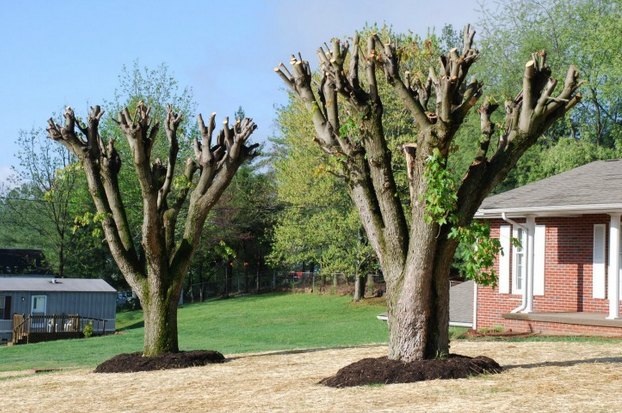
If your tree feels “too big,” scrapes the roof, or makes you nervous during storms, you’re not boxed into a choice between topping or cutting it down.
Several ANSI A300-compliant approaches reduce risk and manage size without wrecking the tree.
Crown Reduction (Proper Height Reduction)
Crown reduction is the right way to lower height or tighten a spread on a healthy tree. Instead of lopping branches off to stubs, the arborist cuts back to appropriate lateral branches that are large enough to take over as new leaders. These are called reduction cuts.
Here’s what sets a proper crown reduction alternative apart from topping:
- Height reduction: Realistically, you can often take 10–25% off the overall height per pruning cycle without shocking the tree.
- Cut type: Each cut goes back to a smaller branch that’s at least one-third the diameter of what you remove. The tip still has leaves, so the branch can function right away.
- ANSI A300 compliance: Fully compliant when done within size and percentage limits for the species.
- Structural preservation: Branch collars and natural unions stay intact, so attachment strength is maintained.
- Cost vs topping: Usually more per visit than a quick topping job, but you avoid the constant regrowth cycle and lower your long-term risk and costs.
If you want to dig into the nuts and bolts of how this is planned and laid out in the standard, take a look at our guide on the crown reduction proper method. It walks through how a real arborist designs a reduction without sliding into topping territory.
Crown Thinning (Lightening the Canopy)
Crown thinning is the right tool if your goal is to reduce wind load and weight more than raw height. Instead of shrinking the overall size, the arborist removes select small interior branches throughout the canopy.
Done correctly, crown thinning can:
- Increase internal airflow so the canopy catches less wind and behaves more like a net than a sail during storms.
- Reduce weight on long, stretched limbs, lowering the risk of branch failure over your house or driveway.
- Let more light penetration reach turf, shrubs, and beds below so your landscape works better as a whole.
Crown thinning shines as a storm hardening strategy on big oaks and other shade trees in Florida. The key is restraint and proper technique. Over-thinning or stripping foliage off the ends of branches creates “lion tails,” which is its own kind of damage. For a deeper look at why that’s a problem, check out our lion tailing comparison.
Drop-Crotch Pruning (Natural Step-Back)
Drop-crotch pruning is essentially a careful form of crown reduction that focuses on keeping a natural outline. You reduce the top or sides by cutting back to a lower crotch where a firm lateral branch can become the new endpoint.
Here’s how it works in practice:
- Each cut uses existing branch unions as a stopping point. No arbitrary stubs.
- The goal is a balanced canopy that still looks like the same species, just a bit shorter or narrower.
- Drop-crotch pruning pairs well with selective thinning to handle both height control and storm resilience in one plan.
Cost Comparison: Topping vs Proper Pruning
On one invoice, topping often looks cheaper. The crew is in and out quickly, less climbing skill is needed, and you get dramatic height reduction. If you look at the next 10–15 years, the numbers usually shift the other way.
- Topping: Lower cost per visit, but the explosive regrowth traps you in a 1–3 year cycle of repeat topping. Add increased storm damage risk, emergency removals, HOA fines, and shortened tree life and the “cheap” option gets expensive fast.
- Crown reduction/thinning: Higher cost per visit, but the work lasts longer. Often you only need follow-up every 3–5+ years, the tree stays healthier, and you cut the odds of catastrophic failure.
Once you factor in HOA fines, restoration orders, property damage, and a reduced tree lifespan, topping almost always ends up the more expensive choice over time. That surprises a lot of people who only look at the first quote.
If you’re weighing topping vs proper pruning, read through our resource on pruning mistakes. It breaks down how shortcuts can snowball into bigger bills later on.
Tree Topping vs Crown Reduction: Quick Comparison
This table sums up the big differences we see in the field between topping and proper crown reduction or drop-crotch pruning.
| Aspect | Tree Topping | Crown Reduction (Drop-Crotch Pruning) |
|---|---|---|
| Cut Type | Heading cuts to stubs; remove main leader | Reduction cuts back to lateral branches |
| ANSI A300 Compliance | No (explicitly discouraged) | Yes, when within limits |
| Regrowth | Epicormic sprouts, weak attachment | Normal branches from proper unions |
| Storm Performance | Higher failure risk | Improved or maintained stability |
| Impact on Tree Lifespan | Often reduced by 10–30 years | Minimal impact or extended life |
| Appearance | Unnatural, flat-topped, stubby | Natural outline preserved |
| Long-Term Cost | High (repeat work, damage, removal) | Moderate (fewer, higher-quality visits) |
Can a Topped Tree Recover?
Some topped trees can be pulled back from the edge. Others are too far gone and never really become safe or attractive again.
in Florida, I see a lot of topped live oaks and laurel oaks. A few of them are worth the time to rehab, but only after a careful look at how badly they were cut and what condition they were in to start with.
Topped Tree Recovery Assessment
A good arborist won’t just glance at the canopy and give you a yes or no. They walk the whole tree and look at specific factors:
- Recovery feasibility by severity:
- Low severity: Only a few limbs topped, most of the structure intact. Recovery is usually very doable.
- Moderate severity: Big chunks of the canopy topped, but some original scaffolds still present. It’s a maybe, with careful work.
- Severe: Main stem or whole canopy topped flat. Recovery odds drop way down and removal often ends up the smarter move.
- ISA assessment requirement: Before you spend money on restoration, you want an on-site inspection from a certified arborist who understands structure, decay, and local regulations.
- Corrective pruning sessions: True restoration isn’t one visit. Expect 2–5 pruning sessions over 3–7 years to thin and shape the strongest regrowth.
- Cost Florida restoration (USD): Depending on tree size and severity, you might spend from a few hundred dollars on small, lightly topped trees up to several thousand on large specimens.
- Success rate (%): With proper care, moderate cases often hit a 60–80% success rate in rebuilding a safer, more natural canopy. Severe topping has a much lower success rate and often ends in eventual removal anyway.
How Professional Restoration Works
A professional Florida outfit like Panorama Tree Care will handle a topped tree in stages instead of hacking it once and walking away. Typical steps include:
- Initial assessment: Check for structural cracks, cavities, decay columns, and root problems. Decide if the tree is structurally sound enough to justify restoration, or if removal is wiser.
- Selective sprout thinning: On the first visit, remove the weakest and worst-placed epicormic shoots. Leave a small number of better-positioned sprouts to become new scaffold branches.
- Structural training: Over subsequent years, use reduction cuts and targeted thinning to steer those chosen sprouts into a new framework. The goal is fewer, stronger limbs instead of a brushy mess.
- Monitoring & follow-up: Recheck the tree every 1–2 years. Watch for cracks at old topping sites, new decay, storm damage, and adjust the plan as the tree responds.
The idea is to break the rapid regrowth cycle triggered by topping and convert the sprout mess into a manageable structure. Even with that, a heavily topped tree usually never equals the strength or longevity of a tree that was properly pruned from the start.
Three Things Homeowners Often Miss About Recovery
- Hidden decay: A topped tree can look green and vigorous above while hiding significant internal decay that only shows up with advanced inspection tools or careful probing.
- Insurance implications: Some insurers get prickly about claims when there’s obvious topping, especially if an adjuster or expert can tie the failure to that work.
- Opportunity cost: Sometimes the smartest and cheapest long-term play is to remove a badly topped tree and replant a well-chosen species in a better spot, away from structures and lines.
FAQ: Tree Topping in Florida
Here are straight answers to questions homeowners ask most often about tree topping, legality, and better pruning options.
1. Why not to top trees?
Topping strips off too much foliage at once, which shocks the tree into a starvation response and burns through stored reserves. It then throws out weak epicormic sprouting to survive. Those large topping wounds invite decay, you end up with brittle regrowth, and your storm failure risk jumps. It often violates ANSI A300 pruning standard guidelines and a lot of HOA rules. Proper reduction and thinning get you clearance and risk reduction without turning your tree into a liability.
2. Is tree topping the same as crown reduction?
No, not even close. Tree topping vs crown reduction is one of the biggest dividing lines between hacks and pros in arboriculture. Topping means cutting leaders back to bare stubs, ignoring natural unions. Crown reduction uses reduction cuts back to suitable lateral branches so the structure and flow of the tree stay intact and compliant with ANSI A300. One is a harmful shortcut. The other is a legitimate, controlled technique.
3. What if my neighbor topped my tree without permission?
If a neighbor or their hired crew steps over the line and tops branches on your side, you may have civil claims for property damage. That goes double if a protected tree was involved. Document the scene with lots of photos, get written estimates or invoices for repairs, and talk with both a certified arborist and an attorney. If a protected tree was involved, you can also contact Hillsborough County for guidance or to report the damage.
Contact Panorama Tree Care team for a free assessment and estimate.
4. Am I liable if a topped tree fails in a storm?
Liability always depends on facts, but here’s the blunt truth. If you knowingly used a practice that professional standards condemn, it’s harder to prove you took “reasonable care.” If a topped tree breaks and causes damage, especially after HOA warnings or advice from an arborist, you can end up with greater liability exposure than someone who followed ISA and ANSI standards.
5. How much does it cost to restore a topped tree in Florida?
Restoration work is not cookie-cutter. Costs depend on tree size, how hard it was topped, and how many follow-up visits it will take. As a general Florida range, you might spend a few hundred dollars for minor corrective work on a small tree and several thousand dollars for a multi-year restoration plan on a large oak. The only way to know is to get an on-site estimate from a company like Panorama Tree Care.
6. How do I report illegal topping in Florida?
If you think someone has topped a protected tree or otherwise violated the rules, you can:
- Reach out to Hillsborough County’s tree/land development department with the address, photos, and any details you have.
- Contact your HOA or property management if you’re in a deed-restricted community and it’s on association-controlled property or subject to HOA standards.
- Ask a certified arborist to inspect and document the condition of the tree for potential enforcement or legal action.
7. Is topping ever acceptable for storm damage or insurance claims?
After a hurricane or severe storm, some contractors try to sell “storm damage topping” as a quick fix, shaving trees down all over a neighborhood. The ISA position against topping and the ANSI A300 prohibition don’t magically vanish after a storm. Emergency work should focus on removing hazards using proper cuts, stabilizing or removing truly unsafe trees, and then planning follow-up pruning. Turning a storm-damaged tree into a topped tree usually just trades one problem for a worse one.
8. Does utility line work count as topping?
Under the wires, you might see cuts that look like topping. In a sense they are heading cuts, but they fall under utility company right-of-way management and separate safety standards. The priority there is keeping electric lines clear, not aesthetics. Homeowners should avoid copying those cuts on private trees. A better long-term solution is planting low-growing species under lines or shifting planting zones so large trees never grow into the wire space in the first place.
Final Summary & Next Steps
Tree topping in Florida is more than a bad look. It directly conflicts with the ANSI A300 pruning standard, goes against the ISA position against topping, and can put you at odds with your Florida HOA tree standards and the Hillsborough County tree ordinance if you hit protected trees.
The damage isn’t just cosmetic. Topping drives starvation, sunscald, decay, weak epicormic regrowth, and a big jump in storm failure risk.
That often shortens the tree’s lifespan and raises your long-term costs. By contrast, ANSI-compliant methods like crown reduction, crown thinning, and drop-crotch pruning let you manage size and risk while keeping the tree’s structure intact.
If your tree has already been topped, a well-planned recovery program can sometimes pull it back into a safer, better-looking condition over several years.
Your best bet is to avoid topping in the first place and work with someone who understands both the biology and the local rules.
To move forward with safer alternatives in Florida:
- Read our guide on the crown reduction proper method so you know what to ask for.
- See how topping compares to other bad habits in our lion tailing comparison.
- Look through other pruning mistakes that can cost you money and trees.
Then schedule an on-site evaluation with a trusted Florida firm such as Panorama Tree Care. They can walk your property, explain HOA and county considerations, and design a long-term, topping-free care plan that keeps both your trees and your wallet in better shape.
Quick Reference: Impacts & Alternatives (EAV Highlights)
This quick chart lines up the main impacts of tree topping against epicormic regrowth and proper crown reduction so you can see the trade-offs clearly.
| Factor | Tree Topping Damage | Epicormic Regrowth | Crown Reduction Alternative |
|---|---|---|---|
| Immediate Leaf Area Loss | Often 50–100% | Replaced by dense but weak sprouts | Typically 10–25% with planned cuts |
| Attachment Strength | N/A (original branches cut off) | Adventitious, weak attachment | Strong at natural branch unions |
| Sunscald Onset | Within weeks on exposed bark | Sprouts may partially shade later | Minimal new exposure if done correctly |
| Decay Entry Points | Multiple per large cut | Increases over time at stub sites | Fewer, smaller wounds that close faster |
| Lifespan Impact | Often shortened by 10–30 years | Higher long-term failure risk | Helps maintain or extend lifespan |