If you have a tree struck by lightning, keep people away from it, check from a safe distance for broken limbs and power lines, take photos, water the root area if conditions are dry, and arrange an arborist inspection. Do not rush to remove the tree just because it was hit. Some lightning-struck trees recover, while others decline suddenly or develop problems over the following weeks. The first goal is safety, then giving the tree time for the true extent of the damage to become visible. (UF/IFAS; Alabama Cooperative Extension)
Why Tampa Bay Trees Get Hit
Florida is known for intense thunderstorms, and tall trees are among the objects most likely to be struck. Trees contain water and sap, and lightning can travel from the crown through the trunk and even into the roots. (UF/IFAS; Alabama Cooperative Extension)
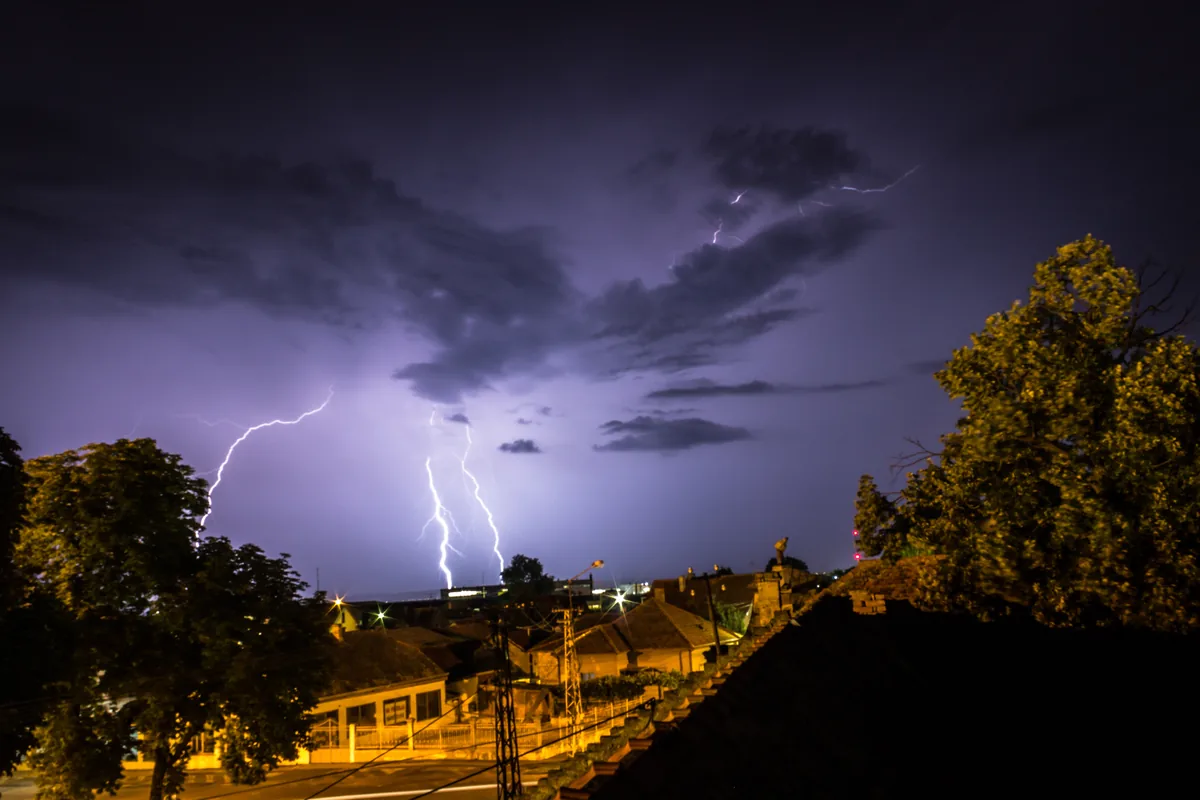
The electrical energy heats moisture inside the tree extremely quickly. That can make sap and water boil, create steam, burst cells, loosen bark and split wood. Damage may follow one narrow path down the trunk or affect much more of the tree.
Florida led the U.S. in lightning density in 2025, with 305 lightning events per square mile, according to Vaisala Xweather’s annual report. Tampa’s Raymond James Stadium had 309 hours of lightning warnings, third-most among U.S. open-air stadiums. (Vaisala Xweather)
Lightning safety also matters for the homeowner. As of September 4, 2026, Florida had recorded five lightning deaths for the year, and the state had the highest lightning casualty rate in the United States. The National Weather Service says sheltering under a tree is the second leading cause of lightning casualties. (WUSF lightning safety report)
Never use an oak, pine, palm or any other tree as shelter during a Tampa Bay thunderstorm. Get inside a safe building or vehicle instead.
First 48 Hours: What to Do Step by Step
The first two days are about keeping people safe, recording what happened and avoiding unnecessary work that could make the situation worse. Wait 30 minutes after the last thunder before going back outside to check the tree; lightning can strike 10 to 15 miles from a storm. (WUSF lightning safety report)
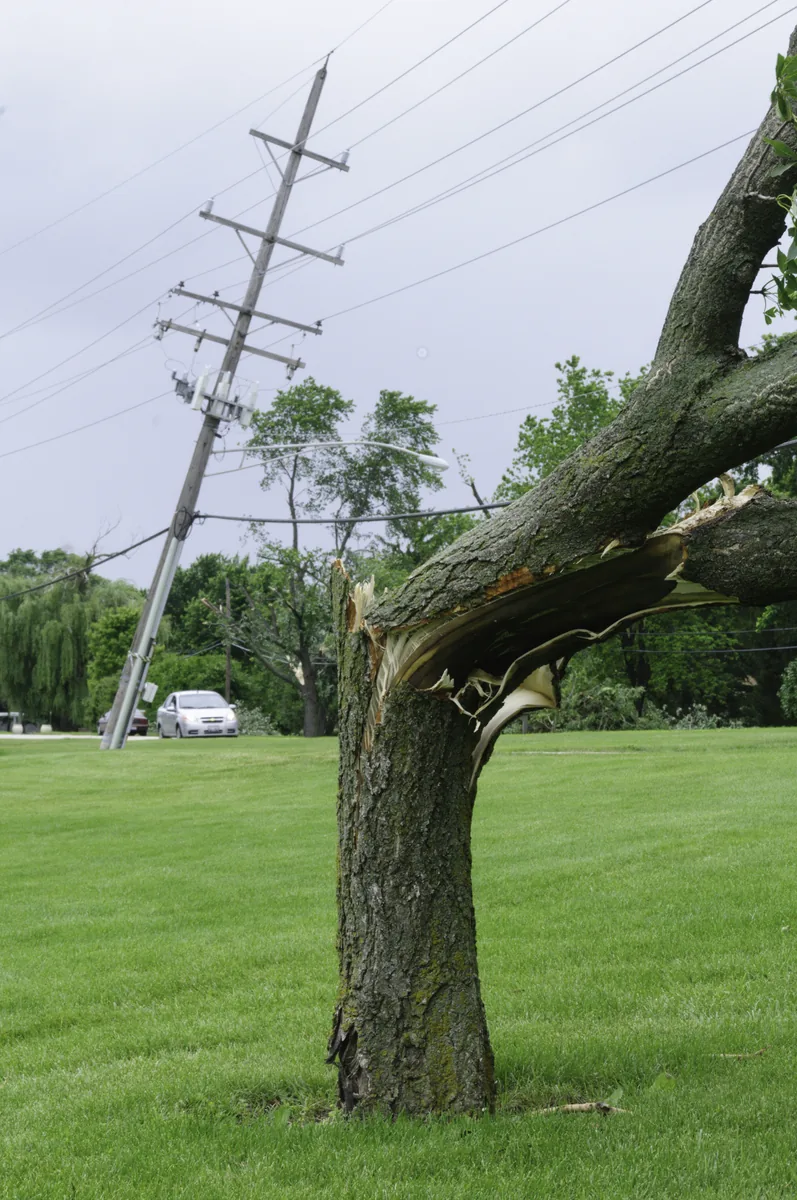
- Keep everyone clear and look for hanging or cracked limbs. Stay outside the area where a damaged branch or part of the tree could fall. Look from a safe position for a split trunk, broken limbs, hanging branches or freshly fallen wood.
- Stay away from power lines. If the tree, a branch or any debris is touching or close to a utility line, do not approach it. Contact the utility and keep other people away from the area.
- Take dated photos. Photograph the whole tree, the trunk, fallen bark, cracks, damaged branches and any nearby property damage. These photos can provide a record of the tree’s condition immediately after the strike and may also be useful if you need to speak with your insurer.
- Do not rush to cut, seal or paint the wounds. Avoid cutting into the lightning scar just to make it look cleaner. Our arborists do not recommend tree paint or wound sealer. If there is no immediate hazard, give the tree time before making major pruning or removal decisions.
- Water deeply if conditions are dry. Lightning can damage roots and the tissues that carry water through a tree. Alabama Cooperative Extension recommends deep watering so the top 6 to 9 inches of soil remain moist, which can help reduce additional water stress while the tree responds to the injury.
- Ask about preventive insect treatment quickly. Pines struck by lightning are often attacked by Ips, southern pine and black turpentine beetles, and hardwoods by ambrosia beetles, sometimes within days. Alabama Cooperative Extension says preventive treatments work only if applied before beetles bore in, ideally within a day or a few days, because no labeled products control them once inside. Any insecticide must be used according to its label. (Alabama Cooperative Extension)
- Call an ISA Certified Arborist. A professional assessment can look beyond the obvious bark scar. Our arborists also check the trunk, main branch unions, roots, canopy and anything the tree could strike if damaged wood fails.
Do not assume a dramatic-looking scar means the tree must come down. Likewise, do not assume a small scar means there is no serious damage inside.
How to Tell If a Tree Was Struck
Lightning damage to trees can look very different from one tree to another. Sometimes the evidence is obvious, while other strikes leave damage that is much harder to see.
A common sign is a long strip of loose, discolored or missing bark running down the trunk or along a large branch. Lightning can blow out a narrow strip of bark and expose the wood underneath, or it can cause much wider bark loss and deep cracks. (UF/IFAS; Alabama Cooperative Extension)
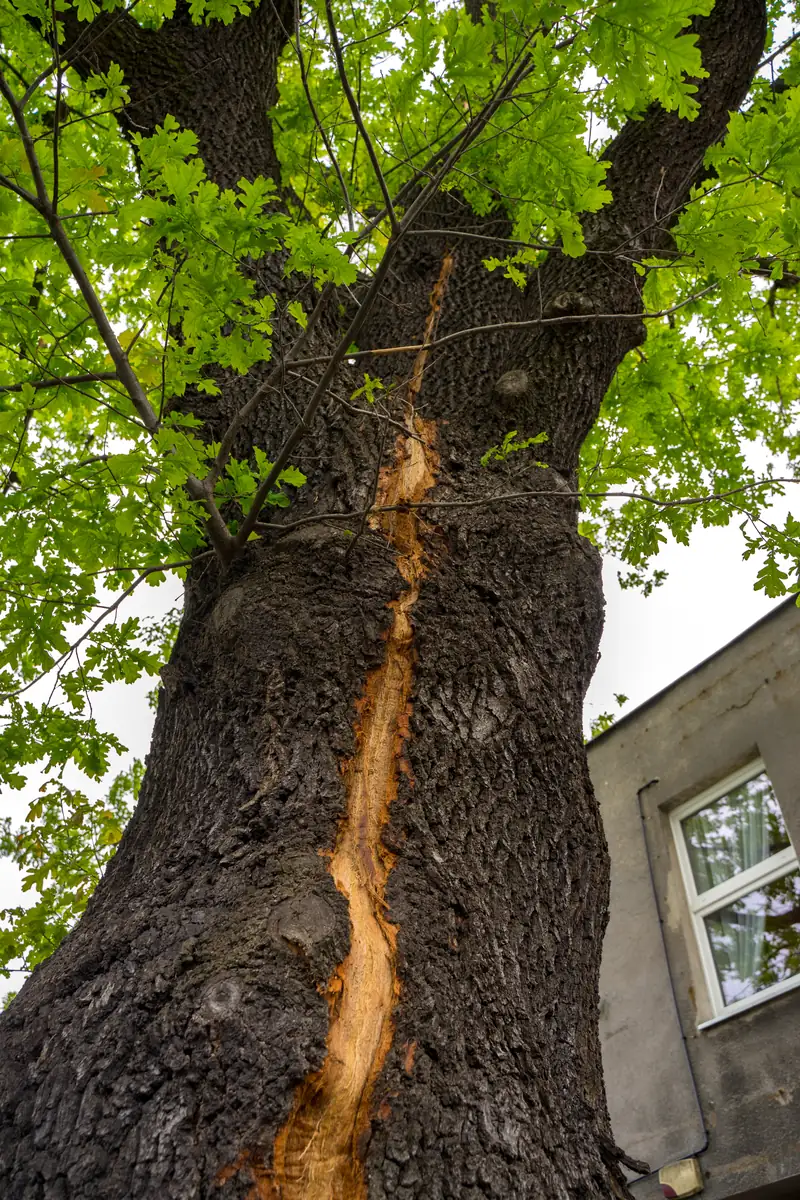
You may also see pieces of bark scattered around the base of the tree. A vertical crack or scar may run down one side of the trunk, and in more severe cases the trunk or major limbs may be split.
The canopy can change too. Leaves may wilt, turn brown or appear scorched after the strike. In some trees, sudden dieback becomes noticeable within days because the lightning damaged tissues that move water through the tree.
The roots may also be injured, and that damage is much harder to see from the surface. A tree can therefore look better immediately after the storm than its internal condition really is.
Tall trees are more exposed simply because of their height. Pines deserve particular attention after a lightning strike because stressed pines can attract secondary pests, including bark beetles, in the days and weeks after the event.
Will the Tree Survive?
There is no fixed rule for lightning-struck tree survival. A tree may die quickly, decline over time or recover from the injury. (Alabama Cooperative Extension)
That uncertainty is why an arborist looks at the whole tree instead of judging it by the lightning scar alone. Important questions include how much bark and wood were damaged, whether the trunk split, whether major branches were affected, how healthy the tree was before the strike and whether the root system also appears compromised.
If there is no immediate hazard, waiting can provide valuable information. Alabama Cooperative Extension recommends waiting several weeks before removing or even pruning a lightning-struck tree so hidden damage has time to show in the canopy. Hazardous branches or an unstable tree are the exception and should be addressed sooner.
During that period, watch the canopy for increasing wilt or dieback. Check the trunk for expanding cracks, loose bark and signs of insects.
Pines need especially close monitoring for bark beetles after a strike. Hardwoods can also attract ambrosia beetles after being weakened. These secondary pests can add more stress to a tree that is already trying to recover from lightning damage.
A tree risk assessment can document the condition of the tree and help separate damage that can be monitored from structural problems that require action.
When a Lightning-Struck Tree Should Be Removed
A lightning strike by itself does not automatically mean removal. The decision depends on how badly the tree’s structure was damaged and what could be hit if part of the tree fails.
A tree may need urgent attention if the main trunk has split, a major branch is hanging over a house or driveway, or a large crack has left the tree structurally unstable. Lightning can also expose internal wood to future decay, so serious trunk damage may create a longer-term weakness even when the canopy remains green.
Alabama Cooperative Extension recommends removing a tree whose trunk is split. Removal is also recommended when cracks reach one-third or more of the trunk diameter and the tree is near a home, street or driveway. If bark is stripped from one-third or more of the trunk’s circumference, removal is recommended for decay-prone species or where valuable targets are within the dripline. Narrower scars are candidates for monitoring and preventive treatment. (Alabama Cooperative Extension)
When there is an immediate danger to people, a home, driveway or another occupied area, use emergency tree service rather than waiting to see what happens.
Trees with narrower, more superficial damage may be candidates for monitoring. Over the following weeks, the arborist can watch how the crown responds and whether the damaged wood remains structurally acceptable.
If the trunk has lost too much strength, the tree has split badly or continued decline makes safe retention unrealistic, tree removal may be the safer option. The decision should be based on the actual condition and location of the tree, not simply the fact that lightning struck it.
Removing a damaged tree in Tampa or Hillsborough County may need a permit. Florida law bars local governments from requiring a permit, fee, mitigation or replanting for removing a tree on a lot actively used for a single-family detached home when an ISA Certified Arborist or Florida-licensed landscape architect documents that it poses an unacceptable risk. The documentation must be based on an on-site assessment under ISA best management practices, and removal must be the only practical way to reduce the risk below moderate. See our tree permit guide and Fla. Stat. 163.045.
Does Insurance Cover a Lightning-Struck Tree?
Insurance coverage depends on the individual policy and on whether the tree caused damage to insured property. A standing lightning-struck tree that has not damaged covered property may be treated differently from a tree that struck a house, fence or another insured structure.
On a standard HO-3 form, lightning is one of the named perils for trees, shrubs and plants. That coverage pays up to 5% of the dwelling limit for all trees, shrubs and plants combined, with no more than $500 for any one tree. If a lightning-struck tree damages your house or another covered structure, that damage is handled under the structure’s coverage. Florida policies vary by insurer and edition, so check your declarations and policy form. (ISO HO 00 03, 2000 edition sample form)
Take photos and contact your insurer for guidance on your own policy. For a broader explanation, see tree damage and homeowners insurance in Florida.
Lightning Protection for Valuable Trees
Tree lightning protection systems are designed to give electrical energy a preferred path to the ground rather than letting it travel through the tree’s tissues. The ANSI A300 Part 4 standard covers installation and maintenance practices for these systems.
These systems use conductive components, commonly copper, to carry the electrical charge toward the ground. Alabama Cooperative Extension notes that they are costly systems and require a well-trained tree care specialist for proper installation. (Alabama Cooperative Extension)
A300 Part 4 guidance recommends protection for trees whose trunks are within 10 feet of a structure or whose branches extend above it, for historic or unusually valuable trees, and for isolated trees in open areas such as pastures or golf courses. (Tree Care Industry Association)
A protected tree is never a safe shelter during a thunderstorm. ANSI A300 guidance is clear that the purpose of the system is to reduce lightning damage to the tree by providing a preferred path to ground, not to make the tree safe for people standing beneath it.
Lightning-Struck Tree FAQs
Can a tree be struck by lightning twice?
Yes. A tree can be struck once or multiple times. Tall trees and trees that remain prominent in their surroundings can continue to be exposed during future thunderstorms. (Alabama Cooperative Extension)
A previous lightning scar does not make the tree immune to another strike.
Is it safe to stand near a tree that was just struck?
Do not approach while the storm is still active, and never shelter beneath the tree. The National Weather Service identifies sheltering under trees as a major cause of lightning casualties. (WUSF lightning safety report)
After the storm, continue to keep your distance if the tree has hanging limbs, a split trunk, loose wood or contact with power lines.
How long before a struck tree shows it is dying?
Some trees can show severe symptoms within days, including wilting and browning leaves. In other cases, the full extent of lightning damage takes several weeks to become visible, which is why major pruning or removal is often delayed when the tree is not an immediate hazard.
Keep watching the canopy, trunk and branches during that period instead of assuming that a green canopy immediately after the strike means the tree is safe.
Should I fertilize a lightning-struck tree?
Do not rush to fertilize simply because lightning hit the tree. In our experience, fertilizer will not repair tissue damaged by the strike.
The immediate care priority is reducing additional stress, keeping the root area appropriately moist during dry conditions and having the damage assessed. UF/IFAS recommends keeping the soil moist to give a struck tree its best chance of recovery. (UF/IFAS)
If you have a tree struck by lightning in Tampa Bay, the safest next step is to find out what happened beneath the visible scar. Our arborists can inspect the trunk, roots, branches and canopy, then explain whether the tree should be monitored, treated as an immediate hazard or considered for removal.
Book a tree risk assessment after a strike, especially when the tree can reach your home or driveway. Homeowners looking for tree service in Lutz can also contact Panorama Tree Care for an arborist inspection. For broader seasonal planning, see storm preparation for trees.
Request an estimate or call (813) 234-9842 to have an ISA Certified Arborist inspect a lightning-struck tree.