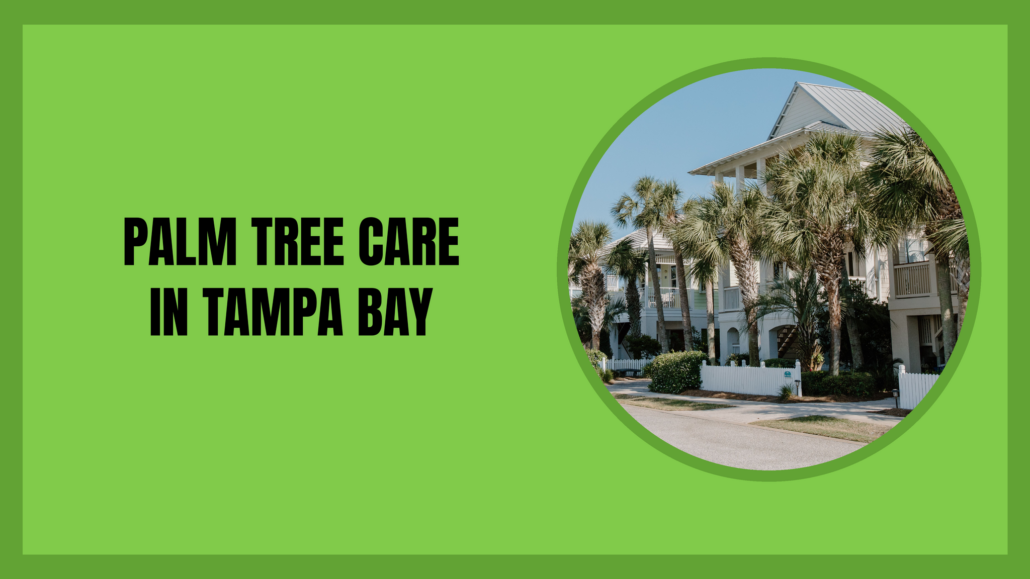
A palm on your lot usually comes down to four calls: how often to trim it, what to feed it, whether a slide can be turned around, and when it has to come out. I have worked palms in Hillsborough, Pinellas, Manatee and Sarasota counties since 2000.
The costliest habit I see is not neglect. It is over-pruning. Every spring, homeowners pay crews to strip green fronds off healthy palms. That starves the canopy, thins the trunk, and makes a crown more likely to snap off in the next hurricane. Palms store and move nutrients differently from oaks and maples. Treat a palm like a shade tree and the damage shows up years later, then takes years to undo.
Key Takeaways
- Most palms in Tampa Bay need one or two trimming visits a year, and self-cleaning species such as royal and foxtail palms need none at all.
- Potassium deficiency is the number one cause of ugly palms here. Every soil in Central Florida is potassium deficient for palms, and correcting it takes two to three years.
- The correct palm fertilizer analysis is 8-2-12 plus 4Mg with micronutrients, applied four times a year, with 100 percent of the nitrogen, potassium, magnesium and boron in controlled-release form.
- Lethal bronzing was first identified in Hillsborough County in 2006. Tampa Bay is the origin point of this disease in Florida, not a distant bystander.
- Ganoderma butt rot has no cure, attacks the lower 4 to 5 feet of trunk, and rules out replanting another palm in the same hole.
- A “hurricane cut” makes storm failure more likely, not less. Palms cut that way snapped their crowns at a higher rate after the 2004 and 2005 hurricane seasons.
How Often Palms Need Trimming in Tampa Bay
One or two visits a year covers most palms in this region, and a fair number need less. Species sets the pace, not the calendar. A Washingtonia robusta stacking a dead skirt needs yearly work. A Roystonea regia drops its own fronds and needs almost nothing. A Sabal palmetto holding old leaf bases, the boots, sits in the middle.
Trim when you have a dead frond, a heavy fruit stalk, or a real clearance issue over a roof, driveway or walkway. “It has been a year” is not a reason. Cutting on a schedule instead of on evidence is how healthy palms get hollowed out.
Which Fronds to Remove and Which to Leave
Take off only fully dead fronds, along with flower and fruit stalks. Any frond that still holds green stays. Use the clock-face rule: treat the crown as a clock and keep every frond between 9 and 3. Nothing above the horizontal line comes off.
That rule matters more on a palm than on any other tree in the yard. Potassium moves freely inside the plant. When the palm cannot get enough from Florida sand, it draws it out of the oldest leaves and pushes it into the new spear and the bud. Those yellow, spotted lower fronds are not waste. They are a reserve the palm is still using. Cut them early and you remove the supply the newest growth was drawing on, which makes the shortage worse.
A palm has one growing point, the apical meristem, in the center of the crown. There is no backup bud and no epicormic recovery the way an oak can bounce back. Damage the meristem and the palm is finished. That is why our crews follow ANSI A300 Part 1 on palms, including keeping live healthy fronds above horizontal, and why our Tree Trimming & Pruning work looks conservative next to a landscaping crew’s pitch.
Do this:
- Cut fronds that are fully brown and hanging.
- Remove seed pods and flower stalks before the fruit drops.
- Clear fronds physically touching a roofline, gutter or service line.
- Sanitize saw blades between palms.
Do not do this:
- Remove green or partly green fronds.
- Cut above the 9-to-3 line.
- Shave, scrape or “skin” the trunk to expose smooth wood.
- Use climbing spikes on a palm you intend to keep.
Spikes need their own warning. ANSI A300 Part 1 says climbing spurs shall not be used when entering and climbing trees for pruning. Palms make that worse: they cannot compartmentalize wounds. Every spike hole is a permanent puncture and an open door for pathogens. The trunk never heals over it.
Why the Hurricane Cut Damages Palms
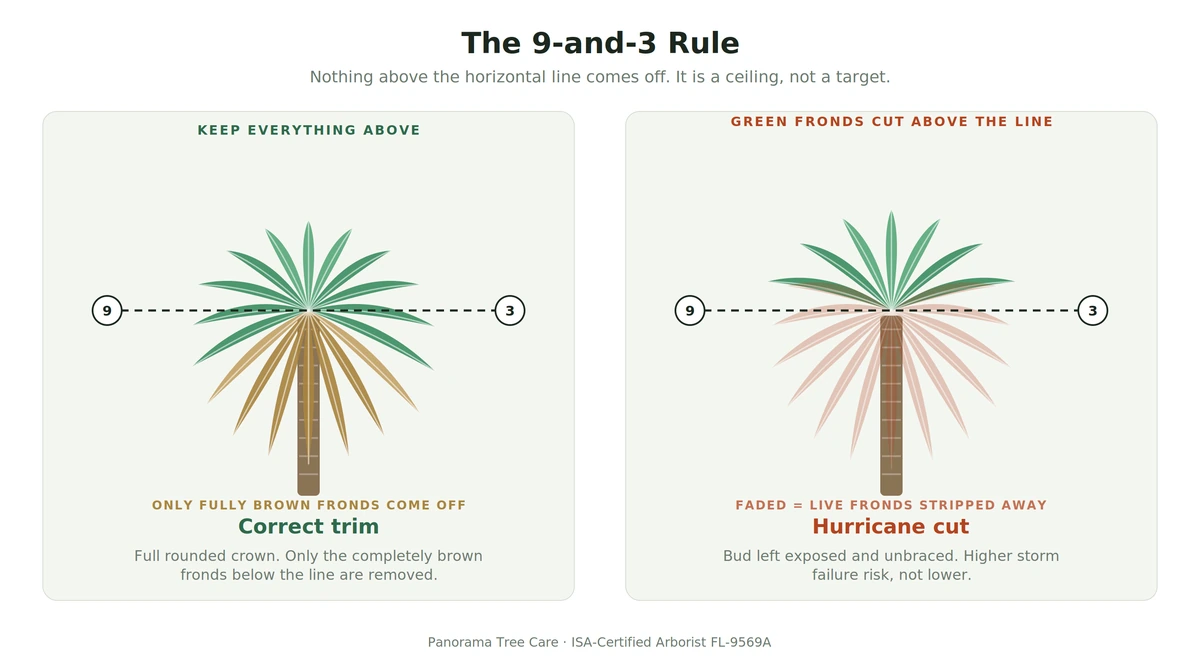
Palms cut into the tight tuft look, often sold as storm prep, snapped their crowns off at a higher rate than palms with full canopies. That is field observation, not a randomized trial. UF/IFAS pages from Ed Gilman after the 2004 and 2005 seasons, and Doug Caldwell’s Collier County notes after Hurricane Wilma, are the records I point to: some arborists reported that coconut palms and other palms with many lower fronds stripped took more damage than unpruned palms, because the cut left the bud exposed.
The pitch for a hurricane cut sounded sensible: fewer fronds, less sail, less wind load. What it missed is that outer fronds shield and cushion the bud. Cut the canopy back to a few upright spears and you leave the meristem and the narrow neck of the crown open to direct wind. You also strip photosynthetic capacity right before the hardest stretch of the year.
There is a second cost to that cut. A palm builds trunk diameter from the top, and a starved crown lays down a narrower ring. Repeat the hurricane cut for several years and you get pencil-pointing, a taper where the trunk grows thinner as it rises. That taper is a permanent structural weak point. Fertilizer cannot widen a section of trunk that has already formed.
Flower Stalks, Seed Pods and Self-Cleaning Species
Palms with a crownshaft shed their own fronds and do not need routine trimming. The crownshaft is the smooth green or gray sleeve of tightly wrapped leaf bases at the top of the trunk. When a frond dies, the base lets go and the whole leaf falls as one piece.
| Palm | Self-cleaning | Routine trimming need |
|---|---|---|
| Royal palm (Roystonea regia) | Yes | Clearance and safety only |
| Foxtail palm (Wodyetia bifurcata) | Yes | Clearance and safety only |
| Areca palm (Dypsis lutescens) | Mostly | Occasional cleanup of clump |
| Sabal palm (Sabal palmetto) | Partly | Boots and dead fronds |
| Washingtonia (Washingtonia robusta) | No | Annual skirt removal |
| Canary Island date (Phoenix canariensis) | No | Annual, plus stalk removal |
| Pygmy date (Phoenix roebelenii) | No | Annual, spine caution |
| Queen palm (Syagrus romanzoffiana) | No | One to two visits per year |
Fruit and flower stalks are separate from frond work. Queen palms dump slick orange fruit by the bucket onto driveways and pool decks. Washingtonias scatter seed and send volunteer seedlings into beds for years. Taking the inflorescence off before it sets fruit takes minutes, avoids the mess, and pushes more of the palm’s energy back into leaves.
Frond Removal After a Freeze
Leave freeze-damaged fronds on the palm until the risk of more cold is gone. Tampa Bay sees a few nights near or below freezing most winters, and browned fronds after one of them look bad. They are still useful. Those damaged leaves and leaf bases buffer the bud from the next cold night.
Cut them in January and you remove that insulation just before the next front. Wait until the season settles, usually well into spring, then judge what actually died. Palms often push a healthy new spear from a crown that looked finished in February.
Palm Nutrition: What Most Dying Palms in Tampa Bay Actually Have
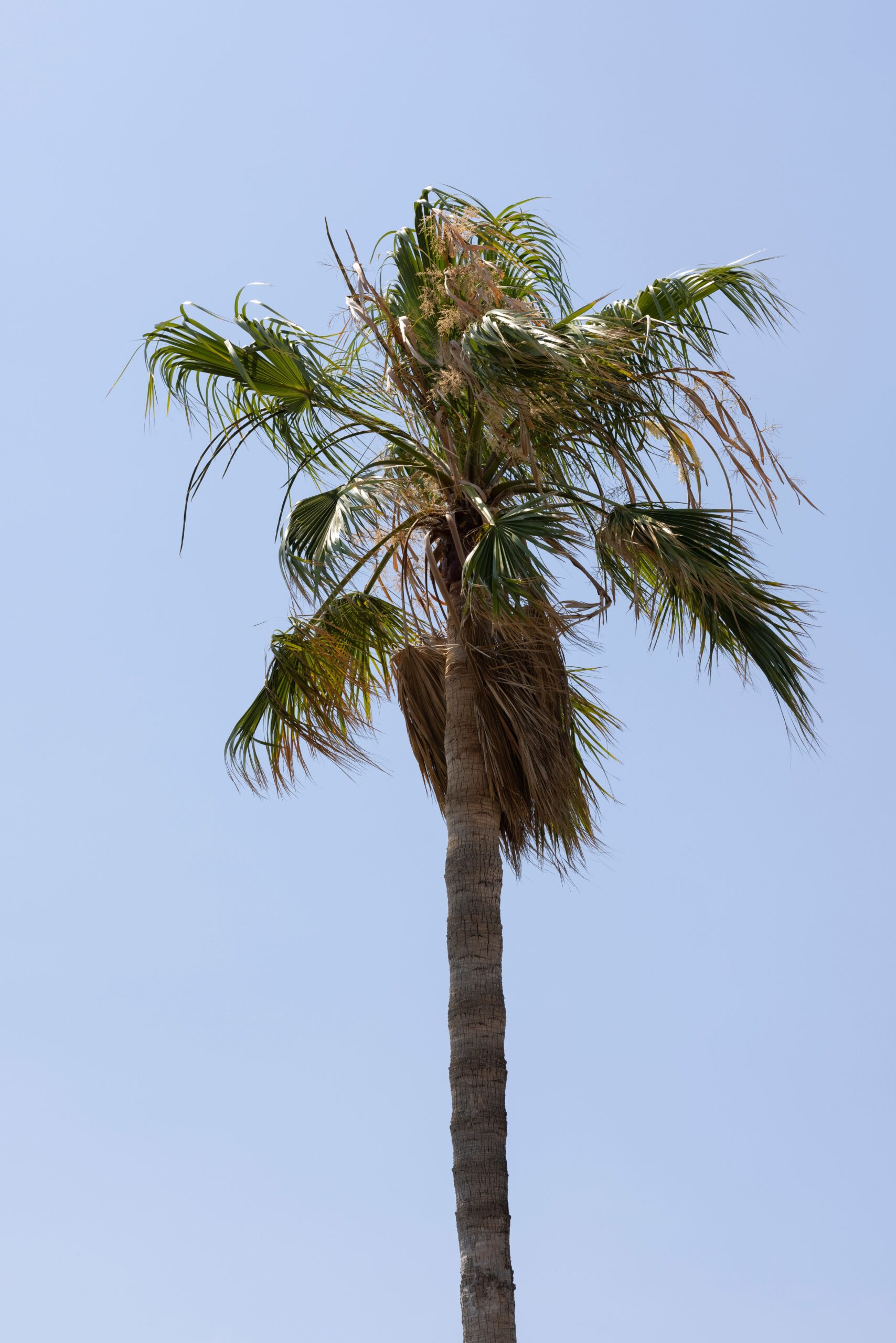
Potassium deficiency is the answer about nine times out of ten. Every soil across Central Florida is short on potassium for palms. Our sand has very low cation exchange capacity, which means it cannot hold potassium, magnesium or nitrogen. Summer rains and daily irrigation flush those elements past the root zone.
Palms demand a lot of nutrition because they keep huge leaves for years. When supply runs short, symptoms show across the whole canopy. Most homeowners read that as disease and ask for a removal quote. Most of the time the palm is just hungry.
Potassium Deficiency
Start with the oldest fronds. Potassium shortage shows first on the lowest leaves and moves upward. Look for translucent yellow-orange spotting, easiest to see with the sun behind the leaf, then dead tips and margins on the leaflets. Badly short palms develop frizzled, withered leaflet ends that look scorched.
Over time the trunk thins and the crown shrinks. A queen palm running empty may carry eight or nine fronds instead of a healthy fifteen.
The fix is slow. Getting a potassium-short palm back to full color takes two to three years on a controlled-release program, because the palm has to grow all new leaves. Damaged ones never green up again. High nitrogen fertilizer makes it worse, which is what happens when a lawn service spreads turf feed across a yard full of palms.
Magnesium, Manganese, Iron and Boron
Different nutrients hit different parts of the canopy. That pattern is the shortcut.
Magnesium deficiency appears on the oldest fronds as broad yellow bands along both leaf margins with the center of the leaf staying distinctly green. It is common on Canary Island date palms in Florida landscapes and shows up on other species mostly through bad fertilization.
Manganese deficiency, known in the trade as frizzle top, attacks the newest growth. Emerging spears come out weak, withered, scorched and undersized. This one moves fast and kills palms. It is common in high pH soils and in landscapes with a lot of concrete or shell nearby.
Iron deficiency also targets new leaves, showing as overall yellowing with green veins. In palms it usually points to a root problem: planted too deep, waterlogged soil, or a root zone that has been compacted or trenched.
Boron deficiency produces bizarre new growth. Fronds emerge accordion-shaped, hooked, or with the tips sharply bent, and the spear can look like it was crimped in a vise.
| What you see | Which fronds | Likely cause | Correction time |
|---|---|---|---|
| Translucent yellow-orange spotting, necrotic tips | Oldest | Potassium | 2 to 3 years |
| Yellow margins, green center stripe | Oldest | Magnesium | 1 to 2 years |
| Frizzled, withered, undersized new spears | Newest | Manganese | Weeks to months if caught early |
| Uniform yellowing with green veins | Newest | Iron, usually a root issue | Varies with the root fix |
| Hooked, crimped or accordion-folded leaves | Newest | Boron | One to two growth cycles |
The direction matters more than the color. Oldest fronds first points to a mobile nutrient the palm is rationing. Newest fronds first points to something acute, and acute problems need a faster response.
The Fertilizer Specification That Actually Works
Use an 8-2-12 plus 4Mg palm fertilizer with micronutrients, four times a year. That mix comes from UF/IFAS research and is the standard our crews use. The numbers alone are not enough. That is where most retail bags fail.
For the product to work, 100 percent of the nitrogen, potassium, magnesium and boron must be controlled-release or slow-release. Water-soluble forms of those four wash out of Florida sand before the palm can take them up. Manganese, iron, zinc and copper should be water soluble, because oxide and sucrate forms of those micronutrients mostly sit unavailable in the soil.
Many bags show the right analysis on the front and the wrong sources on the back. A poorly formulated palm fertilizer can do more harm than none, because soluble nitrogen drives growth the palm cannot support. Spread product over the whole root zone, not piled at the trunk, and skip separate turf feed in that area. Our Deep Root Fertilization program is built on this specification for that reason.
Four Mistakes That Starve Tampa Bay Palms
- Feeding the lawn instead of the palm. High-nitrogen turf fertilizer applied within the palm’s root zone actively drives potassium deficiency.
- Building a mulch volcano. Mulch piled against the trunk holds moisture on the wood and invites rot. Keep it a few inches back and no more than a few inches deep.
- Removing yellowing fronds. Covered above, and it remains the most common self-inflicted wound in the region.
- Fertilizing once a year in spring. A single annual application leaves the palm running on empty for three quarters of the growing season.
Palm Diseases That Kill Palms in Tampa Bay
Lethal bronzing was first identified in Hillsborough County in 2006, so this region is ground zero for the disease in Florida. Three pathogens account for most palm deaths I diagnose here, and none can be reversed once symptoms set in. Knowing them by sight is what separates a fixable nutrient problem from a removal call.
Lethal Bronzing
Lethal bronzing is caused by a phytoplasma, a bacterium with no cell wall that cannot be cultured in a lab. It was first called Texas Phoenix Palm Decline after the same pathogen showed up in Canary Island date palms in Texas a few years earlier. It has since been found in 16 palm species across 31 Florida counties.
Here it was first recovered from edible date, wild date, Canary Island date and queen palms. In 2008 it turned up in Sabal palmetto, our state tree, and the scale of the problem became clear.
Symptoms follow a sequence:
- Premature fruit drop, the earliest sign when fruit is present.
- Flower stalk death, with new inflorescences turning black before opening.
- Bronzing of the oldest fronds, a reddish-brown discoloration that moves up the canopy faster than any nutrient problem.
- Spear leaf collapse. Once the spear dies, the palm is gone.
Treatment is blunt. Once a palm shows symptoms, the labeled rate of oxytetracycline does not reverse them, and the palm comes out immediately to remove the infection source. Healthy palms near a confirmed case get tested first, then injected with oxytetracycline hydrochloride every three to four months for at least two years as prevention. Those injections leave permanent wounds, so they make sense when the disease is confirmed nearby, not before.
Ganoderma Butt Rot
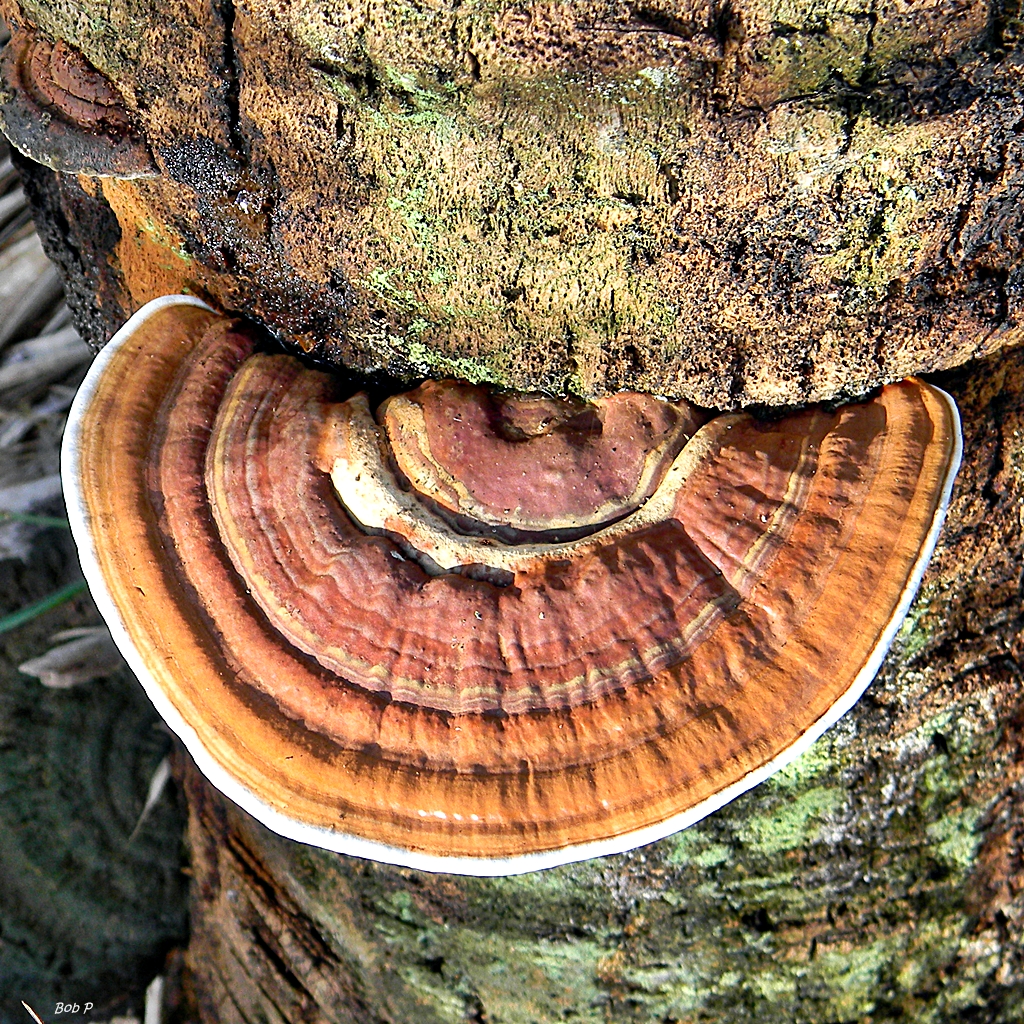
Ganoderma butt rot is fatal, has no treatment, and permanently contaminates the planting site. The fungus, Ganoderma zonatum, breaks down lignin in the lower 4 to 5 feet of the trunk. It does not make soft, mushy wood, so the trunk can feel solid until it fails.
At least 65 palm species have been recorded with it, and every palm is treated as susceptible. It is not a pathogen of other plant families, so oaks and magnolias are not at risk from it.
Confirmation requires either a conk on the trunk or internal discoloration visible after the palm is cut down. The conk, technically a basidiocarp, is a hard shelf-like bracket attached to the lower trunk, white and soft at the button stage, then hardening to a glossy reddish-brown. Many infected palms die without ever producing one.
From the first visible symptoms, a palm typically takes six months to a year to die. Wilting of all leaves except the spear, or a slow unexplained decline in a palm on a good fertilizer program, is the pattern to watch for. When it is confirmed, the palm and as much of the root ball as possible come out, and no palm goes back in that location.
Fusarium Wilt
Fusarium oxysporum f. sp. palmarum hits queen palms, mule palms and Washingtonias in Florida. The signature is unmistakable once you have seen it: one side of a frond dies while the other side stays green, giving the leaf a half-dead, freeze-dried look. Dead fronds hang on the palm rather than dropping.
Fusarium spreads readily on contaminated pruning tools, which is why sanitizing between palms is not optional. A single unsterilized chainsaw can move this pathogen down an entire street of queen palms in one afternoon. There is no cure. For broader context on the pathogens and pests working across this region, our guide to Common Tree Problems in Florida covers what else is out there.
How to Tell a Hungry Palm From a Dying Palm
This is the section to keep. Nutrient disorders and lethal diseases look similar from a distance and completely different up close.
| What you observe | Nutrient disorder | Lethal disease | What to do next |
|---|---|---|---|
| Which fronds decline first | Oldest, moving up gradually | Oldest bronzing rapidly, or whole canopy at once | Watch the speed of progression |
| Symmetry | Even across the canopy | Often one-sided or patchy | Photograph all four sides |
| Spear leaf | Healthy and green | Collapsed, brown, or pulls out with light tension | Test the spear gently |
| Trunk | Normal, may be tapering | Conks, oozing, internal discoloration | Inspect the lower 5 feet |
| Fruit and flowers | Normal | Premature drop, blackened stalks | Check the ground beneath |
| Timeline | Slow over years | Weeks to months | Note the date symptoms started |
If the spear leaf pulls free with gentle pressure, the bud is dead and the palm will not recover, whatever the cause. That single test settles more questions than anything else on the list. When the picture is genuinely mixed, a documented Tree Risk Assessment resolves it properly, and the findings hold up with an HOA or an insurer.
How Palms Behave in Tampa Bay Storms
Palms are among the most wind-tolerant trees in this region when they are left with a full canopy. The trunk is not woody in the way an oak trunk is. It is a bundle of fibrous vascular strands with no growth rings, and it flexes under load instead of resisting it. Sabal palmetto in particular handles hurricane-force wind about as well as anything growing here.
Failures cluster around three conditions: palms that have been repeatedly hurricane cut and now show pencil-pointing, palms with a root plate disturbed by trenching or new construction, and palms already weakened by disease. Fronds tearing off in a storm looks dramatic and matters very little. A crown snapping at the neck is the failure that counts. For a full species-by-species look at storm performance and preparation timing, see our guide to Hurricane Tree Preparation Tampa Bay.
When a Palm Should Be Removed
Seven conditions justify removing a palm. Everything else is worth trying to correct first, because a mature palm takes decades to replace and correcting nutrition is far cheaper than removal plus replanting.
The Removal Triggers
- Confirmed lethal bronzing. Removal is immediate, both for your palm and for your neighbors’ palms.
- Confirmed Ganoderma butt rot. No treatment exists and the trunk is structurally compromised.
- Fusarium wilt in a queen, mule or Washingtonia palm.
- Spear leaf collapse. The bud is dead, so the palm is dead, regardless of how green the lower crown still looks.
- Severe trunk constriction from years of nutrient starvation, leaving a narrow section that cannot be reversed.
- Root plate disturbance from construction, trenching, seawall work or grade changes that has left the palm unstable.
- Unfixable conflict with a structure, such as a palm crowding a foundation, pool cage, service drop or roofline where relocation is not practical.
Palms transplant far better than most trees, so relocation is worth pricing before removal when the reason is placement rather than health. When removal is the right call, our Tree Removal Service handles palms over structures with crane and rigging work rather than dropping them.
Can a Leaning Palm Be Saved?
Most leaning palms are perfectly sound and need nothing. Palms lean for a reason that has nothing to do with failure. A palm growing toward light develops a curved trunk permanently, because the trunk never adds girth or straightens once formed. That phototropic curve is fixed geometry, not a defect, and a palm that has leaned the same way for fifteen years is not going anywhere.
The lean that matters is a new one. Check for these signs after a storm or after nearby excavation:
- Fresh soil cracking, heaving or mounding on the side opposite the lean
- A visible gap opening between the trunk base and the soil
- Exposed roots on the tension side
- Any change in lean angle you can actually document over recent weeks
Those indicate root plate failure, which is a genuine structural problem. A palm that has shifted recently gets assessed, and depending on species, size and the extent of root loss, straightening and bracing sometimes works where removal would otherwise be the outcome.
What Happens to the Stump and the Planting Site
Palm stumps grind out more easily than hardwood stumps because there is no taproot and no spreading lateral root system to chase. The root mass is a dense, fibrous ball fairly close to the trunk. Our Stump Grinding crews take the stump below grade and clear the root ball so the area can be replanted or sodded.
The exception is Ganoderma. Those spores persist in the soil, and every palm species is considered a host. After a Ganoderma removal, no palm goes back in that spot. Replant with a broadleaf tree, a shrub bed, or turf instead. The fungus is not a primary pathogen of any other plant family, so a non-palm replacement is safe. Removing as much of the infected root ball as possible reduces the spore load, but it does not make the site safe for another palm.
Palm Trimming and Removal Costs in Tampa Bay
Palm work is priced by height, access and disposal, not by a flat per-tree rate. A 12-foot pygmy date palm in an open front yard and a 40-foot Washingtonia leaning over a pool cage are different jobs entirely, even though both are “one palm.”
What Drives the Price
- Height and species. Climbing height, frond weight and trunk diameter all scale the labor.
- Access. A palm reachable by bucket truck costs less than one behind a fence line that needs to be climbed and rigged out piece by piece.
- Proximity to structures. Anything over a roof, pool, seawall or service line requires rigging, and sometimes a crane.
- Debris volume. Palm fronds and trunk sections are heavy and wet, and a mature Canary Island date generates a startling amount of material.
- Diseased material handling. Palms removed for lethal bronzing or Ganoderma need careful handling and disposal rather than chipping on site.
- Permit requirements. Some jurisdictions and some palms need paperwork before work begins.
For general context, tree removal across the Tampa area typically runs from a few hundred dollars up past two thousand depending on those same variables, and palms sit inside that range according to size and access. Every quote we write is a binding written estimate with an itemized scope, so the number does not move mid-job.
Diagnosis and Treatment Program Costs
Two of our figures are fixed and published, which makes budgeting simpler:
- A consulting arborist site visit costs $120, prepaid. That covers a documented diagnosis, which matters when the question is whether a palm is savable or when you need something in writing for an HOA or an insurer.
- A fertilization and preventive insect treatment program for a one-acre lot costs $785 per year, covering three treatments across the year.
Set against a removal plus a replacement palm plus installation, a corrective nutrition program is almost always the cheaper path when the palm is merely deficient. That is the entire reason the diagnosis comes first.
Why the Cheapest Palm Quote Costs More
The cheap palm quote in Tampa usually hides one of three things. The crew is uninsured, which transfers every ounce of liability to your homeowner’s policy the moment someone gets hurt on your property. The crew sells a hurricane cut as storm preparation, which damages the palm you paid to protect. Or the crew runs unsterilized saws from job to job, which is precisely how Fusarium wilt travels through a neighborhood.
Ask for the certificate of insurance, ask what they intend to cut, and ask how they sanitize between palms. Three questions, and they filter out most of the problem.
Palm Removal Permits Across Tampa Bay
Palms are regulated differently from hardwood trees, and the rules change at every city line. Trunk diameter thresholds that govern oaks often do not apply to palms at all, which catches people out. As of mid-2026, these are the palm-specific provisions worth knowing.
| Jurisdiction | Palm-specific provision |
|---|---|
| City of Tampa | Chapter 13 governs removal, and the tree trust fund structure classifies mitigation separately for Palm as its own tree type alongside Types 1, 2 and 3 |
| Unincorporated Hillsborough County | The exempt species list includes queen palm, subject to conditions |
| Pinellas County | Chapter 58, revised effective 23 January 2026. On non-homesteaded property, palms over 6 feet in height require a permit for removal or transplanting. On homesteaded, owner-occupied single-family property, only trees over 24 inches DBH are protected |
| Temple Terrace | All palms with at least 4.5 feet of clear trunk are protected, with queen palm excluded as invasive |
| Statewide | Florida Statute 163.045 allows removal of a documented dangerous tree on residential property without a local permit, with documentation from an ISA-certified arborist or licensed landscape architect |
Municipal codes change, and the Pinellas revision this year is a good example of how much can shift in a single ordinance cycle. Our full breakdown of thresholds, mitigation and the hazard exemption process sits in our guide to Florida Tree Permit Regulations, and we assess and advise on permit requirements as part of the job on every removal we handle.
Palm Species Care Reference for Tampa Bay Yards
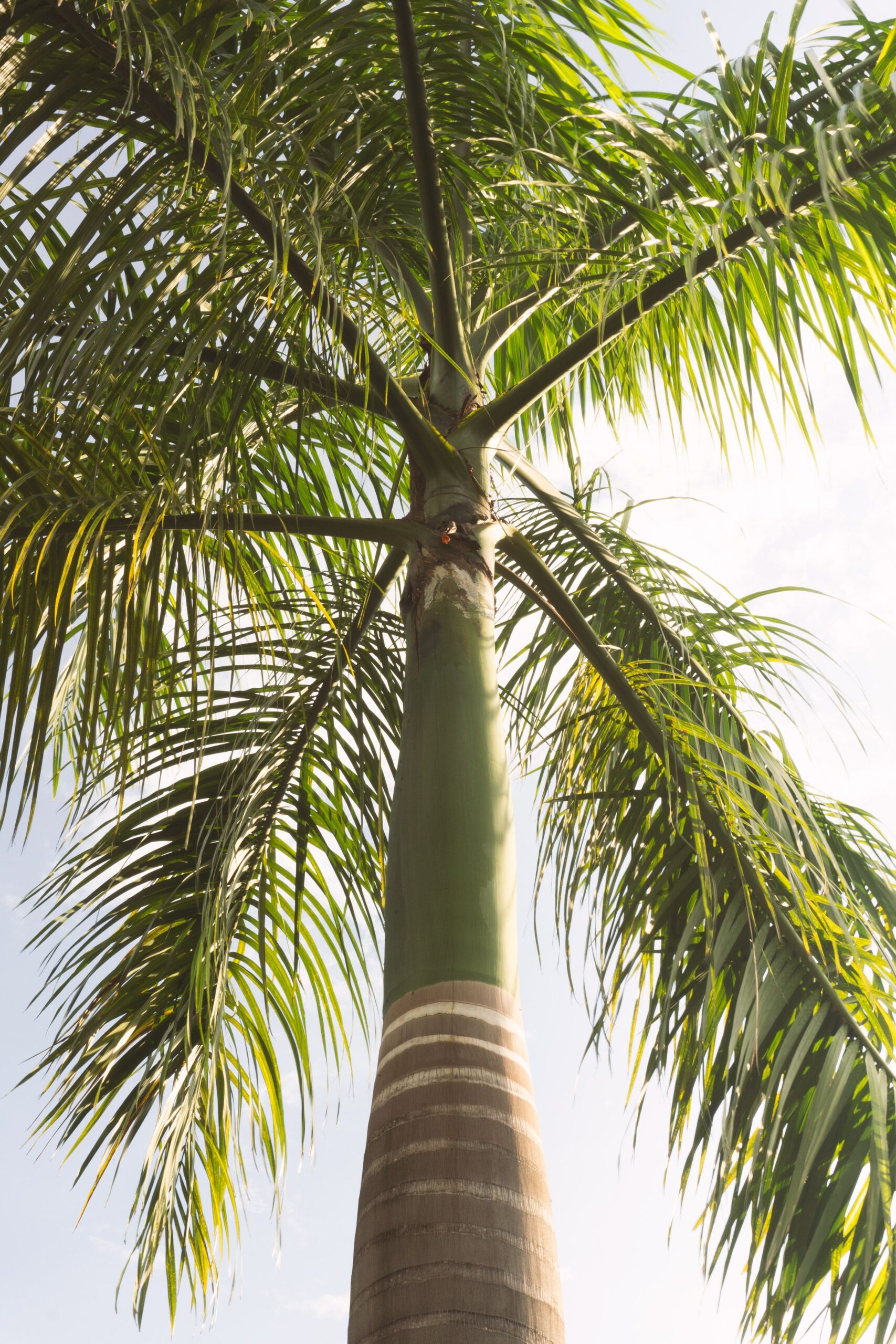
Every palm on this list grows somewhere in the four-county area, and each one carries a different risk profile. If you are replacing a palm or planning a new planting, we also grow and deliver palm trees for sale across the region.
| Palm | Scientific name | Self-cleaning | Lethal bronzing risk | Ganoderma risk | Signature deficiency | Mature height |
|---|---|---|---|---|---|---|
| Cabbage palm | Sabal palmetto | Partly | High, confirmed host since 2008 | Susceptible | Potassium | 40 to 50 ft |
| Queen palm | Syagrus romanzoffiana | No | High, early confirmed host | Highly susceptible | Potassium, manganese | 40 to 50 ft |
| Mexican fan palm | Washingtonia robusta | No | Lower | Susceptible | Potassium | 70 to 100 ft |
| Canary Island date | Phoenix canariensis | No | High | Susceptible | Magnesium, potassium | 40 to 50 ft |
| Pygmy date palm | Phoenix roebelenii | No | Susceptible | Susceptible | Potassium, manganese | 6 to 12 ft |
| Sylvester date palm | Phoenix sylvestris | No | High, early confirmed host | Susceptible | Potassium | 30 to 50 ft |
| Royal palm | Roystonea regia | Yes | Lower | Susceptible | Potassium | 50 to 80 ft |
| Foxtail palm | Wodyetia bifurcata | Yes | Lower | Susceptible | Potassium, boron | 25 to 30 ft |
| Areca palm | Dypsis lutescens | Mostly | Lower | Susceptible | Potassium, magnesium | 15 to 25 ft |
| Coconut palm | Cocos nucifera | Yes | Lower for bronzing | Susceptible | Potassium, manganese | 50 to 80 ft |
Two notes on that table. Coconut palms sit at the northern edge of their comfort zone in Tampa Bay. This region runs USDA zones 9b to 10a, and coconuts want 10b and warmer. They survive here in protected microclimates near the water and take visible damage in a hard winter, which is why they are a gamble inland. Second, Sabal palmetto is the state tree and a genuinely tough native, and it appears in our broader guide to Native Florida Trees alongside the other species that handle this climate without help.
Frequently Asked Questions
How often should palm trees be trimmed in Florida? One to two visits per year handles most palms, and self-cleaning species such as royal and foxtail need none. Trim when fronds are fully dead or fruit stalks are forming, not on a fixed schedule. Cutting green fronds damages the palm and provides no benefit.
Why are my palm fronds turning yellow? Potassium deficiency causes yellowing on the oldest fronds in the great majority of Tampa Bay cases, because every soil here is potassium deficient for palms. Yellowing that starts on the newest fronds points to manganese or iron instead, and that pattern needs faster attention.
Should I get my palms hurricane cut before storm season? No. UF/IFAS write-ups after 2004 and 2005, including Gilman’s palm-damage notes and Caldwell’s Wilma comparison, report that heavily stripped palms lost crowns more often than palms left with a full canopy. Removing dead fronds and heavy fruit stalks is real storm prep. Stripping green fronds is not.
Can lethal bronzing be cured? No. Once symptoms appear, the labeled rate of oxytetracycline does not reverse them and the palm is removed immediately. Healthy neighboring palms can be tested and injected with oxytetracycline hydrochloride every three to four months for at least two years as prevention.
How do I know if my palm is dead or just stressed? Test the spear leaf. If the newest unopened frond pulls free with gentle tension, the bud has died and the palm will not recover. A firm spear and green tissue at the crown center means the palm still has a chance, whatever the lower fronds look like.
Do I need a permit to remove a palm tree in Tampa? It depends on the jurisdiction and the palm. City of Tampa handles palms under Chapter 13, Pinellas County requires a permit for palms over 6 feet in height on non-homesteaded property as of January 2026, and Temple Terrace protects palms with 4.5 feet of clear trunk. We confirm the requirement and advise on the permit before work starts.
Can I plant a new palm where a dead one was removed? Yes in most cases, but never after a Ganoderma butt rot removal. Those spores stay in the soil and every palm species is a host. Replant that spot with a broadleaf tree, shrubs or turf, since the fungus does not affect other plant families.
How much does palm tree removal cost in Tampa Bay? Cost depends on height, access, proximity to structures and debris volume rather than a flat rate. Removals across the Tampa area generally range from a few hundred dollars into the low thousands. A documented arborist diagnosis costs $120 and often shows the palm is treatable rather than removable.
About the author
Tony Padgett is an ISA Certified Arborist (FL-9569A) and ISA Tree Risk Assessment Qualified (TRAQ) professional, and the owner of Panorama Tree Care in Tampa. He has worked palms and hardwoods across Hillsborough, Pinellas, Manatee and Sarasota counties since 2000. Panorama Tree Care is a family-owned, fully licensed and insured, BBB A+ accredited business working to ANSI A300 standards.
Call (813) 234-9842 or request a free estimate for a palm assessment anywhere in Tampa Bay.