
TL;DR: In Florida, you generally cannot remove mangroves, and you can only trim them under strict limits set by the Florida Mangrove Trimming and Preservation Act (403.9321–9333).
Around Florida, almost any serious mangrove work on the shoreline needs a licensed professional mangrove trimmer and sometimes a DEP mangrove trimming permit before anyone touches a saw.
Key Takeaways
- All three native species — red mangrove (Rhizophora mangle), black mangrove (Avicennia germinans), and white mangrove (Laguncularia racemosa) — are protected statewide under the Florida Mangrove Trimming and Preservation Act. Size and age don’t matter; a 3‑foot sapling is protected just like a 20‑foot giant.
- On most Florida shorelines, a professional mangrove trimmer licensed by the Florida DEP must perform or directly supervise trimming, especially anywhere near the waterline or in a mangrove buffer zone.
- The law generally limits trimming to about a 25% reduction in canopy in a single event and blocks you from cutting mangroves below certain minimum heights (often 6 feet) unless you have specific written authorization.
- The Florida DEP Department of Environmental Protection issues general permits for routine, compliant trimming and individual permits for heavier work, shoreline alterations, or projects tied to construction and development.
- Illegal mangrove removal or heavy-handed cutting can lead to fines from about $100 per tree to $10,000+, mandatory restoration, monitoring requirements, and even potential criminal charges if the destruction is willful.
- Florida’s mangroves stabilize shorelines, reduce coastal erosion, soften storm surge, and support fisheries. All that protection often enhances property values instead of hurting them.
- Panorama Tree Care provides licensed mangrove trimming services across the area, including DEP permit handling, compliant trimming, restoration planning, and clear documentation for your records and insurance.
- If you’re unsure whether you can trim mangroves on your property, do not cut first. Talk to a Florida certified arborist or licensed mangrove trimmer and contact the Florida DEP office before anyone starts pruning.
Quick Definitions: What Is Florida’s Mangrove Trimming Law?
What is the Florida Mangrove Trimming and Preservation Act?
The Florida Mangrove Trimming and Preservation Act (Sections 403.9321–403.9333, F.S.) is the statewide law that protects mangroves along Florida’s coasts.
It lays out who is allowed to trim mangroves, how much you can cut, minimum height and canopy rules, when permits are required, and what penalties and restoration obligations apply if those rules are violated.
Florida Mangrove Trimming Law: What You Need to Know
The Florida Mangrove Trimming and Preservation Act (403.9321–9333) treats mangroves as a protected coastal resource, not as landscape shrubs you can shape any way you want. Under this law, you usually cannot remove mangroves outright, and trimming is only allowed under specific conditions.
In many situations, those cuts must be made or supervised by a professional mangrove trimmer licensed through the Florida DEP Department of Environmental Protection. The Act covers all three common native species statewide: red mangrove (Rhizophora mangle), black mangrove (Avicennia germinans), and white mangrove (Laguncularia racemosa).
If you’re wondering, “Can you trim mangroves in Florida?” the honest answer is: yes, but only under tight rules.
Around the Tampa Bay Estuary and across the Hillsborough County coastal zone, those rules get even more attention because mangroves are the front line for shoreline stabilization, coastal erosion protection, and critical wildlife habitat. People who ignore that usually meet DEP staff sooner or later.
For broader rules on oaks, pines, and other trees not covered by mangrove law, check our separate guide on Florida tree protection laws.
5 Major Mangrove Trimming Rules in Florida
Florida applies the statewide mangrove law with active local enforcement. Along bays, canals, and open-water shorelines, DEP and local staff keep a close eye on the mangrove fringe.
Every property is a little different, but most waterfront owners should assume these five rules apply unless a DEP officer or licensed professional tells you otherwise in writing.
Rule 1 — Professional Trimmer Required
Under the Florida Mangrove Trimming and Preservation Act, not everyone is allowed to cut mangroves.
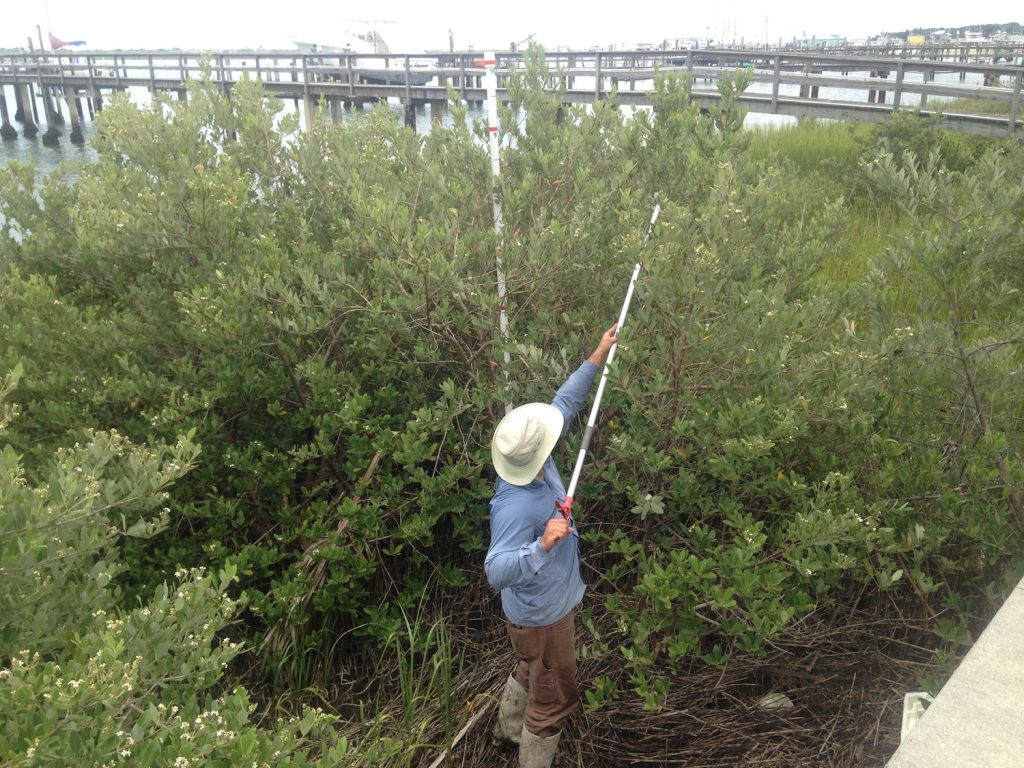
On most coastal properties in Florida, any trimming in a mangrove buffer zone or along the mean high water line must be done by, or under direct supervision of, a professional mangrove trimmer.
Key points about professional mangrove trimmer requirements:
- A professional mangrove trimmer license is issued by the Florida DEP, not by the city or county.
- The trimmer has to meet education and experience requirements and pass a DEP qualification process, which typically includes an exam and a review of field skills. It’s not a weekend certificate.
- Homeowners may be allowed to do very minor trimming on small mangroves set back from the water, but only if they stay inside strict size and height thresholds in the law. That’s narrow, and you need to verify before you cut.
- Florida regulatory staff often expect a licensed professional anywhere the trees form a shoreline fringe or are tied to critical wildlife habitat, such as fish nurseries or bird roosts.
There’s a good reason for this. Mangroves respond differently to pruning than typical yard trees. Bad cuts can kill sections of the stand, destabilize the bank, or count as illegal “topping” that DEP views as removal.
Many violations start with someone who meant well but didn’t understand how strict the Act really is.
Rule 2 — 25% Maximum Canopy Removal
One of the most misunderstood parts of Florida’s mangrove rules is how much foliage you’re allowed to remove. In normal maintenance scenarios, you’re held to about a 25% canopy trim limit.
That means you can’t remove more than around one quarter of the living canopy during a single trimming event.
What the 25% canopy rule usually means in practice:
- No aggressive “hedging” that strips off most side branches and leaves bare poles or trunks.
- No back-to-back severe reductions where each cut is “only 25%,” but the total effect over a season is closer to removal.
- Trimming has to leave a natural, layered canopy with healthy foliage from the top down, not just a flat green wall on top of bare stems.
- If your plans exceed that threshold, you’re likely in DEP individual permit territory, not a simple general authorization.
Experienced crews like Panorama Tree Care don’t guess at this. We look at the stand, estimate current canopy volume, mark planned cuts, and take before-and-after photos. That way, if DEP asks questions, you’ve got a record that shows we stayed inside the 25% canopy limit.
Rule 3 — Height Restrictions
The Act also cares about how low you cut mangroves. Exact numbers depend on original height, species, and site conditions, but as a rough guide, you usually cannot trim mature shoreline mangroves below about 6 feet in height without written authorization from DEP. Shorter cuts without a permit are one of the fastest ways to land in trouble.
Typical height-related restrictions include:
- Red mangroves (Rhizophora mangle) with those trademark prop roots usually carry the strictest height protections, especially along open shorelines and canal edges.
- Trimming has to leave a healthy minimum height, often 6 feet or more, to maintain fish nursery habitat, shade, and wave protection.
- Cutting them back repeatedly to low “stubs” every year is treated as prohibited topping/removal, not maintenance.
- If you’re trying to open up a view, height caps in the law and your permit conditions have to be balanced against minimum legal heights. Many times, DEP will only allow selective “windowing” and lateral thinning, not chopping the whole stand down.
DEP also looks at both current height and historic height. Taking a 15–20 foot stand and converting it to a 4–5 foot hedge without a permit is almost always going to be flagged as a violation, even if you leave them technically alive.
Rule 4 — DEP Permit for Excessive Trimming
Any work that goes beyond the Act’s built-in “general authorization” usually needs a DEP mangrove trimming permit.
That includes cutting more than 25% of the canopy, dropping trees below minimum heights, reconfiguring a thick shoreline forest, or integrating mangrove impacts into a construction project.
The Florida DEP uses two main types of authorizations for mangrove work:
- DEP general permit – For routine trimming within legal limits, with specific conditions on canopy, height, and location.
- DEP individual permit – For projects that exceed those limits or tie into seawalls, docks, dredging, or other shoreline development.
In Florida, if your plan is anything more than light maintenance, expect a permit review. That’s especially true if you want a bigger view window, need to thin out a solid mangrove wall, or plan to tie mangrove work into a seawall or dock rebuild.
Calling the Florida DEP office early saves time and keeps you from designing a project that DEP will never sign off on.
Rule 5 — Shoreline Fringe Protection
The continuous band of mangroves on the water’s edge, often called the mangrove fringe, gets extra attention in enforcement.
That strip between the upland and the mean high water line is doing a lot of work: coastal erosion protection, wave dampening, wildlife habitat, and shoreline stabilization. Regulators treat it as natural infrastructure.
What you generally cannot do to the shoreline fringe:
- Cut large holes through it or carve out big “view corridors” that interrupt the canopy without DEP authorization.
- Dig, fill, or grade around the roots in a way that undermines stability, even if you leave the trunks technically standing.
- Rip out red mangroves with prop roots to stick in a bare seawall, extended dock, or private beach without a permit that explicitly addresses those impacts.
- Scrape off a naturally vegetated mangrove fringe and replace it with turf grass, gravel, or rocks alone.
Inside the Tampa Bay Estuary Program priority area, that fringe is treated like critical shoreline armor. Many DEP staff would rather see your seawall partially shaded by well-maintained mangroves than see a clean wall with nothing protecting the toe from erosion and wave undercutting.
DEP Mangrove Trimming Permits (General vs Individual)
The Florida DEP Department of Environmental Protection runs a two-tier permitting system for mangrove work. General permits cover low-impact trimming that stays in the safe zone.
Individual permits cover anything bigger or riskier. Understanding which lane you’re in keeps projects moving and avoids accidental violations.
DEP General Mangrove Permit
A DEP general mangrove permit (often called a general authorization) is meant for routine trimming that stays within the law’s standard limits. It’s the path for property owners who want regular maintenance, not a major redesign of the shoreline.
Typical attributes of a DEP general mangrove permit:
- Scope: Maintenance trimming that stays under the 25% canopy limit, keeps trees above required minimum heights, and leaves the mangrove buffer zone and shoreline fringe intact and functional.
- Fee: A modest administrative fee that can vary by year and project details. You’re usually paying more for professional documentation than the DEP fee itself.
- Processing time: Often in the 30–60 day range once DEP has a complete application with good drawings and photos.
- Renewal requirement: Some authorizations allow recurring maintenance over a set time frame. You have to keep following the permit conditions or risk losing that privilege.
- Florida DEP office: For the Hillsborough County coastal zone and surrounding areas, the regional DEP office is your main point of contact for questions and applications.
In practice, companies like Panorama Tree Care usually assemble the application package. That means site sketches, species ID, photos, canopy estimates, and a clear description of how the work fits the law. DEP reviewers tend to move faster when that groundwork’s done right the first time.
DEP Individual Mangrove Permit
A DEP individual mangrove permit comes into play when the project goes beyond general permit thresholds. That might be heavier trimming, limited removal that DEP is willing to allow, or tying mangrove impacts into construction like docks, seawalls, or fill and excavation.
Scenarios that may require an individual permit include:
- Trimming more than the 25% canopy in a single pass, even if the trees will remain taller than 6 feet.
- Reducing tall stands significantly below typical minimum heights to carve out a long water view across the property frontage.
- Installing or expanding a seawall, boat lift, or dock that will interfere with prop roots, trunks, or the root zone around mangroves.
- Reworking a dense red mangrove fringe that currently functions as prime fish nursery habitat or an important wildlife corridor along a canal or open shoreline.
Key elements of an individual permit process:
- Application detail: You’ll need a detailed work plan, justification for the impacts, an environmental assessment of what’s at stake, and usually a proposed mitigation or restoration plan to offset unavoidable damage.
- Fees: Higher than general permits, often scaled with project size, complexity, and expected environmental impact.
- Timeline: Plan on months, not weeks. Coordination with other agencies and reviews for wildlife, water quality, and shoreline stability all add time.
- Public and agency review: Some projects trigger public notice or input from other resource agencies, which can change project conditions or timelines.
DEP is looking at more than just your view. They’re weighing long-term shoreline function and habitat. That’s why working with a team like Panorama Tree Care that already knows how DEP staff think, and how the Tampa Bay Estuary goals apply, usually cuts out a lot of back-and-forth and redesign.
How to Approach the DEP if You’re Unsure
If you’re not sure whether your plan sits inside a general permit or if you’re dealing with an individual permit situation, don’t guess. You can:
- Reach out to the Florida DEP office with clear photos, a simple property sketch, and a short write-up of what you’re hoping to do.
- Ask for a pre-application meeting or informal consultation. A short call or site visit can save months of redesign later.
- Bring in a professional mangrove trimmer or Florida certified arborist who already understands DEP procedures and local enforcement patterns.
Penalties for Illegal Mangrove Trimming in Florida
Violating Florida mangrove trimming law is not a “slap on the wrist and move on” kind of deal. The Act lets the Florida DEP and, in some cases, local governments issue fines, force restoration, and even pursue criminal charges for serious or intentional violations. In Florida, they actually use that authority.
Typical Mangrove Violation Penalties
Penalties are case-by-case, but here’s what we routinely see for illegal mangrove trimming or removal in Florida:
- Fine per tree: Often starts around $100 per mangrove and can climb into the thousands of dollars per tree for larger, older, or more ecologically important specimens. For bigger stretches of shoreline, total fines reaching $10,000 or more are not unusual.
- Restoration requirement: DEP typically orders replanting at a replanting ratio higher than 1:1, like two or more new mangroves for every one damaged or removed, plus a monitoring schedule until survival and growth targets are met.
- Criminal penalty: For willful destruction, repeated offenses, or cutting after written warnings, cases can be forwarded for criminal enforcement. That can mean misdemeanor or felony charges under Florida environmental law.
- DEP enforcement timeline: Once a complaint hits, DEP staff usually investigate within days to weeks, especially around Florida where enforcement is known to be proactive.
In the Hillsborough County coastal zone and across the Tampa Bay Estuary, enforcement doesn’t rely only on someone driving by. Aerial imagery, neighbor complaints, HOA disputes, and even law enforcement patrols all feed mangrove cases to DEP.
Real-World Florida Enforcement Patterns
In the field, these are the situations that most often trigger a DEP visit and a violation notice:
- Contractors cutting a whole strip of mangroves along a canal to “open up the water” before a sale or listing, with no DEP permit in sight.
- Homeowners paying unlicensed crews to top mangroves flat for a better view, usually leaving them at 3–4 feet in front of the seawall.
- Developers pushing fill, seawalls, or shoreline grading right into mangrove stands without including mangrove impacts in their permit applications.
In many Florida cases, the end result is the same. Property owners are told they must hire a professional mangrove trimmer or restoration specialist, hire an environmental consultant in some cases, and fund a DEP-approved restoration plan. That bill can easily run higher than what a careful, compliant trim would have cost from the start.
For context on how mangrove law fits into the bigger picture of Florida tree rules and environmental codes, look at our overview of Florida tree protection laws.
Why Florida Mangroves Matter (Ecological & Property Value)
Most waterfront owners want a clean, open view. That’s understandable. But along the coast here, those mangroves in front of you are doing a lot of quiet, heavy-duty work. The Tampa Bay Estuary Program and the Florida DEP both treat them as some of the most valuable “green infrastructure” on the coast.
Ecological Benefits of Mangroves
1. Storm surge and wave protection
Thick mangrove bands help break up storm waves and knock energy out of storm surge before it reaches your seawall or yard. During hurricanes and strong tropical storms, that friction can mean the difference between a battered lawn and a washed-out shoreline.
2. Coastal erosion protection
The tangled aerial roots of red mangroves (Rhizophora mangle), paired with the strong below-ground roots of black and white mangroves, lock soil together and provide long-term shoreline stabilization. Once you strip those roots out, you’d be surprised how fast a bank starts to slump, especially in canals with boat wakes all day.
3. Fish and wildlife habitat
Those red mangrove prop roots are textbook fish nursery habitat. Juvenile snook, redfish, tarpon, and a long list of baitfish tuck into that structure. Wading birds, herons, and shorebirds work those edges constantly. Crabs, shrimp, and snails use the same structure as critical wildlife habitat for feeding and shelter. Chopping it back too hard hits your own fishing and the bay’s health.
4. Water quality improvement
Mangroves act like a natural filter for runoff. They trap sediment, hold back litter, and pull nutrients out of the water that would otherwise cloud your canal or fuel algae blooms. In canals and shallow shorelines around Florida where mangroves were allowed to recover, water clarity has often improved along with fish numbers.
Property Value and Insurance Benefits
There’s a common myth that mangroves hurt property value. Experience along the coast says the opposite. Properly managed mangroves often increase, not decrease, property value because:
- Shorelines with healthy mangroves usually suffer less erosion and lower long-term repair costs than bare seawalls or exposed banks.
- Some insurance carriers and underwriters look more favorably on properties with robust natural buffers that reduce storm and wave losses.
- A well-trimmed, layered mangrove canopy can maintain a filtered water view and privacy while still protecting your lot, your dock, and nearby seagrass beds.
So instead of viewing mangroves as a problem you have to “clear,” it’s smarter to think of them as living storm protection and erosion control systems that can be shaped, within the law, to fit your view and access needs.
If your HOA is pressuring you to “open up the view” or remove vegetation, point them to our resource on HOA coastal tree rules. Association covenants don’t override state mangrove protections, even if the HOA board isn’t up to speed.
How Panorama Tree Care Handles Mangrove Trimming in Florida
Panorama Tree Care provides licensed mangrove trimming service for homeowners, HOAs, marinas, and commercial shorelines across Florida. We focus on legal compliance, ecological sensitivity, and practical solutions that protect both your shoreline and your investment.
Professional Mangrove Trimmer Licensing and Expertise
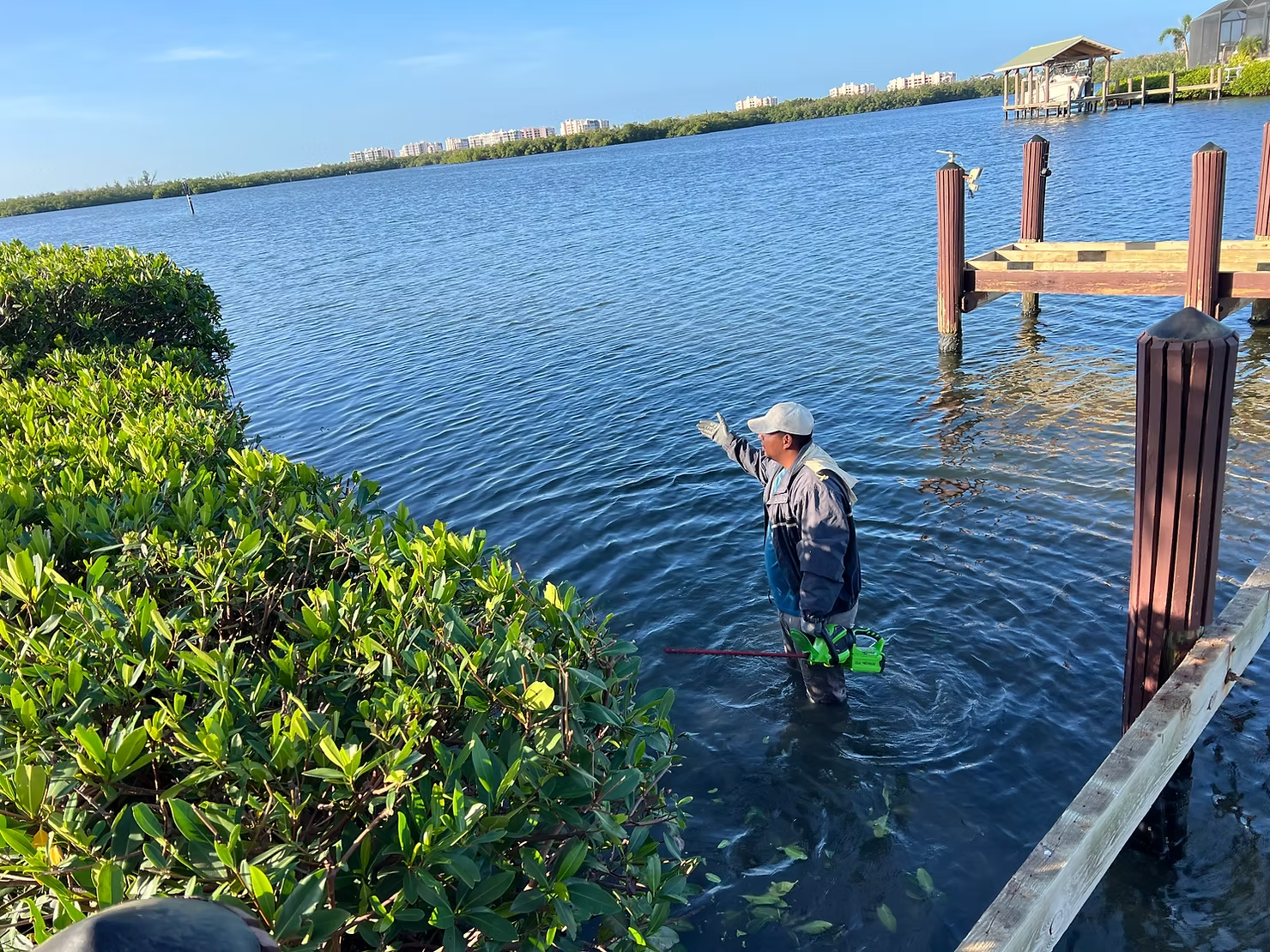
All our mangrove work is performed or directly supervised by a professional mangrove trimmer with a current license from the Florida DEP. That means:
- Our trimmer has completed DEP-recognized training and education on mangrove biology, hydrology, and the legal framework that applies to coastal vegetation.
- They’ve met experience benchmarks and passed a competency evaluation, usually including an exam and field review of actual trimming work.
- Their license is renewed on a repeating cycle, and they stay current with changes to the Florida Mangrove Trimming and Preservation Act and Florida enforcement priorities.
- Panorama staff licensed: Yes. We keep licensed mangrove professionals on staff specifically for Florida projects, not just on call from another region.
Pre-Trim Site Survey and Planning
Before any saws or poles come out, Panorama completes a pre-trim survey of your shoreline. That usually involves:
- Identifying each species present: red mangrove (Rhizophora mangle), black mangrove (Avicennia germinans), and white mangrove (Laguncularia racemosa), since rules and habitat value differ by species.
- Mapping the mangrove buffer zone, the mean high water line, and any obvious critical wildlife habitat indicators like roosting birds or seagrass beds just offshore.
- Measuring current tree heights and estimating canopy density, so we know exactly how much we can remove while staying inside the 25% canopy trim limit.
- Talking through your goals in plain language, whether that’s better views from the patio, safer dock access, reduced storm debris, or a mix of all three, and then matching those goals with what DEP will actually allow.
If the work looks like it will go beyond basic maintenance, we’ll recommend you contact DEP or we’ll help you apply for a DEP general permit or DEP individual permit before any cutting starts. That keeps everyone out of trouble.
Permit Handling and DEP Coordination
Panorama Tree Care can assist with, or fully manage, the mangrove trimming permit process for your Florida property. That typically includes:
- Preparing application packages with clear site photos, to-scale sketches, canopy measurements, and detailed work descriptions that match DEP terminology.
- Working directly with the Florida DEP office to address questions, clarify site conditions, and tweak plans when reviewers request adjustments.
- Tracking permit processing timelines and providing responses quickly when DEP needs more information, which helps keep the job moving toward approval.
That way you’re not stuck guessing how to fill out forms while the growing season passes or trying to explain your shoreline over the phone without a plan.
Compliant Trimming Techniques
Once permits and authorizations are in place, our crews trim mangroves using methods that match both Florida law and standard arboricultural best practices for long-term tree health:
- We use selective cuts that preserve primary structural limbs and maintain a natural, tiered canopy instead of blunt “line trimming”.
- We prioritize tree health and stability. That means no “lions-tailing,” no stripping all inner foliage, and no illegal topping that forces weak new growth.
- We manage debris carefully so branches and leaves don’t blanket seagrass beds, oyster bars, or other sensitive shoreline resources.
- We stay within minimum height thresholds and canopy percentage limits that apply to your specific stand and permit conditions.
To improve views, we focus on targeted windowing and thinning in key sightlines, not just taking everything down to the same flat height. That approach keeps DEP happy and usually leaves you with a better-looking shoreline in the long run.
Post-Trim Documentation and Long-Term Plan
After the work is complete, Panorama provides documentation you can keep in your files, share with DEP if needed, or provide to an HOA or insurance carrier. That often includes:
- Before-and-after photos that match the original plan and show how the trimming stayed within the approved footprint and intensity.
- Notes on species present, percentage of canopy reduced, and final post-trim heights along each segment of shoreline.
- Recommendations on how often you should schedule maintenance so mangroves don’t get away from you again and so future work can be lighter and easier to permit.
We also help coordinate mangrove work with other property needs. That might mean lining up your next tree trimming service for non-mangrove trees during the right season, spacing heavy work so you’re not stressing the shoreline all at once, and protecting root zones when you improve landscaping upland of the mangroves.
Common Mistakes in Florida Mangrove Trimming (and How to Avoid Them)
Most mangrove violations don’t start with bad intent. They start with someone who didn’t understand the law or treated mangroves like regular yard shrubs. Here are mistakes we run into around Florida all the time, along with better ways to handle them.
Mistake 1: Assuming “It’s Just a Bush” Not a Protected Mangrove
Problem: A homeowner or landscaper sees a clump of green on the back edge of the yard, figures it’s a regular shrub, and clears it during cleanup. Weeks later they find out it was young red or black mangroves and now they’re in violation.
Fix: Learn a few basic ID clues. Red mangrove prop roots that arch into the water are a dead giveaway. Black mangroves often have salt crystals on the leaf surface and pencil-like “snorkel” roots in the soil. If there’s any doubt, stop and bring in a professional mangrove trimmer or Florida certified arborist before anything gets cut.
Mistake 2: Topping Mangroves for a View
Problem: Someone takes a saw and cuts a row of mangroves off at chest height to get a clear horizon line. Everything is flat-topped, usually much lower than 6 feet. It might look tidy for a minute, but in legal terms that can be treated as unlawful removal.
Fix: Work with a licensed trimmer to design selective windowing that lines up with your key sight angles. By lifting some branches, thinning others, and shaping vertical layers, you can get a much better view while staying within height and canopy limits the law actually allows.
Mistake 3: Hiring Unlicensed Crews
Problem: A low-cost crew drops a flyer or knocks on the door offering “mangrove trimming” with no DEP license, no understanding of the Act, and a hedge-trimmer mindset. They cut the stand like a hedge row and leave the homeowner holding the bag when DEP shows up.
Fix: Before any work on shoreline vegetation, ask to see a current professional mangrove trimmer license issued by DEP, not just a business tax receipt. Check insurance and ask for Florida references that involve shoreline trimming. If they can’t provide that, don’t use them.
Mistake 4: Self-Trimming Without Understanding the Law
Problem: A homeowner trims what they think is a “small amount,” but they actually cut far more than the 25% canopy trim limit or drop trees below minimum height. They assume because the trees are still green, everything is fine.
Fix: If you’re going to do any self-trimming at all, keep it extremely conservative and set back from the water, and only if you’re sure the Act allows it at that location. If you have any doubt on species ID, location, or limits, stop and either call DEP or hire a professional.
Mistake 5: Ignoring Permits for Waterfront Projects
Problem: Someone decides to rebuild a dock, add a boat lift, or replace a seawall and treats the mangroves as an afterthought. The contractor clears roots or trunks to get equipment in and assumes the permit for the structure covered the vegetation too.
Fix: Treat mangroves as part of your waterfront project from day one. Sit down with your builder, your mangrove professional, and the permit drawings, and figure out whether a DEP general permit or individual permit is going to be needed for mangrove impacts. Build that into the schedule and budget so it doesn’t become an emergency later.
A lot of these mistakes overlap with general misunderstandings about Florida’s environmental rules. For a bigger-picture look at how trees and coastal vegetation are regulated, see our guide to Florida tree protection laws.
FAQ: Florida Mangrove Trimming Rules in Florida
Can homeowners trim mangroves themselves in Florida?
Homeowners can do very limited trimming in some narrow situations, usually involving small mangroves away from the waterline and only if they stay inside strict height and canopy rules. Along most Florida shorelines, though, trimming needs a professional mangrove trimmer licensed by DEP. If you’re not absolutely sure it’s allowed, err on the side of assuming you need a professional and probably a permit.
Can I trim mangroves to restore my water view?
You can often improve a view through careful, selective trimming, but you’re not allowed to just turn mangroves into a low hedge or cut them out. Any view work has to respect the 25% canopy trim limit and minimum height rules, and bigger view changes often require a DEP mangrove trimming permit. A licensed trimmer can lay out view corridors that satisfy both DEP and your line of sight.
What if mangroves are damaging my seawall or dock?
Conflicts between mangrove roots and concrete or wood structures are handled on a case-by-case basis. Don’t cut roots or remove trees on your own to protect the structure. Instead, contact the Florida DEP office and bring in a licensed mangrove professional. They can help determine whether selective trimming, targeted root management, or a DEP individual permit tied to structural repairs is needed.
Contact Panorama Tree Care Florida for a free assessment and estimate.
When is the best time of year to trim mangroves in Florida?
You can trim mangroves much of the year, but professionals often avoid peak nesting seasons and time work to reduce stress on the trees and disturbance to wildlife. Tides and access also affect scheduling. For your oaks, palms, and other landscape species, see our guide on the tree trimming service guide, since those timing rules are different.
How much does professional mangrove trimming cost in Florida?
Costs depend on tree size, density, access, and permit requirements. A small maintenance job with good access might run a few hundred dollars. Extensive shoreline work requiring DEP permits, documentation, and potential restoration planning can be much higher. Compared to dealing with a mangrove removal Florida penalty and required replanting, hiring a professional mangrove trimmer upfront is almost always the cheaper route.
Are all mangroves on my property protected, or only those at the waterline?
All three native species — red, black, and white mangroves — are protected regardless of whether they’re at the water’s edge, in the intertidal zone, or farther upland. DEP may allow slightly different trimming options depending on location, but the Act still applies. Don’t assume upland mangroves are exempt just because they’re not standing in water.
What is the penalty if my landscaper illegally trims mangroves?
In most cases, DEP holds the property owner responsible, even if a contractor was the one holding the saw. You can face fines per tree, mandatory planting at a higher replanting ratio, monitoring costs, and permit fees to fix the damage. That’s why you should always hire only DEP-licensed mangrove professionals for Florida shoreline work and keep their license info on file.
Where can I learn more about overlapping HOA, county, and state rules?
For HOA-specific problems and conflicts, read our guide on HOA coastal tree rules. For broader statewide protections beyond mangroves, see our Florida tree protection laws resource. Remember, state mangrove rules still apply even if your HOA or county code is silent or more lenient.
Final Summary & Next Steps
Florida’s mangroves, especially around the Tampa Bay Estuary, are covered by one of the toughest coastal vegetation laws out there: the Florida Mangrove Trimming and Preservation Act (403.9321–9333).
That law controls who can trim, how much canopy can be removed, and how low trees can be cut, and it enforces those limits with significant fines and restoration requirements when people step over the line.
If you own waterfront property in Florida, your safest move is to:
- Assume any mangroves on or near your shoreline are protected until proven otherwise.
- Talk with a professional mangrove trimmer or Florida certified arborist before any mangrove cutting, even if it looks minor.
- Use the DEP general permit or individual permit process whenever your project goes beyond light, clearly allowed maintenance.
Need compliant mangrove trimming or help with a mangrove trimming permit in Florida?
Contact Panorama Tree Care for a site evaluation, a clear, legal trimming plan, and full-service DEP coordination. You’ll protect your shoreline, keep your view, and avoid the headaches and costs that come with a mangrove violation.
Key Legal and Biological Details at a Glance
The table below pulls the main legal and biological details into one place so you can quickly compare permit types, penalties, and species information.
| Entity | Attribute | Details (2026 context) |
|---|---|---|
| Florida Mangrove Trimming and Preservation Act | Statute section | Florida Statutes 403.9321–403.9333 |
| Florida Mangrove Trimming and Preservation Act | Protected species | 3 – red mangrove, black mangrove, white mangrove |
| Florida Mangrove Trimming and Preservation Act | Trimming authority | Primarily licensed professional mangrove trimmers under DEP oversight |
| Florida Mangrove Trimming and Preservation Act | Maximum removal | Typically about 25% of canopy per trimming event |
| Florida Mangrove Trimming and Preservation Act | Penalty range | From ~$100 per tree up to $10,000+ total, plus restoration |
| DEP general mangrove permit | Scope | Routine trimming within height and 25% canopy limits |
| DEP general mangrove permit | Fee | Moderate administrative fee (varies by project) |
| DEP general mangrove permit | Processing time | Approx. 30–60 days for complete, simple projects |
| DEP general mangrove permit | Renewal requirement | May allow recurring maintenance; continued compliance required |
| DEP general mangrove permit | Florida DEP office | Regional DEP office serving the Hillsborough County coastal zone |
| Red mangrove (Rhizophora mangle) | Identification feature | Distinctive prop roots extending above and into the water |
| Red mangrove (Rhizophora mangle) | Trimming restriction | Often the strictest protection among mangrove species |
| Red mangrove (Rhizophora mangle) | Minimum height after trim | Commonly 6 feet or higher, depending on site and permit |
| Red mangrove (Rhizophora mangle) | Habitat value | High-value fish nursery and shoreline stabilization |
| Red mangrove (Rhizophora mangle) | Florida prevalence | Common coastal species along open shorelines and canals |
| Professional mangrove trimmer license | Issuing authority | Florida DEP |
| Professional mangrove trimmer license | Education requirement | DEP-recognized training and experience in mangrove biology and regulations |
| Professional mangrove trimmer license | Exam requirement | Yes – competency evaluation is typically required |
| Professional mangrove trimmer license | Renewal cycle | Renewed every several years, subject to current DEP rules |
| Professional mangrove trimmer license | Panorama staff licensed | Yes – Panorama Tree Care uses licensed mangrove professionals |
| Mangrove violation penalty | Fine per tree | Often around $100+ per mangrove, increasing with severity |
| Mangrove violation penalty | Restoration requirement | Replanting at a higher than 1:1 ratio with monitoring |
| Mangrove violation penalty | Criminal penalty | Possible for willful destruction or egregious violations |
| Mangrove violation penalty | DEP enforcement timeline | Investigation typically within days to weeks after a complaint |
| Mangrove violation penalty | Florida enforcement frequency | Active – especially in the Tampa Bay Estuary and Hillsborough County coastal zone |