TL;DR: To choose a safe, reputable tree service in Florida, don’t just go with whoever knocks on your door. Verify ISA certification through the official portal, confirm real insurance and workers’ comp, check Florida licensing and local business records, and get everything in writing.
Make sure they follow ANSI A300 pruning standards and can point to solid local references. Walk away from storm chasers, cash-only lowball bids, and anyone who can’t prove their credentials on paper.
Key Takeaways
- Always verify ISA certification through the official ISA credential verification portal before hiring. A logo on a truck or business card is not proof.
- Request a current, carrier-issued certificate of liability insurance and confirm workers’ compensation coverage for everyone setting foot on your property.
- Use the Florida DBPR contractor lookup and Hillsborough County business tax receipt records to confirm a licensed tree service in Florida, not just a name on Facebook.
- Insist on a detailed written estimate and contract that spells out scope of work, price, timeline, access, and cleanup in plain language.
- Professional tree services should clearly commit to ANSI A300 pruning standards and be upfront about what they will NOT do, like topping or spiking live trees.
- Be very cautious of storm chaser tree services that flood neighborhoods after storms with pushy door-to-door pitches, rock-bottom prices, and cash-only demands.
- Florida tree work typically costs: trimming $200–$1,200, removals $500–$5,000+, stump grinding $150–$500 depending on size, risk, and access.
- Panorama Tree Care, led by ISA Certified Arborist Tony Padgett FL-9569A, lines up with every point on this 2026 Florida tree service checklist.
Quick Definitions: What Is a “Qualified” Tree Service?
Qualified tree service company: A tree care business that is legally registered and licensed where required in Florida, carries active liability insurance and workers’ compensation, employs or is directly led by an ISA Certified Arborist, follows ANSI A300 pruning standards, performs work with trained crews and proper gear, and backs everything with written estimates and contracts.
ISA Certified Arborist: A tree care professional who has passed the International Society of Arboriculture exam, documented real-world experience, agrees to a code of ethics, and keeps up with continuing education. You can confirm status anytime through the ISA credential verification portal at no cost. Learn more about DIY vs pro.
Storm chaser tree service: A temporary or out-of-town crew that shows up right after hurricanes or strong wind events, often with little or no insurance, offering cut-rate cash deals door-to-door, then vanishing if there’s damage, poor work, or a dispute.
The 7-Point Florida Tree Service Checklist
Before you hand anyone a deposit or let them fire up a saw in your yard, run them through this 7‑point Florida tree service checklist. It covers ISA certification, insurance, workers’ comp, Florida licensing, written estimates, pruning standards, and local references. You’ll see exactly what to ask for and how to verify every claim yourself.
1. ISA Certification: Verify, Don’t Just Trust
Lots of companies say “we have an arborist.” That might mean their cousin took a class once. You want proof that an ISA Certified Arborist is actually involved in inspecting, planning, or supervising your work, not just used as marketing bait.
How to verify ISA certification:
- Go to the official ISA credential verification portal (search “ISA verify a credential” in your browser).
- Enter the arborist’s name or certification number, for example Tony Padgett, ISA FL-9569A.
- Confirm all of the following:
- Name & certification number match exactly what the company gave you.
- Status shows as “Current” or “Certified,” not “Expired,” “Suspended,” or missing.
- Expiration date hasn’t passed and isn’t just a few days away.
- Any specializations, like Tree Risk Assessment Qualification, if you have large oaks over structures or complicated jobs.
- Ask who will actually be on site. Will the ISA arborist personally inspect the trees, or at least oversee the plan and crew?
The ISA database is free to use and only takes a minute. If a company gets defensive, won’t give you a name, or “forgets” their ISA number, that’s a serious warning sign. A real pro is proud to have you look them up.
2. Insurance Certificate: Protect Your Home and Wallet
Florida tree work often means working over roofs, screen enclosures, sheds, power lines, and swimming pools. One wrong cut or gear failure can create a very expensive problem. That’s why liability insurance and workers’ compensation are non‑negotiable.
What to request:
- A current, Certificate of Liability Insurance sent directly from the insurance agent or carrier. A blurry photocopy or phone photo is not enough.
- Proof of active workers’ compensation coverage if anyone besides the owner is swinging a saw or working on your property.
Key attributes for tree service liability insurance:
- Minimum coverage recommended: Ask for at least $1,000,000 in general liability coverage. Bigger removals or crane work may justify higher limits.
- Certificate request: A reputable company gets these issued every week. It should be free, fast, and routine for them.
- Additional insured option: On larger or higher-risk projects, ask to be listed as an additional insured on their policy so you’re named directly.
- Workers’ comp threshold (Florida): In Florida, most non‑construction businesses with 4 or more employees must carry workers’ comp. Tree work is risky enough that you really want coverage even if they claim they are “just a three‑man crew.”
- Policy expiration check: Look closely at the effective & expiration dates. If coverage expires next week and your job is scheduled for next month, that’s not acceptable. Don’t settle for “we’re renewing it.” Wait for updated proof.
3. Workers’ Compensation Coverage: Avoid Being the “Employer”
Here’s the part a lot of homeowners learn the hard way. If a climber gets hurt and there’s no workers’ compensation, lawyers start looking for whoever has a homeowner’s policy and a checkbook. Under Florida law, that can end up being you as the “statutory employer,” even though you only hired the company.
How to confirm workers’ comp in Florida:
- Ask for a dedicated workers’ compensation certificate that shows:
- The company’s legal name. It must match the contract and estimate, not just the logo on the truck.
- The policy number and insurance carrier, so you or your agent can call if you want to double‑check.
- The active policy period, and that it covers the dates your work will be performed.
- Ask directly: “Are your climbers and ground crew covered by workers’ comp?” Then stop talking and listen carefully.
- Be very wary if you hear:
- “We’re all subcontractors, so we don’t need it.”
- “We pay cash, that’s why it’s cheaper for you.”
- “Workers’ comp is a waste, we’ve never had an accident.”
Florida’s workers compensation requirement exists because tree work is high‑risk. A serious Florida tree service shows their coverage without hesitation. Many will even point it out before you ask, because they know how often homeowners get burned by uninsured outfits.
4. Florida License & Local Business Credentials
Insurance answers the “what if something goes wrong” question. Licensing and local registration answer “who are these people, really, and are they legitimate?” in Florida, you want both in order before you sign anything.
What to check:
- Florida DBPR contractor lookup:
- Use the Florida Department of Business and Professional Regulation online lookup to search the business or owner by name.
- Confirm any license type that applies, the current status, and whether there are disciplinary actions or complaints attached to their record.
- Hillsborough County business tax receipt:
- Ask if they hold a current Hillsborough County business tax receipt (sometimes still called an occupational license).
- They should be able to email or text you a copy on request without dragging their feet.
- Business name consistency: Make sure the name is consistent across:
- The written estimate and contract
- Insurance certificates
- Florida DBPR and county records
- Vehicle signage and website
Minor differences can be fine if they explain them clearly, such as a DBA under a parent LLC. What you want to avoid is three different names and no clear legal entity.
For extra confidence, check the company’s listing with BBB Florida. Look at how long they’ve been listed, their rating, and how they handled any complaints. Long-term, well-documented operations are rarely the ones leaving you with a mess and a disconnected phone number.
5. Written Estimate & Contract: No Handshake Deals
I’ve seen more arguments start with “That’s not what we agreed on” than almost anything else. Verbal promises are useless once the crew leaves. You need a clear, written tree service estimate and a final contract before anyone starts a saw.
Required elements of a written estimate:
- Scope of work: Which trees and exactly what will be done. Examples: “thin crown 15–20%,” “remove deadwood 2 inches and larger,” “full removal to ground level,” “stump grinding to 6–8 inches below grade.” Vague phrases like “trim it back” don’t cut it. When you hire our stump grinding crew or any tree pro, look for specifics like “grind to 6–8 inches below grade” instead.
- Price: A clear fixed price or well‑defined unit pricing. Avoid “around” numbers that mysteriously change once the chips hit the truck.
- Timeline: Estimated start and completion dates and whether the crew will be there straight through or splitting days between jobs.
- Insurance statement: A note that they maintain liability and workers’ comp, ideally with carrier names listed so you can match them to the certificates you receive.
Other critical attributes:
- Payment terms: Skip anyone who wants full prepayment. A typical, fair setup is:
- No deposit or a small deposit (0–25%) for normal residential jobs.
- Remaining balance due only after the work is completed as outlined and you’ve walked the property.
- Cancellation clause: There should be a straightforward clause describing how to reschedule or cancel, and what happens if weather or emergencies push the date.
- Warranty inclusion: For plant health care or cabling, a written warranty is ideal. For pruning and removal, you’re usually looking for a guarantee on workmanship and cleanup, not a promise the tree will survive a Category 4 storm.
- Florida average response time: In normal conditions, respectable companies can usually provide estimates within a few business days. During hurricane or tropical storm recovery, expect delays, but the professional outfits will still get you written estimates before working.
If someone insists “we don’t need to write all that down” or keeps things vague, assume they want the flexibility to change the plan later. That’s not who you want running a saw over your roof.
6. Pruning Standards & Climbing Practices (ANSI A300)
Good pruning is surgery, not hacking. A tree can look “cleaned up” the day they pull away and then start failing a few years later because of bad cuts. That’s why standards like ANSI A300 exist.
Ask directly: “Do you follow ANSI A300 pruning standards?” and “What does that mean for my trees?” The way they answer tells you a lot.
A crew that knows what they’re doing will explain that ANSI A300 covers:
- Proper cuts at the branch collar so the tree can seal over the wound. No flush cuts that slice into the trunk and no long stubs left to rot.
- Reasonable crown reduction when needed, but never topping. No removing massive amounts of live foliage just to make it “look open.”
- Tree health and structure as the priority, not fast, cosmetic shortcuts that stress the tree and make it more likely to fail in Florida’s winds.
Climbing spike policy:
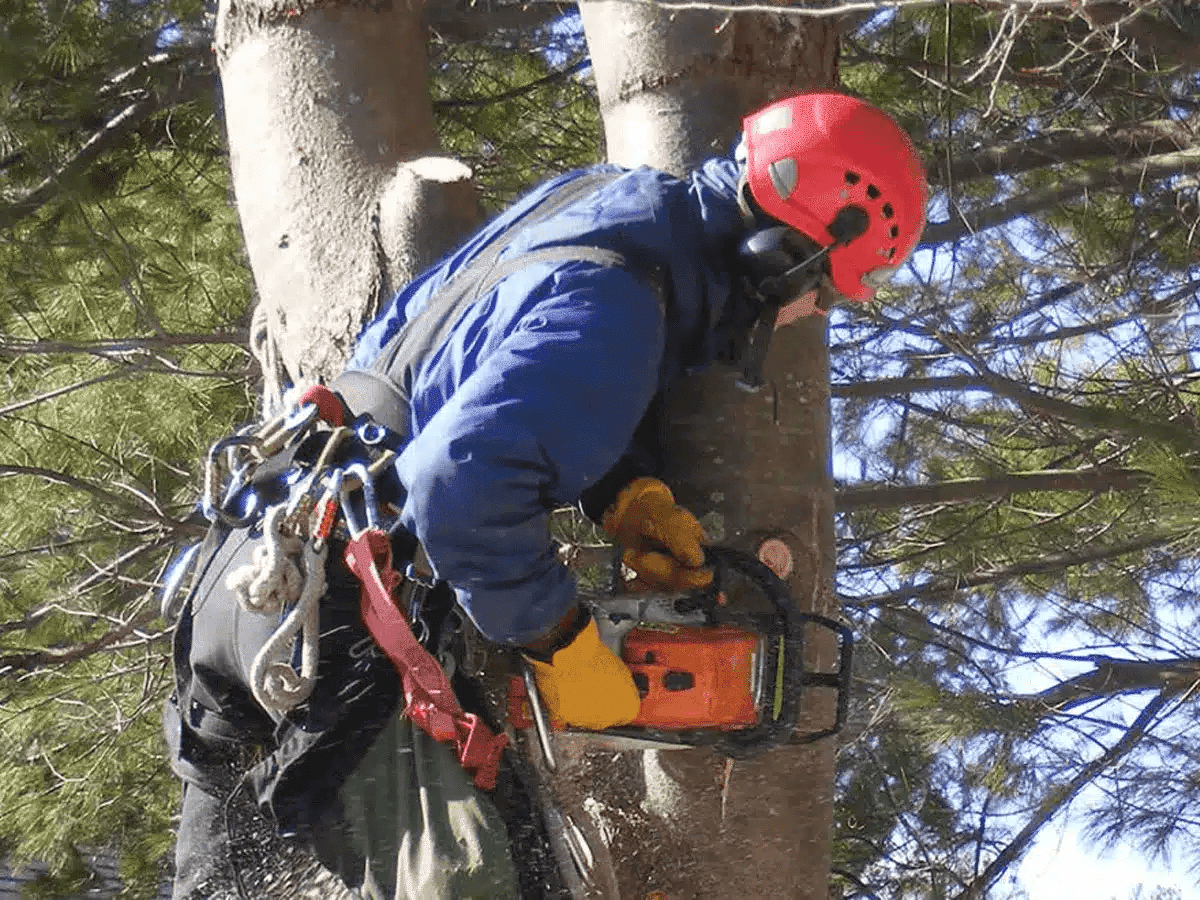
- Spikes (gaffs) should NEVER be used on living trees that are being pruned and kept. They’re for removals only.
- Each spike hole is a wound. On a large live oak, that can mean hundreds of punctures that open the door for decay and pests.
- Ask: “Will your climbers use spikes on my live trees?” The correct answer is clear: no, unless we’re removing the tree.
A company that talks openly about an ANSI A300 compliance claim and has a strict no-spike policy on live trees is thinking years ahead, not just about getting through the day’s route.
7. Local References & Online Reviews
Credentials and paperwork are one side of the coin. Real‑world performance is the other. You want proof the company has been safely working on real homeowners’ trees, not just taking nice photos of someone else’s job.
Local references to request:
- Addresses or at least neighborhoods where they’ve worked on similar trees to yours. In Florida that often means live oaks, laurel oaks, pines, and palms.
- Previous customers who are willing to share a short text or phone confirmation about their experience.
How to use Florida tree service reviews:
- Check Google reviews, BBB Florida, and sites like Angi Florida tree service.
- Look beyond the star rating and read the details:
- Comments about safety practices, cleanup, and communication with the office and crew.
- How the company responds to negative reviews. Professional, solution‑focused replies are a good sign.
- Repeated mentions of the same crew leader or ISA arborist by name. That points to stable staffing and real oversight.
A long history of solid local reviews is far more trustworthy than a brand‑new company with ten perfect 5‑star ratings from generic usernames created last week.
5 Red Flags of an Unqualified Tree Service
Every storm season in Florida, the same pattern repeats. Homeowners are stressed, trees are down, and unqualified crews rush in to scoop up fast cash. Avoiding the wrong company is just as important as finding the right one.
Keep an eye out for these five red flags: storm chasing, door‑to‑door pressure, cash‑only lowball estimates, spiking live trees, no written contract, and fuzzy or missing ISA credentials.
- 1. Door-to-Door Solicitation After Storms
After hurricanes or strong wind events, storm chaser tree services start cruising your neighborhood:- Arrival timing: They show up almost immediately, sometimes before the rain stops, walking door to door.
- Solicitation method: Strong, emotional pitches like “I see that dangerous limb. We can fix it for you today before it falls.”
- Pricing pattern: Very low “starter” prices that often jump once equipment is set up and the job is half done.
- Insurance status: Typically uninsured, underinsured, or unwilling to share documents, claiming “we left them at the shop.”
- Work quality: Fast, rough cutting, little attention to tree health, and sloppy or incomplete cleanup.
- Florida prevalence: Extremely common after major hurricanes and tropical storms, when demand outstrips supply and people are desperate.
Legitimate local companies rarely need to cold-knock. They’re usually overwhelmed with inbound calls from existing customers and referrals.
- 2. Cash-Only, “Today Only” Lowball Estimates
A surprisingly cheap quote can feel like winning the lottery. Usually it isn’t:- They insist on cash only and refuse checks or credit cards, which makes it hard for you to dispute anything later.
- The bid is far below what other qualified companies quoted for the same tree service in Florida.
- They put heavy pressure on you to decide “right now” or “before we leave the street” to get the supposed deal.
Those bargains commonly come with no insurance, no contract, and no accountability. If they damage your roof or pool cage, the savings disappear fast.
- 3. Climbing Spikes on Live Trees
If you look up and see climbers strapping on climbing spikes to prune a tree that’s supposed to stay, stop the work and ask questions immediately. Spikes are:- Acceptable on removals, where the tree is coming down completely and new wounds don’t matter.
- A major red flag on live tree pruning, because they leave rows of punctures that can start decay pockets all along the stem.
A professional company has a written climbing spike policy and trains their climbers to avoid gaffs on any tree that’s not being taken out.
- 4. No Written Contract or Vague Scope
“We’ll just trim it up” tells you nothing. Be cautious if:- They dodge your request for a written estimate or say contracts “aren’t necessary for small jobs.”
- The description doesn’t name the specific trees or explain what cuts or amount of thinning they’ll perform.
- They brush off questions about debris removal and cleanup or give noncommittal answers like “we’ll see what we can do.”
That lack of detail opens the door to half‑finished work, unexpected add‑on charges, and arguments about what was “included.”
- 5. Can’t Name an ISA Certification Number
A lot of marketing claims use the word “certified” loosely. If a company advertises “certified arborists” but can’t:- Provide an actual ISA certification number, or
- Spell the arborist’s name so you can look them up,
there’s a good chance that credential doesn’t exist. Ask for the ISA number and confirm it yourself through the ISA certification verification portal before you treat their advice as expert.
How Much Should Tree Service Cost in Florida? (Price Reality Check)
Tree service pricing in Florida shifts with tree size, how difficult it is to access, the level of risk, and how much cleanup is involved. For 2026, most homeowners fall somewhere in these ranges: trimming $200–$1,200, removals $500–$5,000+, stump grinding $150–$500. If a quote is dramatically below these numbers, that’s usually a lowball warning, not a miracle deal.
Typical Florida price ranges:
- Tree trimming / pruning: ~$200 to $1,200+
- Small ornamentals and simple palms land on the low end, especially if access is easy.
- Large live oaks arching over homes, sheds, or pool enclosures run much higher because of extra rigging, labor, and risk management.
- Tree removal: ~$500 to $5,000+
- Key factors include height, trunk diameter, lean, decay, and proximity to houses, power lines, and driveways.
- Extra‑large or hazardous removals can exceed $5,000, especially when cranes, heavy equipment, or traffic control on busy streets are involved.
- Stump grinding: ~$150 to $500
- Pricing depends on stump diameter at ground level, how widespread the roots are, and whether the machine can reach it without tearing up your yard.
If you want a more detailed price breakdown with scenarios and photos, check out our guide on tree removal cost in Florida. It walks through what pushes a job toward the high or low end of the ranges.
Why the cheapest bid can be the most expensive:
- If something goes wrong and there’s no insurance, damage to roofing, fences, vehicles, or pools comes straight out of your pocket.
- Improper cuts can weaken a tree for years. That often leads to emergency removals down the road after storms and more extensive property damage.
- Some low bids skip key items like hauling, stump grinding, or disposal fees and then tack them on later as “extras” once you’re committed.
Paying a fair price for a properly insured, well‑trained crew with modern equipment almost always costs less over time than repairing the fallout from a bargain job.
Questions to Ask Before Hiring a Florida Tree Service
Having a written list of questions in your hand is one of the easiest ways to filter out risky operators fast. These 10 questions highlight who’s transparent and properly set up and who’s hoping you won’t look too closely.
- What is the name and ISA certification number of the arborist overseeing my job?
Write down the name and number right on your notes. Then plug it into the ISA credential verification portal before you sign anything. - Can you send me a certificate of liability insurance and workers’ compensation from your agent?
Tell them you want it emailed directly from the agent. Confirm coverage limits (aim for $1M+) and verify that workers’ comp covers the crews who will actually be doing the work. - Are you licensed to operate in Florida, and do you have a current Hillsborough County business tax receipt?
Use the Florida DBPR contractor lookup to verify their status and ask to see their Hillsborough County business tax receipt so you know they’re properly registered locally. - Do you follow ANSI A300 pruning standards, and can you explain how that affects my trees?
Listen for specific talk about proper cuts, no topping, structural pruning, and long-term tree health, not just “we’ll clean it up nice.” - What is your policy on climbing spikes for live trees?
The answer you want to hear is: “We never use spikes on live trees except for removals.” Anything softer than that is a red flag. - Is all the work done by your employees, or do you use subcontractors?
If they use subs, ask who supervises them and how insurance and workers’ comp apply to those crews. You don’t want uninsured subcontractors on your property. - What equipment will you use on my property, and how will you protect my lawn, driveway, and structures?
This should prompt talk about ground protection mats, careful equipment placement, rigging techniques, and regular equipment inspection of saws, ropes, and aerial lifts, not improvised ladders and sketchy shortcuts. - What exactly is included in your written estimate and final contract?
Make sure it spells out:- Clear scope of work for each tree in everyday language.
- Full cleanup and debris removal, or what happens if you want to keep the wood.
- Whether stump grinding is included, priced separately, or not part of this phase.
- What are your payment terms, and do you offer any workmanship guarantee?
Avoid full prepayment. Ask what happens if there’s a concern about specific cuts or cleanup so you know how they handle follow‑up issues. - Can you provide recent local references or addresses where you’ve done similar work?
A solid company can point to jobs in nearby neighborhoods and encourage you to check their Florida tree service reviews online so you can see how other homeowners describe them.
If you’re on the fence about doing some work yourself versus hiring a crew, have a look at our overview on DIY vs pro tree service. It lays out where DIY makes sense and where it’s better to keep both feet on the ground and call in help.
How Panorama Tree Care Meets Every Checkpoint
Panorama Tree Care was built around the same standards we’re telling you to use. We expect homeowners to ask hard questions, because that’s how you separate a true licensed tree service in Florida from someone with a chainsaw and a pickup.
Panorama Tree Care Credentials at a Glance
The table below summarizes how Panorama Tree Care stacks up against the key attributes you should be checking for any Florida tree service.
| Attribute | Panorama Tree Care |
|---|---|
| ISA certification | ISA Certified Arborist Tony Padgett, FL-9569A |
| Insurance coverage | $1,000,000+ general liability, workers’ compensation for all field crews |
| Years in Florida | Long-term, ongoing service across Florida neighborhoods and communities |
| ANSI A300 commitment | Yes – follows ANSI A300 pruning standards and modern best practices on every pruning job |
| BBB status | Strong standing with BBB Florida and a positive complaint resolution record |
1. ISA Certification: Verified Expertise
Panorama Tree Care is owned and led by ISA Certified Arborist Tony Padgett (FL-9569A). You can verify Tony’s credential anytime in the ISA credential verification portal by searching his name or certification number. We encourage you to check.
That certification means your trees are evaluated and your work is planned by someone trained in tree biology, risk assessment, structural pruning, and ANSI A300 pruning standards. You’re not just getting “tree cutting.” You’re getting arborist‑level planning with crews executing under that guidance.
2. Insurance & Workers’ Compensation: Fully Documented
We carry robust liability insurance with at least $1,000,000 in general liability coverage, along with active workers’ compensation for our field crews. When you request proof, our office sends a current certificate of insurance straight from our carrier so you know it’s legitimate.
On larger or higher‑risk projects, we can have you listed as an additional insured so your name and property are specifically referenced on our policy. This is one of the protections that separates a professional Florida tree service from a side gig operation.
3. Florida & Local Credentials: Legitimate Florida Operation
Panorama Tree Care operates as a fully registered, licensed tree service in Florida. Our information lines up across:
- Florida registration and licensing records for our business.
- Our current Hillsborough County business tax receipt.
- The business name printed on our insurance certificates and service agreements.
We maintain good standing with BBB Florida, which reflects years of work in the community and a consistent, documented approach to resolving any concerns that arise.
4. Written Estimates & Contracts: Clear and Detailed
Every job starts with a detailed written estimate. We walk your property, go tree by tree, and then spell out what’s being done and what it costs. Before any work begins, we finalize a written agreement that includes:
- A tree‑by‑tree description of pruning, removals, or hazard work.
- Whether removal includes stump grinding, and if so, to what depth and what happens with the grindings.
- Expected timing, access requirements, and any special considerations like pets, gates, or neighbors’ property.
- Clear payment terms and exactly what’s included in cleanup so there are no surprises when we’re finished.
5. ANSI A300 Pruning & Safety Practices
Our crews prune according to ANSI A300. That means no topping, no extreme lion‑tailing, and no shortcuts that compromise tree structure just to make the canopy look “lighter” for a week. We also have a firm policy against using climbing spikes on live trees that are being pruned, reserving them only for removals.
We use modern, regularly serviced equipment and follow a strict equipment inspection routine for chainsaws, rigging lines, saddles, and aerial lifts. That approach, paired with ongoing training, supports our goal of maintaining a zero-incident safety record on your property and ours.
6. Reputation & Local Experience
Panorama Tree Care has been serving Florida neighborhoods for years, from routine maintenance of street trees and backyard oaks to complex removals near utilities, roofs, and pool cages. A big part of our business comes from repeat customers and referrals, not door‑to‑door sales.
Our online reviews and testimonials consistently highlight:
- Responsive communication from the first call or message through the final cleanup.
- Careful protection of turf, driveways, buildings, and neighboring properties while equipment is on site.
- Thorough cleanup that leaves your yard looking like the trees “grew that way,” not like a logging site.
Take a look at platforms like Google, BBB Florida, and Angi Florida tree service listings to see how other homeowners describe their experience working with us.
If you’re ready to get a professional set of eyes on your trees, contact Panorama Tree Care to schedule a visit. We’ll walk your property, talk through priorities, and give you a clear, written plan for your tree care.
Common Mistakes Homeowners Make (and How to Avoid Them)
Even diligent homeowners miss a few details the first time they hire a tree service. After watching thousands of jobs over the years, these are the mistakes I see most often and the simple ways to avoid them.
- Mistake 1: Choosing solely on price
Problem: The lowest bid usually cuts corners on something you can’t see at first glance, like insurance, crew training, equipment maintenance, or proper cleanup.
Fix: Line up each quote and compare the scope, insurance, and credentials side by side. If one number is way below the others, treat it as a red flag and ask what’s missing, not as an instant win. - Mistake 2: Not verifying ISA certification or insurance
Problem: Taking a company’s word for it is how people end up responsible for injuries or bad pruning work with no recourse.
Fix: Spend ten minutes on the ISA credential verification portal, request insurance certificates directly from their agent, and confirm workers’ comp is in place for the crews on your job. - Mistake 3: Accepting vague verbal promises
Problem: Misunderstandings about “how much” would be taken off, which limbs were supposed to go, or whether haul‑off was included crop up constantly after the fact.
Fix: Require a written estimate and contract that spells out specific work in plain language, covers debris removal, and states clearly whether stump grinding is part of this job or a separate item. - Mistake 4: Allowing topping or heavy “lion-tailing”
Problem: Cutting back main leaders or stripping out most interior branches may look “clean” initially, but it weakens the tree and makes it more likely to snap in high winds.
Fix: Ask how their approach lines up with ANSI A300 standards and refuse any recommendation to top trees. If someone pushes for drastic cuts without a solid explanation, get a second opinion from another ISA Certified Arborist. - Mistake 5: Ignoring timing and access planning
Problem: Scheduling work when driveways are full, gates are locked, or neighbors are hosting events can lead to rushed work, delays, or equipment parked in awkward spots.
Fix: Coordinate dates and access with your tree service, including gate codes, where equipment can park, and whether neighbors need a heads‑up about trucks or chipper noise. - Mistake 6: DIY cutting on large or risky trees
Problem: I’ve seen more than a few ladders kicked out, saws bound in pinched cuts, and limbs swing the wrong way into roofs because a job looked easier than it was.
Fix: Save DIY for small, low‑risk limbs you can reach safely from the ground. Before you climb or cut near structures or lines, read our guide on common DIY tree cutting mistakes and seriously consider calling in a qualified pro.
FAQ: Choosing a Tree Service in Florida
Here are straight answers to the questions homeowners ask most often when they’re sorting through quotes and trying to hire a tree trimmer or removal crew.
Is it safe to pick the cheapest tree service quote?
Not usually. If one quote is much lower than the others, something is almost always missing. Often that’s insurance, proper training, or the right equipment. You might save a few hundred dollars upfront but end up dealing with property damage, bad cuts, or unfinished work. Compare overall value and protection, not just the bottom line.
When should I get tree service estimates in Florida?
For big oaks near your house or trees that worry you, get estimates before storm season kicks into gear. After major storms, demand spikes and the best companies’ schedules get packed. For non‑emergency maintenance, reach out a few weeks ahead so you can collect multiple written estimates and choose calmly instead of under pressure.
Should I tip tree workers in Florida?
Tipping isn’t expected, but crews definitely appreciate it, especially after long days in Florida heat or on tough technical jobs. If you like how they treated your property and how they cleaned up, a tip or a strong Google review (or both) is a solid way to say thanks.
What if a tree service damages my property?
First, take clear photos and videos of the damage from several angles. Then contact the company right away and document that communication. A reputable tree service will address issues through their liability insurance and work with you on a solution. That’s exactly why verifying their coverage before hiring is critical. Without it, you may be left paying for repairs yourself or fighting a losing battle.
Can I verify a company’s credentials after I’ve already hired them?
Yes, and if you feel uneasy, you absolutely should, especially if work hasn’t started yet. Use the ISA credential verification portal, search the Florida DBPR contractor lookup, and request updated insurance certificates. If they resist or stall on providing proof, that’s a good reason to cancel before anyone starts the job.
How do I know if a tree really needs removal or just pruning?
An ISA Certified Arborist can perform a tree risk assessment, looking at decay, cracks, root issues, lean, and what the tree could hit if it fails. A qualified pro will walk you through your options, whether that’s pruning, cabling, monitoring, or removal, instead of jumping straight to the chainsaw. For more on why those credentials matter, see our page on the importance of hiring certified arborists.
Is it better to hire a tree service in the off-season?
Florida doesn’t really shut down for winter the way northern states do. Tree work happens year‑round here. You might get more scheduling flexibility in non‑storm months, but you shouldn’t delay clear safety issues just to chase a small discount. Reducing risk comes before timing minor savings.
What should be included in a tree service contract?
Your contract should spell out, in writing:
- Exact scope of work for each tree or area of your property.
- Total price and any conditions that could change it.
- Timeline and any access or parking needs.
- Cleanup details, including debris removal and whether logs or chips are left on site.
- Insurance and licensing statements that match the certificates you received.
- Payment terms and a simple cancellation or reschedule policy.
Avoid contracts that talk about “trimming” in vague terms without saying what’s actually getting cut and hauled away.
Final Summary & Next Steps
Choosing a tree service in Florida is not just about who can show up the fastest with a chainsaw. You’re trusting someone to work over your home, vehicles, and family. That means you need to verify ISA certification, insurance, workers’ comp, licensing, pruning standards, written contracts, and local reputation, and steer clear of storm chasers and too‑good‑to‑be‑true deals.
Use the 7‑point checklist above before you sign or pay anything. If a company dodges questions, gets irritated about documentation, or tries to rush you into a same‑day decision, take that as your sign to move on.
When you’re ready to work with a fully vetted, local team led by ISA Certified Arborist Tony Padgett (FL-9569A), reach out to Panorama Tree Care for a written estimate and straight, practical advice about your trees. We’ll help you make safe, informed decisions about your property’s tree care in 2026 and beyond.
Contact Florida tree service experts for a free assessment and estimate.
For related topics, explore:
- Why a certified arborist importance shows up when choosing qualified tree service
- Getting accurate tree service quotes and understanding tree removal cost
- Finding the right DIY vs pro approach for tree work
- Common cutting mistakes homeowners make