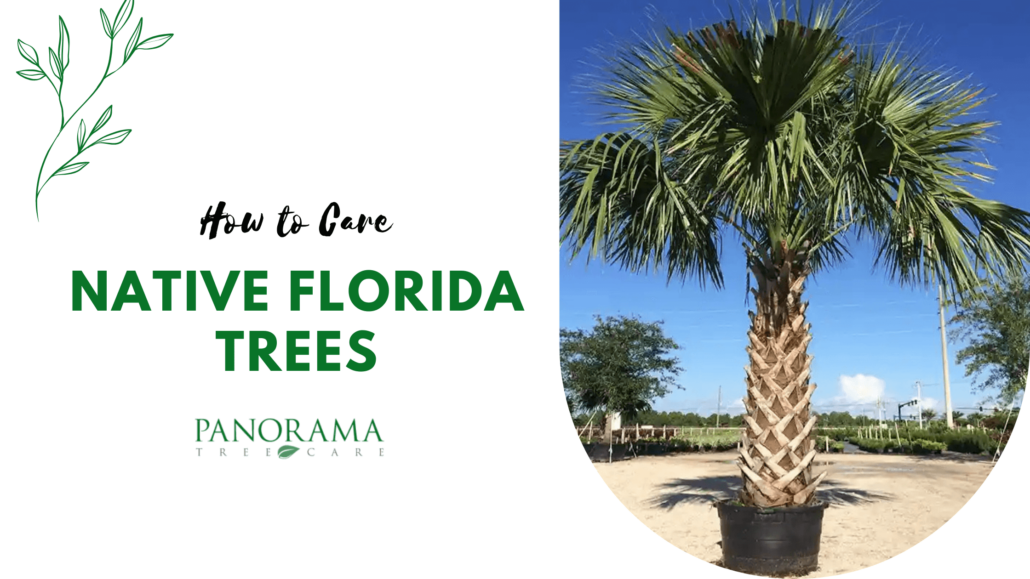
TL;DR: If you live in the area and you’re planning for the long haul, native Florida trees are almost always the smartest move. They handle our heat, humidity, sandy soils, and storms with far less drama, usually need less water and fertilizer, and support local wildlife.
The key is transplanting native species into the right spot in your yard and planting them correctly from day one.
Key Takeaways
- Top native trees for Florida include Live Oak, Southern Magnolia, Bald Cypress, Sabal Palm, Red Maple, Slash Pine, Sweetgum, and Dahoon Holly.
- Florida’s planting climate is USDA Zone 9b–10a with hot, humid summers, sandy soils, intense sun, heavy summer downpours, and occasional winter frosts.
- Natives typically need less irrigation, fertilizer, and pest control than non-native trees once established, as long as they’re matched to site conditions.
- Live Oak and Sabal Palm rank among the best native trees for hurricane wind resistance and long-term storm performance.
- For sandy soils, Slash Pine, Live Oak, Sabal Palm, and Bald Cypress perform exceptionally well; Red Maple does well with consistent moisture or irrigation.
- Correct planting—root flare at grade, a wide planting hole, and 1–2 years of regular watering—is critical in the Florida climate and makes or breaks tree survival.
- The Florida-Friendly Landscaping program and UF IFAS Extension recommend many of these species for urban and residential landscapes in the region.
- Panorama Tree Care offers native planting services guided by certified arborists to maximize long-term health, safety, and storm resilience.
What Are Native Florida Trees?
Native Florida trees are species that evolved in Florida’s natural ecosystems and arrived here without human help. They’re part of the original plant communities that were growing in the area long before neighborhoods, interstates, and shopping centers showed up.
In Florida, which sits in USDA hardiness zones 9b–10a, native trees like Live Oak, Sabal Palm, Bald Cypress, and Southern Magnolia are built for our specific mix of:
- Brutal summer heat and humidity
- Fast-draining, sandy soils
- Seasonal heavy rains and dry spells
- Periodic tropical storms and hurricanes
Because these species are already tuned to these conditions, they usually outperform non-native ornamentals in the long run and need far less coddling once they’re established.
Why Plant Native Trees in Florida? (5 Benefits Over Non-Native)
Folks often get drawn to showy, imported trees they saw on vacation or at a big-box garden center. They look great in the pot, but five years later they’re crispy, pest-ridden, or leaning after every storm. Native trees tend to avoid that story.
In Florida landscapes, natives generally:
- Use less water once established
- Handle local pests and diseases better
- Feed and shelter native birds and pollinators
- Stand up to tropical storms more reliably
- Help your yard qualify for Florida-Friendly Landscaping incentives and some local rebate programs
1. Lower Water Needs in a Hot, Sandy Climate
Florida’s growing conditions are a bit of a roller coaster. You’re dealing with:
- USDA zone: 9b–10a
- Average annual rainfall: roughly 50–55 inches, mostly stacked into the June–September wet season
- Soil type: predominantly sandy and quick-draining, often low in organic matter
- Summer heat index: often 95–105°F in July–August, with nights that don’t cool off much
In practice, that means lots of water in a short window, then weeks where everything dries out. Native trees that evolved in this pattern, like Live Oak and Slash Pine, are wired to ride those ups and downs.
Once they’ve had a year or two to get established, many natives only need supplemental water during extended droughts. That reduces your irrigation bill, takes pressure off municipal water systems, and avoids the root-rot issues that show up when people drown non-native trees trying to keep them alive.
2. Natural Pest and Disease Resistance
I see this all the time: someone plants an exotic tree that looks great in photos from California or Asia, and within a couple of seasons it’s a magnet for scale, borers, or leaf spots. Native trees still get pests, but they’ve had a long time to adapt to local insects and pathogens.
Because native species evolved alongside Florida’s bugs, fungi, and bacteria, they usually have better baseline resistance — see native tree disease resistance for the common issues to watch for. That means fewer outbreaks, slower spread of damage, and less need for chemical sprays if they’re planted correctly and not over-stressed.
UF IFAS Extension backs this up. Their recommended list focuses on trees that grow well in Florida landscapes with minimal chemical intervention, as long as site selection and basic care are on point.
For actual diagnosis and treatment of specific problems, you’ll want a dedicated tree health resource or a certified arborist, since this guide is about choosing and planting strong trees from the start.
3. Wildlife Habitat & Native Pollinator Support
If you like seeing birds, butterflies, and beneficial insects in your yard, native trees do more for you in a single planting than a row of foreign ornamentals ever will.
They provide:
- Food: Live Oaks crank out acorns for squirrels and many bird species. Slash Pine produces seeds that feed wildlife. Dahoon Holly’s red berries are winter food for birds. Southern Magnolia flowers offer nectar to pollinators.
- Shelter and nesting: Mature Live Oaks, pines, and hollies all give cover and nesting cavities for songbirds, owls, and small mammals.
- Pollinator support: Native bees and butterflies are synced to the bloom timing and structure of native trees. Foreign ornamentals often miss that timing or don’t offer the right kind of nectar or pollen.
Planting even a few native Florida trees turns a sterile lawn into a functioning mini-ecosystem. You’ll notice the difference in bird and insect activity within a season or two.
4. Better Hurricane Wind Resistance
Plenty of trees look good in calm weather. The real test in Florida is what they look like after a Category 1 or 2 pushes through. Some species bend and bounce back. Others snap like toothpicks or uproot because their root systems weren’t meant for this climate.
Many native trees are naturally better suited for Florida storms because of traits like:
- Root system depth & spread: Live Oaks develop a wide, massive root plate that grips sandy soil and holds firm during high winds.
- Wood density: Denser woods, such as those in Live Oak and Southern Magnolia, are harder to snap than fast-grown, brittle exotics.
- Crown structure: Trees with lower, broader crowns and flexible branches shed wind instead of catching it like a sail.
Starting with native hurricane resistant species often means fewer emergency calls to tree crews, less roof damage, and fewer expensive removals after big storms.
5. Florida-Friendly Landscaping & Possible Rebates
The state-backed Florida-Friendly Landscaping program, run with UF IFAS Extension, is basically a blueprint for yards that use less water and fewer chemicals and still look good. Native trees are a major part of that picture.
By installing recommended natives, you can often:
- Qualify for certain local water conservation rebates and incentives, depending on your city or utility provider.
- Cut back on fertilizer and pesticides, which helps protect Florida’s waterways from nutrient runoff and contamination.
- Stay within HOA and municipal landscape requirements more easily, since Florida-Friendly Landscaping is increasingly referenced in local codes.
If you want to understand the broader tree planting benefits beyond just natives in Florida, there are dedicated resources that walk through energy savings, property value, and air quality benefits in more detail.
Florida Native Tree Species Guide (Profiles with Care Instructions)
Below are some of the best-performing native trees for Florida yards within USDA hardiness zones 9b–10a. These are species I see over and over again holding up well in real neighborhoods, not just in brochures.
Each profile covers mature size, growth rate, soil preferences, maintenance level, and where that tree really shines in a residential landscape.
Live Oak (Quercus virginiana)
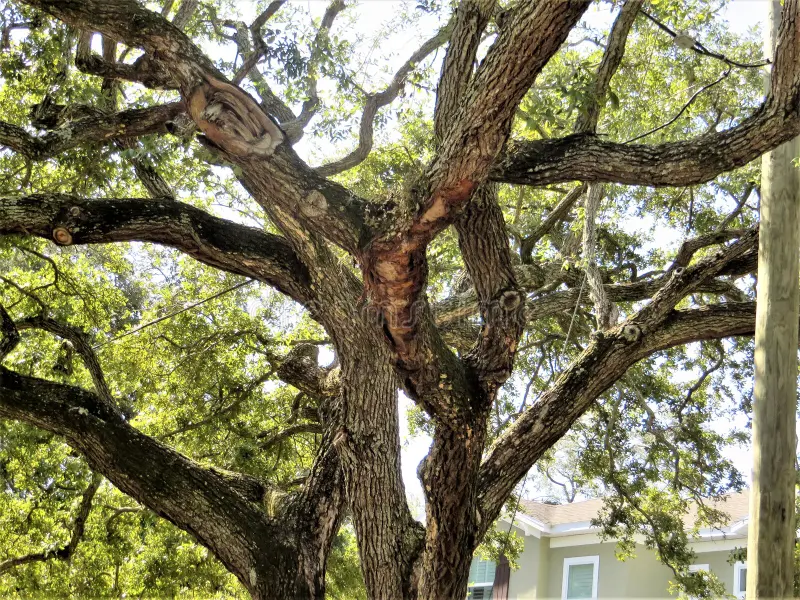
Overview: If you picture a giant spreading oak with big limbs draped in Spanish moss, that’s Live Oak. It’s the classic, long-lived shade tree in the South and one of the best native trees for a Florida yard, as long as you respect its size.
- Mature height: 40–80 feet
- Canopy spread: 60–100+ feet, often wider than it is tall
- Growth rate: slow to moderate, faster when young under good conditions
- USDA zone: 7–10, right in the sweet spot for Florida
- Wind resistance: top tier when structurally pruned and not overfilled or topped
- Florida soil suitability: thrives in sandy or loamy, well-drained soils; tolerates some drought and light salt once established
Best use: Large shade tree for generous front or back yards, centerpiece in spacious landscapes, and as a street or park tree where there’s no overhead wire conflict. In older neighborhoods, healthy Live Oaks are usually the backbone of the canopy.
Soil & water: Prefers moderately well-drained soils but does just fine in typical Florida sands without much fuss. Once established, irrigation needs drop way off, and overwatering can actually do more harm than good.
Maintenance level: Moderate. It needs proper structural pruning early on to build strong, well-spaced limbs and to manage clearance over roofs and driveways. Expect acorn drop and small leaf litter. Spanish moss is mostly cosmetic and not something to panic about unless it’s extreme.
Expert tip: Give this tree room. Don’t plant Live Oaks within 20–30 feet of houses, driveways, or pools. The canopy spread at maturity is massive, and the root system wants to spread too. Think decades ahead, not just how it looks coming out of the nursery pot.
Southern Magnolia (Magnolia grandiflora)
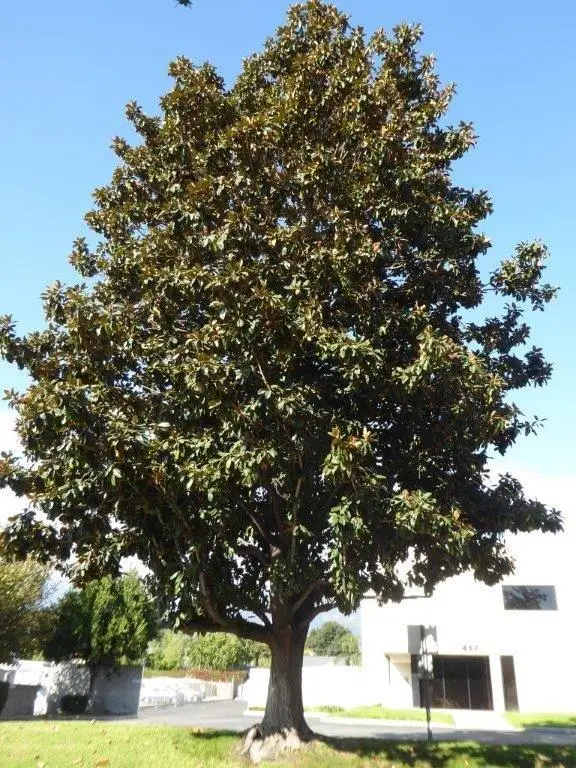
Overview: Southern Magnolia is that dark, glossy-leaved evergreen with huge, fragrant white flowers that almost look fake. It pulls double duty as a shade tree and a high-impact ornamental native flowering tree.
- Mature height: 40–70 feet, depending on cultivar
- Canopy spread: about 30–50 feet with a dense, pyramidal form
- Evergreen: yes, but it sheds older leaves and seed pods all year
- Flower season: heavy bloom in late spring through early summer, with scattered flowers beyond that
- Growth rate: moderate
Best use: As a specimen tree where you want a focal point, near entryways or patios with enough room, or in a line for screening in larger yards. It can anchor a front yard by itself.
Soil & water: Likes slightly acidic, well-drained soils. It handles typical Florida sandy soils if you boost organic matter with mulch and keep a reasonably consistent water supply, especially in the first few years.
Maintenance level: Moderate to high, mainly because of the leaf and cone litter. The leaves are tough and don’t break down quickly, so they’re not ideal over pools, small patios, or tight courtyards unless you’re okay with regular cleanup.
Expert tip: Look at compact cultivars if your yard is smaller. Keep a wide mulch bed around the dripline and avoid heavy foot traffic over roots. Southern Magnolias don’t tolerate constant root compaction or aggressive root cutting along driveways very well.
Bald Cypress (Taxodium distichum)
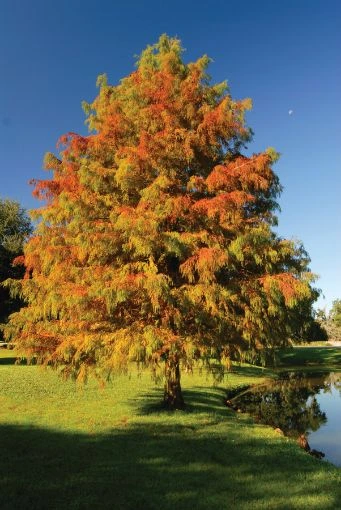
Overview: Bald Cypress is a Florida wetland classic. It’s a deciduous conifer, so it looks like a pine or cedar but drops its needles in winter. People assume it only belongs in swamps, but it’s surprisingly adaptable to many Florida urban sites.
- Mature height: 50–70+ feet
- Flood tolerance: excellent, often grows in standing water or on the edge of ponds and streams
- Deciduous: yes, needles turn rust-orange to brown and fall in late fall or early winter
- Growth rate: moderate in most residential situations
- Florida planting location: great for low sites, pond edges, stormwater retention areas, and swales
- Root knee formation: yes, especially in consistently saturated soils
Best use: As an accent near water features, in retention areas, or in naturalistic back corners that see occasional flooding. It brings a very “old Florida” look to a property.
Soil & water: It can grow in anything from mucky, flooded soils to moist sands. It’s less happy way up on dry, exposed, pure sand where it gets no supplemental water. If you want Bald Cypress in a higher, drier yard, some irrigation goes a long way.
Maintenance level: Low to moderate. You’ll get needle and small cone drop seasonally. The biggest issue is those “knees.” In constantly wet turf, they often pop up and become an obstacle for mowers or trip hazards along walkways.
Expert tip: If you’re nervous about knees in the lawn, offset the Bald Cypress a little farther from manicured turf and closer to a pond edge, ditch, or bed that you can mulch instead of mow.
Sabal Palm (Sabal palmetto)
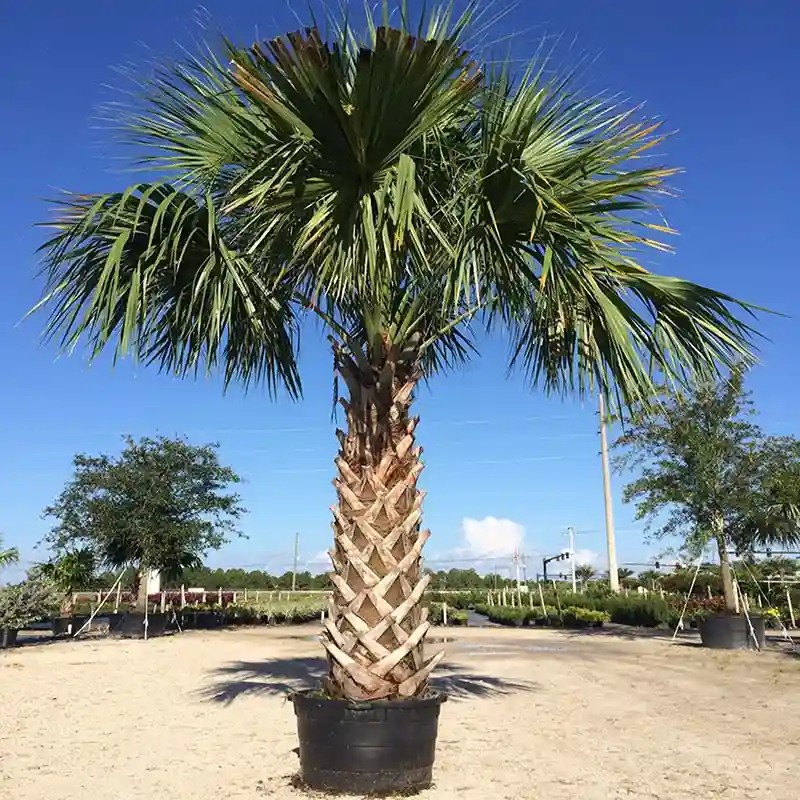
Overview: Sabal Palm is the state tree of Florida for good reason. It’s tough, iconic, and one of the most hurricane-resilient native trees available. You see them lining older streets for decades with barely a hiccup after storms.
- Mature height: 40–60 feet
- Salt tolerance: high, suitable for coastal and bayside locations
- Hurricane resistance: top tier, extremely wind-tolerant
- Maintenance level: low once it’s established
- Protected status in Florida: yes, wild collection is regulated in many areas
- State tree: yes, official state tree of Florida
Best use: Coastal and near-coastal landscapes, driveway and entry accents, group plantings, and mixed native beds. Because it grows upright, it’s also a good option for narrow side yards where you want height but not a huge spread.
Soil & water: Very forgiving. It does well in poor, sandy soils, tolerates drought once established, and handles salt spray within about 0–1 mile of the coast. It’s a natural fit for low-input, Florida-Friendly plantings.
Maintenance level: Low. Don’t let anyone talk you into “hurricane cuts” that strip off healthy fronds and leave a skinny tuft. That makes the palm weaker, not stronger. Only remove brown, dead fronds and flower or seed stalks if you don’t like the mess.
Expert tip: Transplanting Sabal Palms is specialized work. They usually arrive without a big root ball like a standard tree. Make sure experienced crews handle them, with proper watering during the long re-establishment period, or they’ll decline slowly over a year or two.
Red Maple (Acer rubrum)
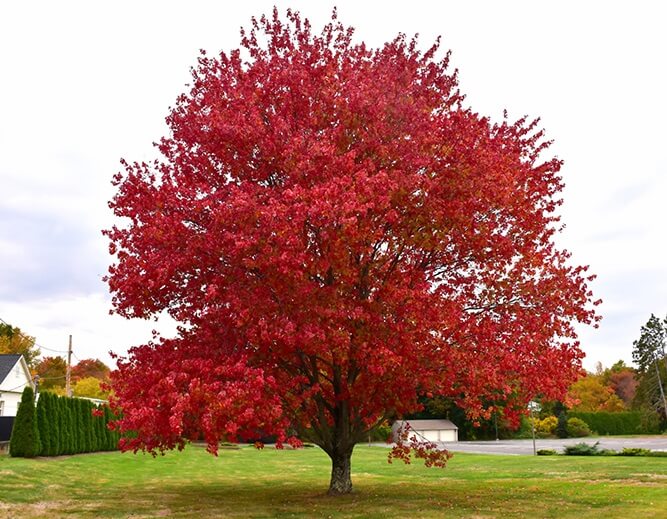
Overview: Red Maple gives you something Florida doesn’t naturally have much of: real fall color. It’s a native tree that can turn shades of red and orange, which makes it a popular ornamental choice for folks who miss northern autumns.
- Mature height: 40–60 feet
- Growth rate: moderate to fast with good moisture and soil
- Soil moisture: prefers moist to wet soils, and doesn’t like to dry out for long
- Soil pH tolerance: best in slightly acidic soils; struggles in very alkaline, fill-type sands
Best use: Shade tree for irrigated yards, rain gardens, or spots that naturally stay moist. It’s great near swales, downspouts, and areas that collect runoff where other species might complain.
Soil & water: In Florida, Red Maple really shines when it has reliable moisture. On dry, white sand with no irrigation, it often declines. If your site is on the dry side, either commit to a regular watering plan or pick another species.
Maintenance level: Moderate. It can push surface roots that lift sidewalks or make mowing bumpy. It also benefits from early structural pruning so branches attach strongly and are well spaced as it grows quickly.
Expert tip: Position Red Maple where roof runoff, driveway drainage, or AC condensate lines already bring water. That way, you’re using “free” moisture to keep it happy instead of running irrigation constantly.
Slash Pine (Pinus elliottii)
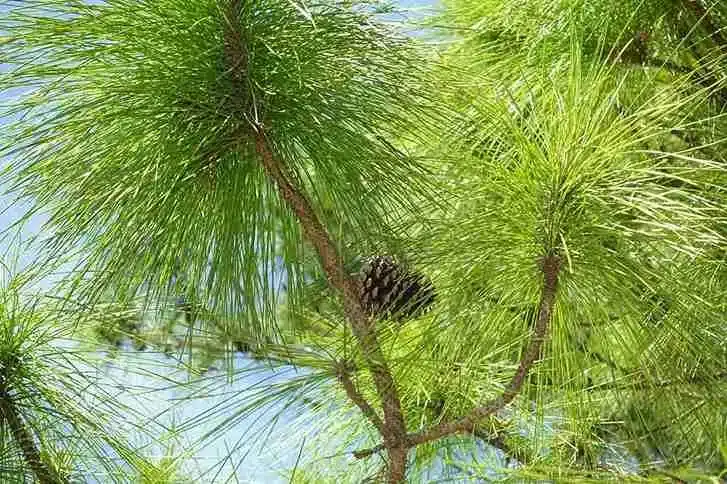
Overview: Slash Pine is a tall, straight native pine that feels right at home in Florida’s sandy soils. It brings vertical height, a classic pine look, and good wildlife value without demanding rich soil.
- Mature height: 60–80 feet
- Growth rate: moderate to fast, especially in well-drained sands
- Soil tolerance: very good in sandy, low-nutrient soils
Best use: Naturalistic or woodland-style plantings, informal windbreaks, wildlife gardens, and large backyards where needle and cone drop is not a frustration. It pairs nicely with Live Oak and native understory shrubs.
Soil & water: Thrives in well-drained, sandy soils and is content with fairly low fertility. Once established, Slash Pine is relatively drought-tolerant and doesn’t want wet feet for long periods.
Maintenance level: Low. Expect regular needle and cone drop, and occasional limb shedding. Poorly rooted or trees in chronically saturated soils can be more vulnerable to windthrow, so avoid planting in wet spots or compacted fill where roots can’t anchor well.
Sweetgum (Liquidambar styraciflua)
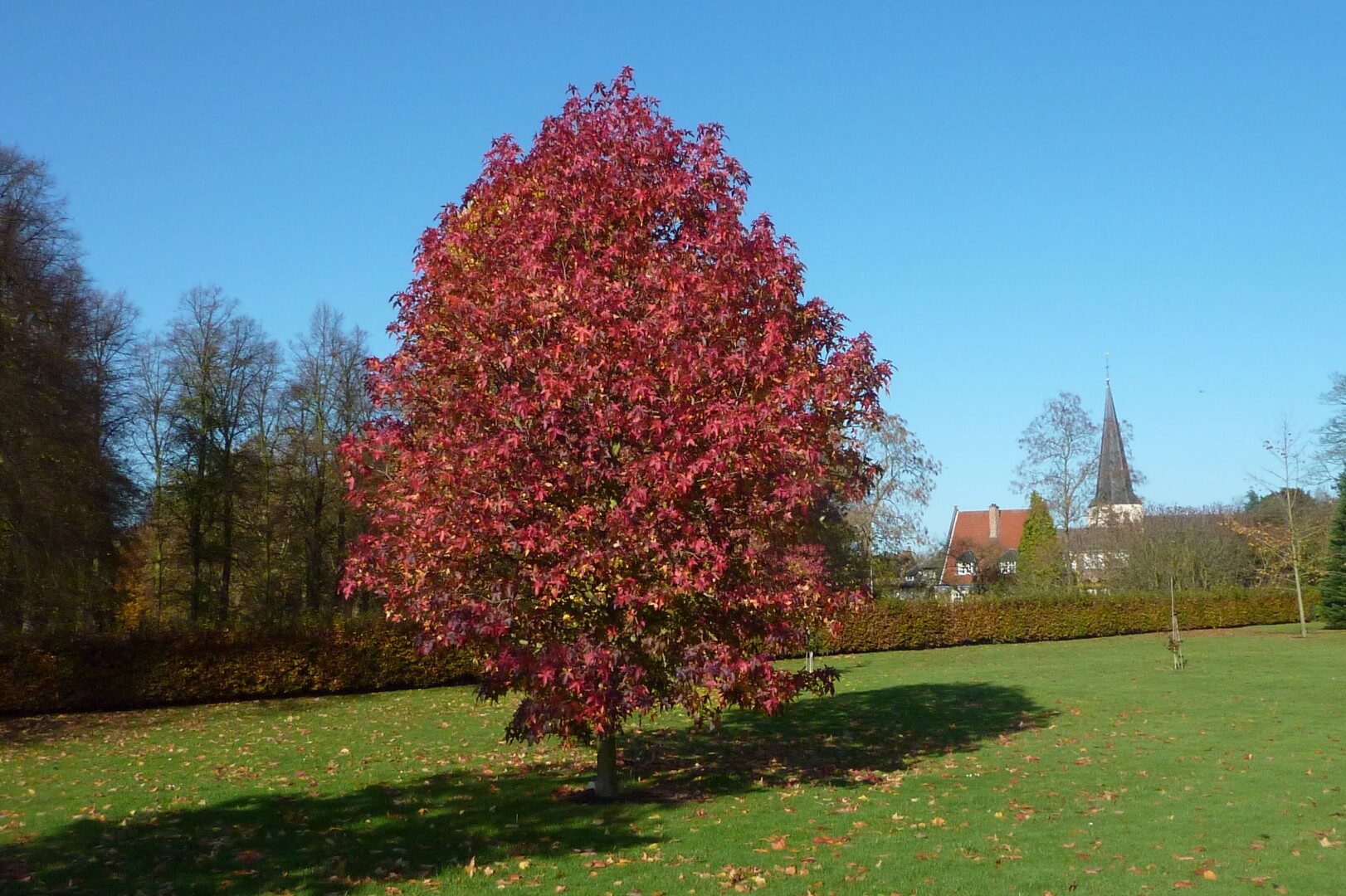
Overview: Sweetgum is a tall, native hardwood with star-shaped leaves and some of the better fall color you can get around here. It has a more “wild” look that fits larger or more natural landscapes better than tight, formal yards.
- Mature height: 60–80 feet
- Growth rate: moderate
- Soil preference: moist, well-drained soils, and it can tolerate some seasonal flooding
Best use: Larger properties, back corners of yards, wildlife plantings, and areas where you want shade and don’t mind natural litter. It’s not ideal right over patios or in small front lawns.
Soil & water: Does best with consistent moisture and decent soil. On hot, exposed, very dry sand with no irrigation, Sweetgum tends to stress and thin out, which makes it more prone to pests and breakage.
Maintenance level: Moderate. The spiky seed “gumballs” are the main complaint. They can be a nuisance on sidewalks, driveways, and lawns where people walk barefoot.
Expert tip: Put Sweetgum where you can let the gumballs fall into mulch or groundcover. Back edges of the property, natural areas, or underplanted beds work far better than a high-traffic front yard.
Dahoon Holly (Ilex cassine)
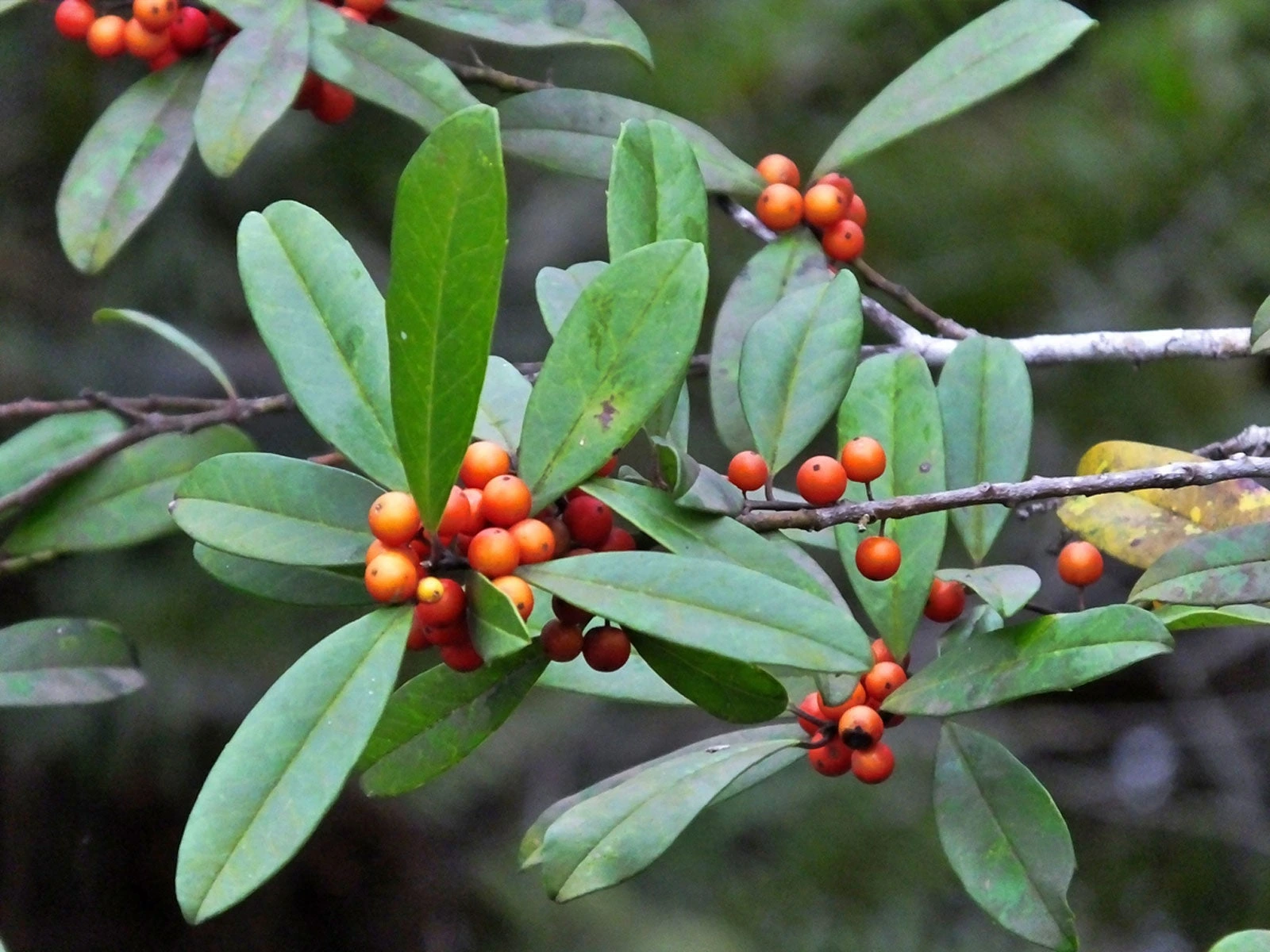
Overview: Dahoon Holly is a medium-sized native evergreen tree or large shrub with clean, narrow foliage and bright red berries on female plants. It brings color and wildlife value without overwhelming a small yard.
- Mature height: 20–30 feet
- Growth rate: moderate
- Soil preference: moist, acidic soils; tolerates periodic flooding and damp areas
Best use: Screening along property lines, small-yard shade, accent trees near ponds or low spots, and habitat plantings to support birds and pollinators. It works well where a Live Oak would simply be too big.
Soil & water: Dahoon Holly likes moisture, but in Florida it will still perform in regular sandy soils if you give it some irrigation. Around ponds, swales, or the low side of your lot, it usually thrives.
Maintenance level: Low to moderate. It needs occasional pruning to shape or keep it within bounds. Female plants produce berries, but you need at least one male in the area for good fruit set.
Expert tip: Choose named cultivars when possible so you know if you’re getting a male or female and how large it’s likely to get. Keep it a bit away from light-colored concrete if you’re worried about berry stains where they fall.
For a broader overview beyond Florida-specific natives and into other Florida regions or additional species, see this companion guide:
Best Native Trees for Florida Sandy Soil
Florida’s default soil is sand. Sometimes it’s clean white sand, sometimes it’s construction fill, and sometimes you get pockets of better loamy material. Either way, trees have to adapt to fast drainage and low organic matter.
In these conditions, Slash Pine, Live Oak, Sabal Palm, and Bald Cypress really shine. Red Maple can do well too, but only if you keep moisture levels up. Planting methods matter just as much as species. If you plant a great tree too deep in sand or backfill with potting soil, you’ll still have trouble.
Top Performers in Sandy Soils
- Slash Pine (Pinus elliottii) – Excellent tolerance
- Thrives in poor, sandy, low-nutrient soils that frustrate many non-native trees.
- Good choice for dry, exposed sites with full sun and minimal irrigation.
- Live Oak (Quercus virginiana) – Excellent tolerance
- Develops a deep, widespread root system that locks into sand and resists uprooting.
- Handles typical urban fill soils surprisingly well when planted at proper depth and not overwatered.
- Sabal Palm (Sabal palmetto) – Excellent tolerance
- Extremely well-adapted to coastal sands, low fertility, and salt spray.
- Fits naturally into xeric, Florida-Friendly landscapes that rely on rainfall more than irrigation.
- Bald Cypress (Taxodium distichum) – Excellent in wet sandy areas
- Ideal for low-lying sandy areas that stay moist or are periodically flooded.
- Less reliable on high, dry sands without supplemental irrigation, where it may thin out over time.
- Red Maple (Acer rubrum) – Good with irrigation
- Performs well in sandy soils that have some organic matter mixed in and consistent moisture.
- Best planted near rain gardens, swales, or zones with irrigation already planned.
Planting Depth & Root Zone Tips in Sand
In sandy soils, roots like to stay in the upper foot or two of soil where the water and nutrients are. If you bury the root flare or create a soft, rich “pot” in the planting hole, you’re setting the tree up for trouble later.
To give your tree a strong start in sand:
- Dig the hole 2× as wide as the root ball, but only as deep as the root ball itself, so the tree doesn’t settle too low.
- Find the root flare and keep it at or slightly above grade. If you can’t see the flare, remove excess soil or mulch from the top of the root ball until you do.
- Backfill with the existing native sand, not rich potting soil. You want roots to move out into surrounding soil, not circle inside a “planting pit” of different material.
- Apply 2–3 inches of mulch in a wide ring to keep roots cooler, slow evaporation, and add organic matter over time. Keep mulch pulled a few inches away from the trunk to avoid rot and insect issues.
Native Trees That Resist Florida Hurricanes Best
After every big storm, there are the same questions: “Why did that tree snap while the one beside it barely lost a branch?” Species choice and care history have a lot to do with it.
In Florida, Live Oak and Sabal Palm stand out as the most hurricane-resistant native trees. Southern Magnolia and Bald Cypress generally perform well too when they’re healthy and properly pruned.
Wind Resistance Ranking for Key Native Trees
- Live Oak (Quercus virginiana) – Top tier
- Develops a wide, deep root system that creates a very stable root plate in undisturbed soil.
- Dense wood and a relatively compact, low crown hold up under intense winds.
- Sabal Palm (Sabal palmetto) – Top tier
- Flexible trunk and fronds deflect wind instead of catching and holding it.
- History across Florida shows Sabal Palms often survive major hurricanes with minimal damage while other trees fail.
- Southern Magnolia – High
- Strong, relatively dense wood with good anchoring roots when grown well.
- Because it’s evergreen, foliage can catch wind, so structural pruning to thin and balance the crown is very helpful.
- Bald Cypress (Taxodium distichum) – High
- Native to floodplains, where it evolved with strong winds and wet soils.
- Flexible branches and fine-textured foliage allow wind to pass through, reducing breakage.
Why Some Native Trees Handle Hurricanes Better
Storm performance isn’t just the name of the species written on a tag. It’s the combination of the tree’s biology, where it’s planted, and how it’s been treated over the years.
- Root system depth & spread: Trees with broad, undisturbed root plates do far better than those in tiny planting pits, cut by trenching, or surrounded by compacted construction fill.
- Wood density: Dense, slower-grown wood like Live Oak doesn’t snap as easily as fast-grown, brittle wood typical of some non-native ornamentals.
- Crown structure: Thinned, well-structured crowns that let wind move through are safer than dense, lopsided canopies. Proper pruning builds this over time.
- Maintenance history: Regular structural pruning by a certified arborist, combined with no topping and no severe lion-tailing, dramatically improves wind resistance.
For detailed storm preparation, pruning timing, and emergency planning, check a dedicated hurricane prep guide focused on tree care in Florida’s coastal zones.
How to Plant and Establish a Native Tree in Florida
Most tree failures I see in Florida start with mistakes on planting day. Wrong depth, tiny holes, no watering plan, or the wrong spot for that species. Get those early steps right, and most native trees reward you with decades of relatively low-maintenance growth.
A good planting plan in Florida boils down to smart site selection, a wide planting hole, correct depth with the root flare at grade, a watering schedule that fits our climate, and steady care for the first 1–2 years.
Step 1: Choose the Right Site
Before you ever touch a shovel, walk the yard and think 10–20 years ahead. Ask yourself:
- Space at maturity: How tall and wide will this tree be? Make sure it won’t end up in power lines, scraping your roof, or tearing up a driveway.
- Sun exposure: Most native shade trees want full sun, about 6 or more hours a day. A Live Oak stuck in constant shade between tall houses will struggle.
- Soil moisture: Is this an upland, dry sandy spot or a low, damp area? Live Oak, Slash Pine, and Sabal Palm are better on higher, drier spots. Bald Cypress, Dahoon Holly, and carefully placed Red Maple are good fits in wetter zones.
- Salt exposure: Within roughly 0–1 mile of the bay or Gulf, salt spray starts to matter. Sabal Palm and Live Oak handle that much better than many other trees.
Step 2: Prepare the Planting Hole
- Measure the height and width of the root ball. Dig the hole 2–3 times as wide as that ball, but no deeper than the ball’s height so the tree won’t sink later.
- Roughen or loosen the sides of the hole so roots don’t hit a “glazed” wall and start circling.
- Skip the urge to fill the hole with bagged potting soil. Backfill with your native soil. The tree must adapt to the yard’s actual conditions, not a pocket of artificial mix.
Step 3: Set Tree and Backfill at Correct Depth
- Locate the root flare, the point where the trunk widens and the first main roots start. On many nursery trees, this can be buried under excess soil or mulch in the container.
- Set the tree so that root flare sits at or slightly above the surrounding finished grade. Planting too deep is one of the most common causes of slow decline.
- Backfill with native soil in lifts, gently firming each layer to remove large air pockets. Don’t stomp aggressively and compact the soil into a brick.
Step 4: Watering Schedule for Florida’s Climate
Florida’s mix of brutal sun, daily summer storms, and long dry spells means new trees live or die by their water schedule. For the first 1–2 years, you’re training roots to grow out and down, not stay in the original root ball.
- Weeks 1–4: Water 2–3 times per week, soaking the root ball and the surrounding soil thoroughly each time.
- Months 2–6: During the dry season, water 1–2 times per week. In the rainy season, cut back or turn off irrigation when regular storms keep the soil moist.
- Months 7–24: As the tree establishes, shift to deeper, less frequent watering, about every 10–14 days during dry periods, to encourage deeper rooting.
Always adjust based on the weather. Check moisture 4–6 inches down. It should be cool and damp, not muddy and not powder-dry. Constant saturation is only appropriate for true wetland species like Bald Cypress planted in low, wet areas.
Step 5: Mulch Ring & Staking (If Needed)
- Spread a 2–3 inch mulch layer in a ring at least 2–3 feet beyond the root ball. Wider is better if you can manage it.
- Keep mulch pulled back several inches from the trunk to prevent bark rot and avoid creating a habitat for insects right at the base.
- Stake the tree only if it’s unstable, top-heavy, or in an exposed, windy location. Use flexible ties and remove stakes within 6–12 months so the trunk can strengthen on its own.
Step 6: Establishment Period
Most native Florida trees need about 1–2 years before you can truly call them established. That period is where they’re most vulnerable.
- Keep up with regular watering according to weather, being careful not to overdo it.
- Limit pruning to light corrective work, removing broken, rubbing, or poorly attached branches. Save major pruning for later once the tree is settled.
- Watch for pest issues, lawn equipment damage around the trunk, and signs of stress like wilting, leaf scorch, or premature drop.
If you’re not sure about a planting site or how to handle a specific tree, tapping into certified arborist planting advice can save you from expensive mistakes down the road.
Native Tree Maintenance Calendar for Florida
Tree care in Florida isn’t a set-it-and-forget-it situation, but it’s not a full-time job either, especially with natives. You just need to time your tasks with our subtropical seasons instead of a northern calendar.
A good schedule uses spring and early fall for light fertilization if needed, reserves heavier pruning for the cooler months, adjusts irrigation based on rainfall, and treats hurricane prep as a regular yearly routine, not a last-minute scramble.
January–February (Cool, Drier Months; Frost Risk)
- Frost risk months: December–February. Tender young natives or borderline species may need frost cloth or other protection if a hard freeze is predicted.
- Use this window for structural pruning on mature trees, ideally outside peak nesting season. Cooler weather puts less stress on trees.
- Cut out dead, diseased, or crossing branches to improve airflow and reduce future breakage.
- Check mulch depth and add more if it’s thinned, keeping that gap around trunks clear.
March–April (Warming Up, Growth Resumes)
- Apply a light, slow-release fertilizer in March if your soil tests or UF IFAS recommendations call for it — see our feeding native evergreens guide for specifics. Many established natives in decent soil won’t need any at all.
- Start scouting for early-season pests and fungus as new growth flushes out.
- Begin increasing irrigation for newly planted trees as temperatures rise and days get longer, especially if spring is dry.
May–August (Hot, Humid, Rainy Season)
- Summer heat index: often 95–105°F. Young trees can dry out fast between storms, so keep a close eye on the soil.
- In periods of daily or frequent rain, dial back or shut off irrigation zones to avoid constant saturation.
- Limit pruning to minor corrective cuts. Heavy pruning in peak heat can stress trees and invite pests or disease.
- Start hurricane prep early in this window by booking professional pruning or structural work before everyone gets slammed with last-minute requests.
September–October (Hurricane Season Peak, Early Fall)
- Apply a second light fertilizer dose in early September if appropriate for the species and soil. Don’t overdo late-season nitrogen, which can push weak new growth.
- Inspect crowns for deadwood, cracked limbs, and large, overextended branches that could fail in a storm.
- Have a certified arborist remove or shorten weak limbs using proper pruning cuts rather than topping or butchering crowns.
November–December (Cooler, Drier Transition)
- Reduce irrigation as temperatures drop and storms ease off. Many established natives may not need supplemental water at all this time of year.
- Plan any major structural pruning for late fall through mid-winter when trees are under less heat stress and some species are semi-dormant.
- Monitor forecasts for cold snaps, especially if you’ve added more tender native ornamentals or fruiting species to the mix.
Year-round, keep in mind that established native trees often suffer more from over-helping than neglect. Over-fertilizing and over-watering are two of the most common ways people unintentionally stress otherwise tough native trees.
Florida Native Tree EAV Data Table
The table below summarizes key attributes for some of the main native Florida trees and Florida climate factors. Use it as a quick reference when comparing species for your specific site conditions.
| Entity | Attribute | Value (Typical for Florida) |
|---|---|---|
| Live Oak (Quercus virginiana) | Mature height | 40–80 feet |
| Live Oak (Quercus virginiana) | Canopy spread | 60–100+ feet |
| Live Oak (Quercus virginiana) | Growth rate | Slow to moderate |
| Live Oak (Quercus virginiana) | USDA zone | 7–10 (ideal in 9b–10a) |
| Live Oak (Quercus virginiana) | Wind resistance | Top tier |
| Live Oak (Quercus virginiana) | Florida soil suitability | Excellent in sandy, well-drained soils |
| Sabal Palm (Sabal palmetto) | Mature height | 40–60 feet |
| Sabal Palm (Sabal palmetto) | Salt tolerance | High |
| Sabal Palm (Sabal palmetto) | Hurricane resistance | Top tier |
| Sabal Palm (Sabal palmetto) | Maintenance level | Low |
| Sabal Palm (Sabal palmetto) | Protected status Florida | Yes (regulated wild collection) |
| Sabal Palm (Sabal palmetto) | State tree | Yes |
| Bald Cypress (Taxodium distichum) | Mature height | 50–70+ feet |
| Bald Cypress (Taxodium distichum) | Flood tolerance | Excellent (handles standing water) |
| Bald Cypress (Taxodium distichum) | Deciduous | Yes |
| Bald Cypress (Taxodium distichum) | Growth rate | Moderate |
| Bald Cypress (Taxodium distichum) | Florida planting location | Wet areas, pond edges, low spots |
| Bald Cypress (Taxodium distichum) | Root knee formation | Yes, in persistently wet soils |
| Southern Magnolia | Mature height | 40–70 feet |
| Southern Magnolia | Canopy spread | 30–50 feet |
| Southern Magnolia | Evergreen | Yes |
| Southern Magnolia | Flower season | Late spring through summer |
| Southern Magnolia | Leaf drop management | Heavy; regular cleanup needed |
| Southern Magnolia | Growth rate | Moderate |
| Florida planting climate | USDA zone | 9b–10a |
| Florida planting climate | Average annual rainfall | ~50–55 inches |
| Florida planting climate | Soil type | Predominantly sandy |
| Florida planting climate | Summer heat index | ~95–105°F |
| Florida planting climate | Frost risk months | December–February |
| Florida planting climate | Salt spray zone distance from coast | Highest within 0–1 mile of coast |
Common Mistakes When Planting Native Florida Trees in Florida (and How to Fix Them)
I see the same problems across yards all over Florida. The good news is most of them are easy to avoid once you know what to look for.
Mistake 1: Planting the Right Tree in the Wrong Place
Problem: Big natives like Live Oak or Sweetgum crammed too close to houses, under power lines, or right against driveways. It looks fine for the first five years, then becomes a constant headache.
Fix: Always check the mature height and canopy spread before planting. On small lots, use smaller natives like Dahoon Holly or compact Southern Magnolia cultivars. If you don’t have room for a full-size Live Oak, don’t force it. Pick a tree that fits your site instead of planning to prune it into submission forever.
Mistake 2: Planting Too Deep in Sandy Soils
Problem: The root flare ends up buried below grade, which leads to trunk rot, girdling roots, and poor oxygen exchange in the root zone. The tree may look fine for a couple of years, then slowly decline.
Fix: Expose and identify the root flare on the nursery tree and set it right at or slightly above the final soil level. If your yard is low and prone to pooling water, raise the planting area with soil and mulch instead of sinking the tree deeper. High and proud is usually safer than too deep in our sandy soils.
Mistake 3: Over-Watering or Under-Watering During Establishment
Problem: New trees either sit in constant mud because sprinklers never turn off, or they get a quick splash every couple of weeks and dry out in between.
Fix: Use a consistent, deep watering schedule for the first 1–2 years, geared to weather. Soak deeply, then let the soil breathe before watering again. Check moisture 4–6 inches down with your hand or a small shovel. If it’s bone dry, you waited too long. If it smells sour and stays mushy, you’re drowning it.
Mistake 4: Over-Pruning or Topping for Hurricanes
Problem: Folks think “shorter is safer” and top their hardwoods or give Sabal Palms extreme “hurricane cuts” that gut the crown. That actually weakens the tree and makes it more likely to fail later.
Fix: Use proper structural pruning to manage branch spacing, reduce defects, and thin the canopy carefully. Only trained pros should be making big cuts on mature trees. Never top trees, and don’t strip palms down to a few upright fronds. Strong structure and good health beat drastic height reduction every time.
Mistake 5: Treating Natives Like High-Maintenance Exotics
Problem: Dumping heavy fertilizer and broad-spectrum pesticides on native trees that don’t need them. That can burn roots, push weak growth, and disrupt beneficial insects.
Fix: Follow Florida-Friendly Landscaping guidelines and UF IFAS recommendations. Use fertilizer only when there’s a documented need, and choose slow-release products. Focus your effort on choosing native species that match your site, so you don’t have to fight nature with a chemical program just to keep them alive.
FAQ: Native Florida Trees
Here are answers to some of the questions I hear most from Florida homeowners about native Florida trees, from small-yard options to salt tolerance and where to find reliable plant material.
What is the best native tree for a small Florida yard?
Dahoon Holly is one of the best all-around natives for tight spaces. It tops out around 20–30 feet with a fairly narrow canopy, stays evergreen, and offers berries for wildlife. It gives you shade and privacy without overwhelming the yard.
Compact Southern Magnolia cultivars can also work in small or medium yards, especially if you maintain a good mulch bed underneath instead of turf. A carefully placed, well-pruned Red Maple can fit too, as long as you plan for its moisture needs and keep it away from power lines and foundations.
What is the fastest-growing native tree for shade in Florida?
Red Maple and Slash Pine are among the faster-growing native trees in our area. Under decent soil and moisture, they can throw meaningful shade within several years.
Just remember that rapid growth isn’t always a free win. Fast growth can mean softer wood and higher breakage risk if you ignore structural pruning. Build in some early pruning to shape the tree and reduce future storm problems.
Which native trees are most salt-tolerant near the coast?
Sabal Palm is one of the most salt-tolerant native trees you can plant, so it’s a go-to for near-coastal and bayside yards. Live Oak also holds up well to moderate salt spray and mildly saline soils, which makes the two of them a solid one-two punch in the 0–1 mile coastal salt spray zone.
Are there any native fruit trees I can grow in Florida?
Yes. While this guide focuses mostly on shade and ornamental natives, Florida can also support native or Florida-native-friendly fruiting trees and shrubs, such as certain persimmon species and a few others suited to our climate.
For a more complete rundown of options beyond this shade and structure-focused list, see a dedicated guide to Florida-native or Florida-adapted fruit trees that covers chilling requirements, disease resistance, and site selection.
Where can I buy native trees in Florida?
Look for reputable local nurseries that specialize in Florida natives or clearly mark plants as native and appropriate for Zone 9b–10a. Many garden centers tied into the Florida-Friendly Landscaping program also stock the species mentioned here.
If you’d rather not play guessing games on sourcing and placement, working with a professional service like Panorama Tree Care lets you lean on certified arborists for species selection, proper handling, and planting tailored to your property.
Contact Panorama Tree Care in Florida for a free assessment and estimate.
Do native trees really need less maintenance than non-natives?
In most Florida yards, yes. Once they’re established, native trees that are matched to the right site typically need far less irrigation, fertilizer, and pest control than many exotic species. They’re built for this climate.
That said, they’re not maintenance-free. Correct planting, early structural pruning, and occasional health checks still matter if you want them to reach their full potential and handle storms well.
Can native trees help reduce my storm damage risk?
They absolutely can. Species like Live Oak and Sabal Palm have a long track record of surviving major storms in Florida when properly cared for. Combine hurricane-resistant native trees with smart placement and good pruning, and you can significantly cut your risk of wind damage compared to a yard full of vulnerable exotics.
Final Summary & Next Steps
Native Florida trees are the backbone of a strong, attractive, and resilient Florida landscape. By choosing species like Live Oak, Southern Magnolia, Bald Cypress, Sabal Palm, Red Maple, Slash Pine, Sweetgum, and Dahoon Holly, you’re working with the region’s natural rhythms instead of fighting them.
Match each tree’s mature size, soil and moisture preferences, and wind resistance to your specific site. Plant with the root flare at grade, dig wide rather than deep, use proper mulch, and follow a simple maintenance calendar that respects our USDA 9b–10a climate, sandy soils, and storm season. Do that, and you’ll end up with long-lasting shade, wildlife habitat, and curb appeal without constant inputs.
If you’d like expert help putting together a native tree plan tailored to your property, Panorama Tree Care offers native planting services guided by certified arborists so your Florida yard can thrive and stay safer through the storms for decades to come.