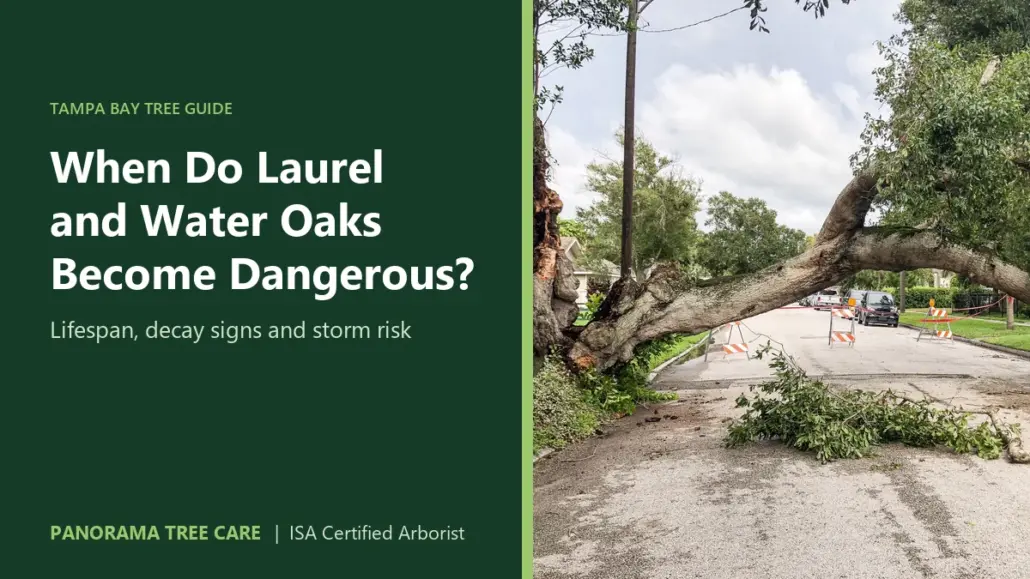
Laurel oak (Quercus laurifolia) typically lives about 50 to 70 years, while water oak (Quercus nigra) has a shorter lifespan of about 30 to 50 years. Both are fast-growing oaks with serious decay concerns as they age. See UF/IFAS Laurel Oak and UF/IFAS Water Oak.
A large older oak beside a Tampa Bay home is not automatically dangerous, but age, internal decay, weak branch unions and root problems can increase risk. Our arborists recommend looking at the tree’s condition before hurricane season instead of judging it by size or age alone.
Laurel Oak vs Water Oak vs Live Oak at a Glance
Laurel oak, water oak and live oak can all become large shade trees, but they differ greatly in lifespan, durability and wind resistance.
| Tree | Typical lifespan | Decay concern | Wind resistance |
|---|---|---|---|
| Laurel oak | About 50 to 70 years | Trunks and large branches often hollow from decay | Lowest (north FL), Medium-Low (south FL) |
| Water oak | About 30 to 50 years | Poor at sealing off decay; many hollow by about 40 years | Lowest |
| Live oak | Can live for centuries when well located and cared for | Much more durable | Highest |
Sources: UF/IFAS Laurel Oak, UF/IFAS Water Oak, UF/IFAS Southern Live Oak, and UF/IFAS Wind and Trees.
UF/IFAS places laurel oak in its lowest wind-resistance group for north Florida and its medium-low group for south Florida. Water oak is in the lowest group in both lists, so the regional distinction matters when reading these ratings for Tampa Bay.
After Hurricane Ivan (2004), recalculated survival was 98% for sand live oak, 81% for live oak, 66% for laurel oak and 65% for water oak. This measure counted trees that lost at least half their branches as dead. UF/IFAS FR174.
That does not mean every mature laurel oak or water oak will fail in a storm. It does mean a large older tree that can reach a house, driveway, pool area or other occupied space deserves closer attention as it matures.
How Long Do Laurel Oaks and Water Oaks Live?
The typical laurel oak lifespan is about 50 to 70 years. UF/IFAS notes that its trunk and large branches often hollow from decay and wood rot as the tree ages. UF/IFAS Laurel Oak
Water oak has a typical lifespan of about 30 to 50 years. It is poor at sealing off decay, and UF/IFAS notes that many water oaks are hollow by around 40 years old. UF/IFAS Water Oak
UF/IFAS describes both as fast growers with weaker wood and serious decay concerns as they age. A tree can still look full and green while important parts of the trunk or branch structure are becoming less sound.
Older Tampa Bay neighborhoods often have large oaks that are now mature, so it is worth checking the age and condition of any big oak near the house. The concern becomes more important when a mature tree has visible defects or could reach a home during storm season.
UF/IFAS says over-mature trees present a high risk to people and property and should be monitored regularly for structural defects. It also recommends inspecting older trees and low wind-resistance species, then removing and replacing high-risk trees when needed. Laurel oak and water oak appear on the lowest wind-resistance list for north Florida. UF/IFAS Wind and Trees
Early structural pruning can help a young oak develop a sound framework and avoid problems that shorten its useful life. For laurel oak, UF/IFAS recommends well-spaced major branches early in life. Good pruning cannot guarantee a particular lifespan or reverse decay that is already present.
Warning Signs of Internal Decay
Most tree decay is caused by fungi that break down wood. UF/IFAS lists visible warning signs such as conks and other fungal fruiting bodies, cavities, carpenter ants and animal nesting holes. These signs do not automatically mean a tree has to come down, but they are good reasons to have an arborist look more closely. UF/IFAS Tree Safety and Decay Guidance
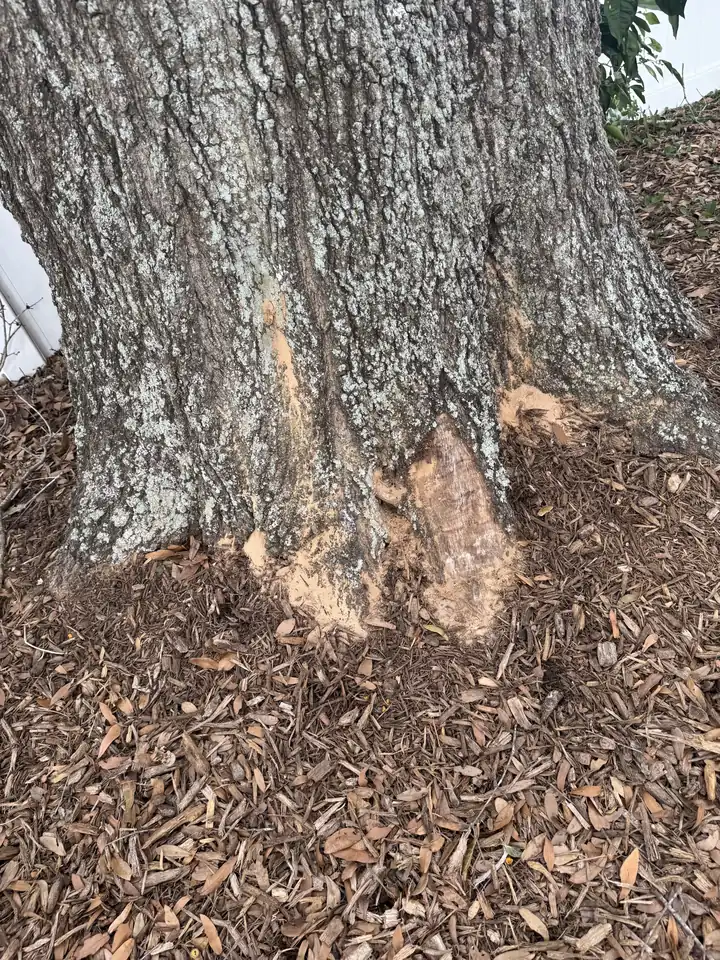
Fungal conks at the base or trunk
Conks are fungal fruiting bodies growing from wood. Because most tree decay is caused by fungi, conks on the trunk, near the base or around major roots can point to decay inside the tree.
For an older water oak or laurel oak, that sign matters because both species already have known problems with internal decay. The location of the fungal growth also matters because decay near the trunk base or major roots can affect support.
Cavities and hollow sounds
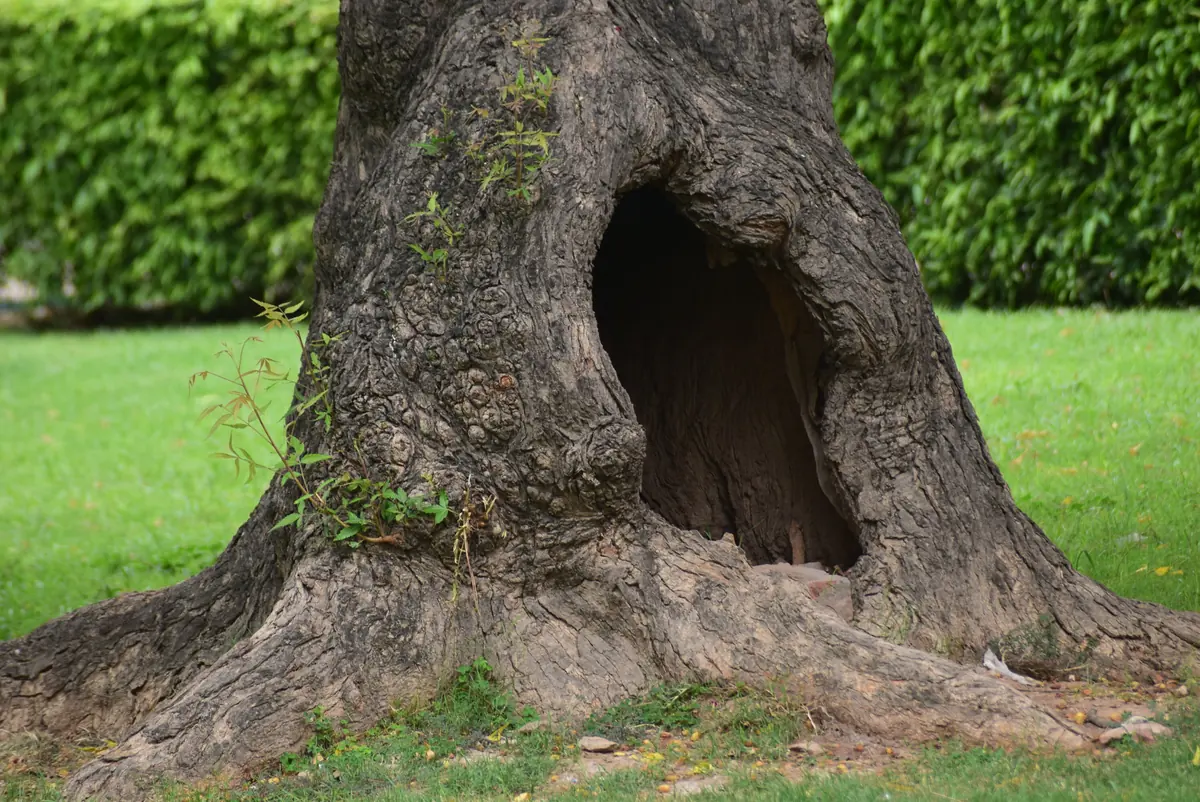
A cavity is an open hollow or decayed area in the trunk or a large branch. UF/IFAS notes that cavities can develop at old injuries or other openings where decay fungi entered the wood.
A hollow sound when the trunk is tapped can also make an arborist look more closely, but sound alone does not show how much solid wood remains. This is especially important with laurel oak and water oak because both can become hollow with age.
Dead upper crown
The crown is the upper part of the tree. Dead branches, thinning foliage or dieback near the top can be signs that a tree is under stress or that root and structural problems deserve closer inspection.
A dead upper crown does not tell us exactly what is happening inside the trunk. Our arborists look at it together with the trunk, major branches, roots and surrounding site.
Cracks and seams
Cracks and seams are lines, openings or splits in the trunk or major branches. UF/IFAS lists cracks and seams among signs that can suggest internal decay and weak points that may increase the chance of failure. UF/IFAS Wind and Trees
The location and size of a crack matter. A long opening through a major trunk or branch union deserves more attention than a harmless surface feature.
Included bark (tight V-shaped unions)
Included bark happens when bark becomes pressed between two stems growing together in a narrow V-shaped union. UF/IFAS says these narrow unions are more likely to fail than smoother U-shaped unions because the included bark weakens the connection.
The risk can sometimes be partly reduced with corrective work or a cable system installed by an experienced arborist. The right choice depends on the size of the stems, their condition and whether decay is already present.
Water oak needs particular attention to competing trunks. UF/IFAS describes poorly attached upright multiple trunks in naturally growing water oaks and recommends training young trees to a central trunk. An arborist should assess established forks before deciding whether pruning, support or removal is appropriate.
Root plate lifting or soil cracking
Roots provide the anchorage that keeps a tree upright. Fresh lifting of soil around the root plate, increasing lean or soil upheaval can point to movement in the root system and should be inspected quickly.
For a large oak beside a Tampa Bay house, movement at the base can be more urgent than a cosmetic defect higher in the canopy. Our arborists consider the roots, trunk and crown together when evaluating the tree.
Disease can also contribute to decline. Hypoxylon canker is associated with stressed or dying oaks and can produce powdery patches followed by crust-like fungal growth where bark is lost; Florida Forest Service guidance explains its role in oak mortality. Root rot is another concern in laurel oaks, as described by UF/IFAS Gardening Solutions. These signs need diagnosis rather than an assumption that every bark defect is the same disease.
Can an Arborist Tell How Hollow the Trunk Is?
Yes, advanced testing can help an arborist understand internal decay when a visual inspection does not show enough. Two tools used for this work are the resistograph and sonic tomography.
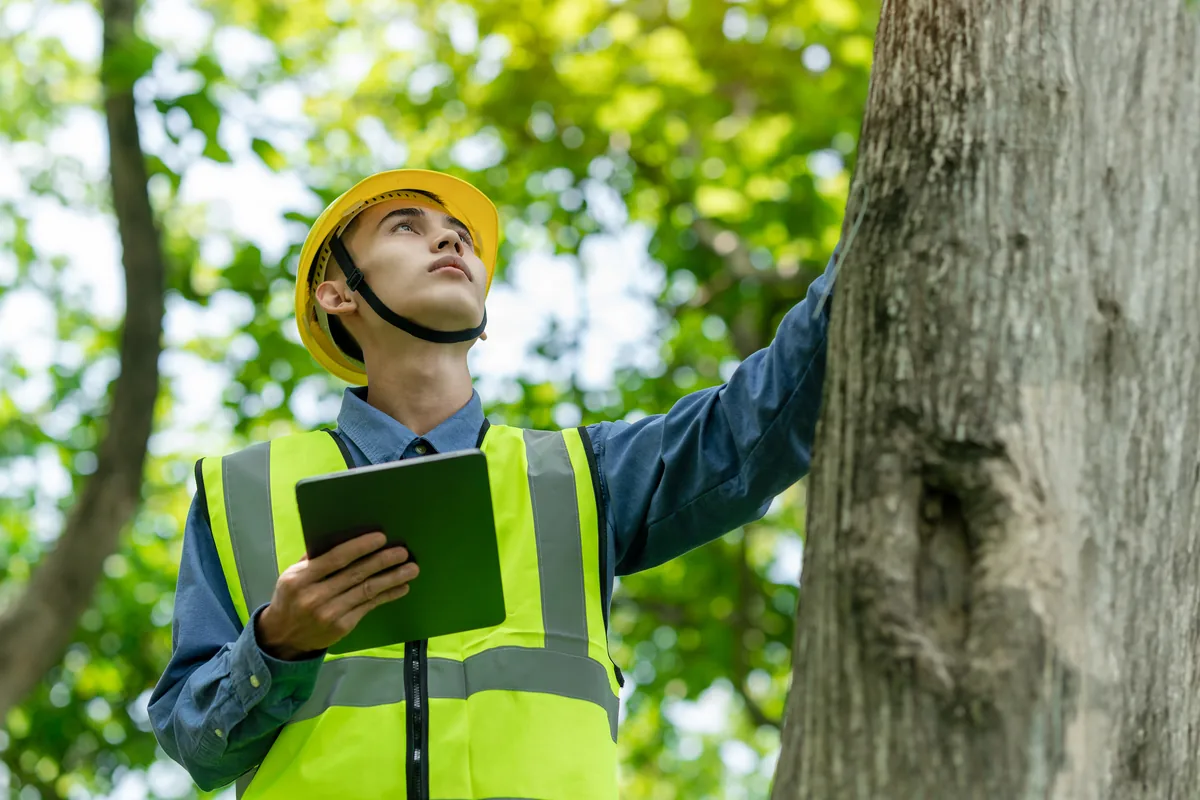
A resistograph drills a very thin needle into the wood and records how much resistance the needle meets. Lower resistance can help identify areas where wood density has been reduced by decay.
In a 2016 Tampa street-tree study, resistance drilling detected internal decay in 67.4% of tested laurel oaks and 29.4% of tested live oaks. The study examined large-diameter trees along hurricane evacuation routes; these percentages do not predict whether a particular yard tree will fail. Koeser and colleagues, 2016.
Sonic tomography takes a different approach. Sensors are placed around the trunk and sound is sent through the wood between them. Slower sound movement can suggest areas of decay or a cavity, and the test is less invasive than drilling. International Society of Arboriculture research on decay testing
Neither tool makes the decision by itself. The arborist interprets the results together with the tree’s visible condition, defects and site because decay testing is only one part of understanding risk.
For a mature oak with a large cavity, fungal growth or suspected internal decay, advanced decay testing can provide more information before deciding what to do.
Prune, Brace or Remove?
Not every older laurel oak or water oak needs to be removed. The right choice depends on the defect, the amount of sound wood, where the weakness is located and what the tree could strike if part of it failed.
Some structural problems can sometimes be managed with crown reduction or a support system. UF/IFAS notes that risk from poorly attached or codominant branches can sometimes be partly reduced through corrective pruning or installation of a cable system by an experienced arborist. UF/IFAS tree safety guidance.
Cabling does not repair rotten wood or make decay disappear. It is a support system that may help certain branch unions when enough sound structure remains. See cabling and bracing.
Removal becomes the safer option when a tree is high risk and its defects cannot be brought to an acceptable level. UF/IFAS recommends inspecting over-mature trees and species with poor hurricane performance, including laurel oak and water oak, and removing trees that are at high risk of failure. UF/IFAS Wind and Trees
If removal is the appropriate risk decision, see tree removal. The goal is not to remove an oak simply because it is old. It is to decide whether its age, decay, structure and location have combined into an unsafe condition.
Are Laurel and Water Oaks Protected in Tampa?
Yes, in most cases. In the City of Tampa, removing a laurel or water oak at least 5 inches in trunk diameter generally requires a permit. Laurel oak is a listed grand-tree species, and qualifying trees at least 32 inches in diameter receive additional review. Diameter is measured 4.5 feet above ground. City of Tampa tree resources.
In unincorporated Hillsborough County, a yard tree on a single-family lot generally needs a removal permit at 12 inches in diameter or larger. Oaks at least 34 inches in diameter can qualify as protected Grand Oaks; street trees and conservation areas have different requirements. See the County removal guide and Grand Oak guidance.
An exception under Florida Statute 163.045 applies to qualifying detached single-family residential property. The owner must hold a signed, onsite assessment by an ISA Certified Arborist or Florida licensed landscape architect documenting unacceptable risk under the required assessment procedures, with removal the only practical way to reduce risk below moderate. When the exemption applies, the local government cannot require a removal permit, fee, mitigation or replanting.
For local oak requirements, see oak tree removal rules in Florida.
Stronger Replacement Trees for Tampa Yards
When a high-risk laurel oak or water oak has to be removed, consider species with better wind resistance and enough space to grow. UF/IFAS wind-resistance lists include the following options, but smaller trees do not replace the shade of a mature oak.
- Live oak: Listed in the highest wind-resistance group, and UF/IFAS says it can live for centuries when properly located and cared for. UF/IFAS Southern Live Oak
- Sand live oak: Listed among the highest wind-resistance species.
- Southern magnolia: Included in the highest wind-resistance group.
- Dahoon holly: Listed among the highest wind-resistance species.
- Yaupon holly: A small tree for smaller spaces, not a like-for-like shade tree replacement. Included in the highest wind-resistance group for the Southeastern Coastal Plain.
The right replacement still needs to fit the yard and available space. For more choices, see native Florida trees.
What to Check After a Storm
From a safe distance, look for hanging branches, fresh splits, a new lean or lifted soil around the roots. Keep people and vehicles out of the area beneath damaged limbs. If a tree or branch is touching or hanging over power lines, stay clear and contact the electrical utility.
Arrange an arborist inspection after a hurricane or major storm even if the oak is still standing. UF/IFAS storm-damage guidance explains why roots, trunk damage and remaining branches all matter when deciding whether a tree can be retained. Do not climb the tree or try to pull down hanging limbs yourself.
Laurel and water oak FAQs
Is my laurel oak going to fall in the next storm?
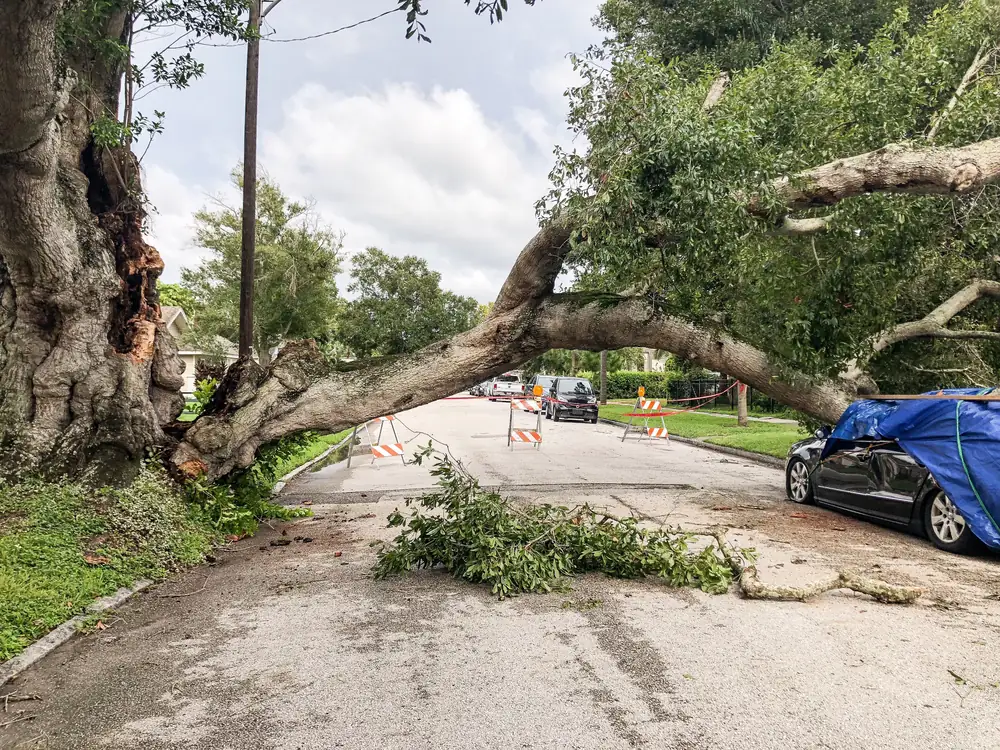
No one can tell from age alone whether an individual laurel oak will fall in the next storm. What we do know is that laurel oak has a lifespan of about 50 to 70 years, often develops internal decay and appears in UF/IFAS’s lowest wind-resistance group for north Florida (medium-low for south Florida).
UF/IFAS says over-mature trees should be monitored regularly for structural defects and that high-risk trees should be removed and replaced when needed. If your oak is mature, close to the house or showing decay signs, a professional inspection can give you a much clearer picture of its current condition. UF/IFAS Wind and Trees
How can I tell a laurel oak from a live oak?
Live oak holds its leaves until new leaves appear, and its acorns grow in clusters of three to five on long stalks. Laurel oak has narrow, smooth, shiny leaves with a yellowish midrib and commonly sheds leaves around early spring. Its acorns are about half an inch long and attach singly, directly to the twig. See the Pinellas County Extension identification guide and UF/IFAS Laurel Oak.
The name laurel oak can also refer to sand laurel oak, Quercus hemisphaerica. UF/IFAS Extension identifies sand laurel oak by this scientific name. UF/IFAS notes sand laurel oak (also called Darlington oak) grows on upland, sandier sites, while Q. laurifolia is generally found on wet sites. Have an arborist confirm the species before applying a lifespan or identification description to your tree.
Do I need a permit to remove a laurel or water oak?
Usually, if the tree meets your jurisdiction’s protected-tree criteria. The Florida Statute 163.045 exemption can apply on qualifying detached single-family property when the owner holds the required signed assessment documenting unacceptable risk and removal is the only practical way to reduce risk below moderate.
See oak tree removal rules in Florida for the detailed permit guide.
How often should an older oak be inspected?
Panorama recommends a Level 2 written risk assessment for mature trees every 3 to 5 years, plus another inspection after any hurricane or major storm. A Level 2 assessment gives you a documented look at the tree’s condition, structural defects and risk at that time.
If you have an older laurel oak or water oak near your Tampa Bay home, do not wait for visible damage during storm season to start asking questions. Book a tree risk assessment so our arborists can evaluate the tree’s condition, structure and risk. If you need tree service in Lutz, Panorama Tree Care can help you decide whether the tree can be safely managed or whether removal should be considered. You can also request an estimate or call (813) 234-9842.