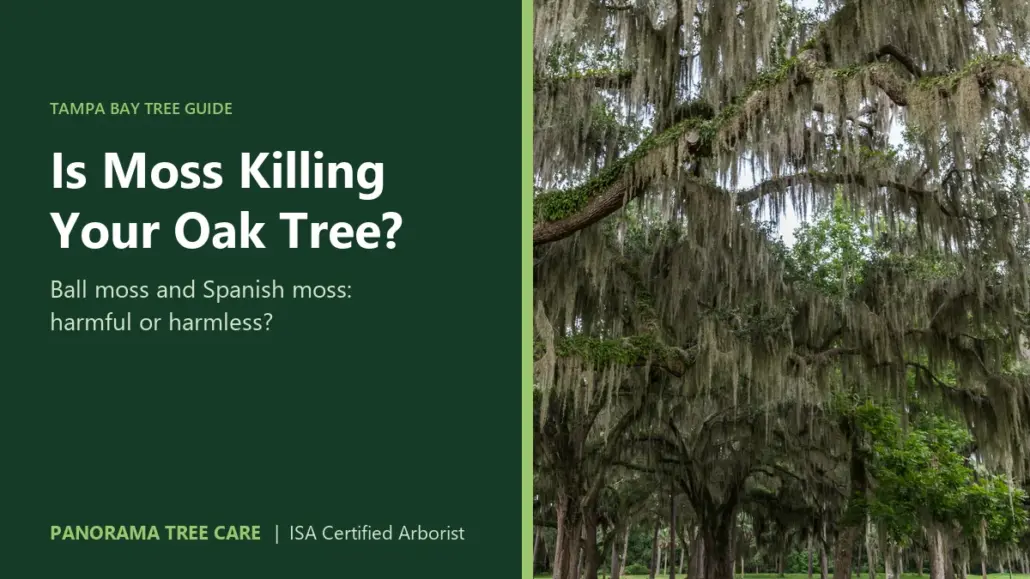
Ball moss and Spanish moss do not kill oak trees. Neither is a parasite, and neither takes water or nutrients from the tree. Heavy moss is often more noticeable on an oak that already has a thin canopy, dead interior limbs or other health problems because more light reaches the branches. In Tampa Bay, a tree covered in moss is not automatically in trouble, but it can be a good reason to look more closely at the oak itself, especially before storm season. UF/IFAS EP485
What Ball Moss and Spanish Moss Actually Are
Despite their names, ball moss and Spanish moss are not true mosses. Ball moss, Tillandsia recurvata, and Spanish moss, Tillandsia usneoides, are flowering plants in the bromeliad family, the same plant family that includes pineapple. UF/IFAS Leon County
They are also epiphytes, often called air plants. An epiphyte grows on another plant for physical support but does not feed from it. Ball moss and Spanish moss collect moisture and nutrients from the air, rain and organic debris around them instead of taking them from the oak.
That is different from a parasite such as mistletoe. A parasite gets resources from its host, while these air plants simply use branches as places to grow.
The two are fairly easy to tell apart. Ball moss forms small, rounded or tufted gray-green clumps around twigs and branches. Spanish moss hangs down in long, curling gray strands or garlands. UF/IFAS EP485
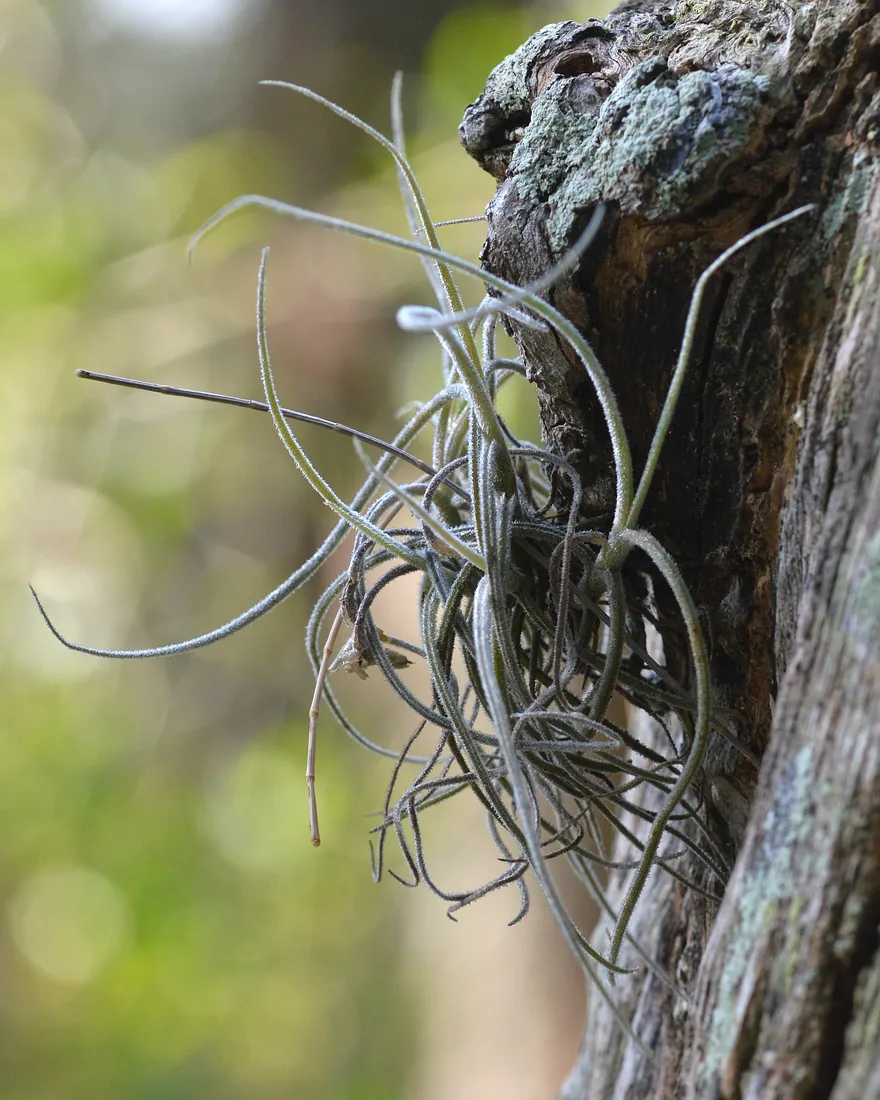
Both are common sights on Florida trees. Spanish moss is especially familiar on oaks throughout the state, including Tampa Bay. UF/IFAS Gardening Solutions
| Feature | Ball moss | Spanish moss |
|---|---|---|
| Appearance | Small, tufted gray-green clumps | Long, curling gray strands |
| Scientific name | Tillandsia recurvata | Tillandsia usneoides |
| Plant family | Bromeliad | Bromeliad |
| Feeds on the oak? | No | No |
Is Moss Hurting My Oak?
In most cases, no. UF/IFAS describes ball moss and Spanish moss as harmless epiphytes rather than parasites, so they are not draining an oak’s water or nutrients.
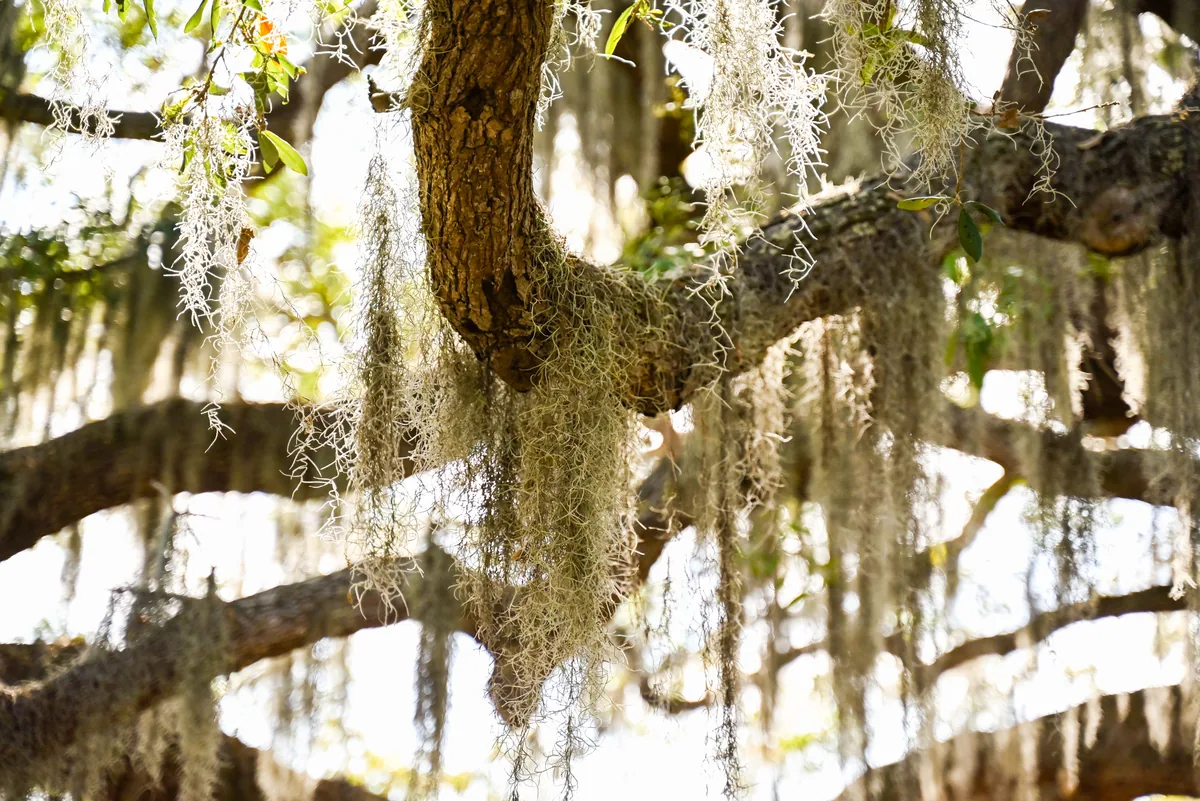
This is important because homeowners often notice heavy moss and tree decline at the same time. The moss may look like it is taking over, but the tree usually became weak for another reason first.
Limb breakage is often blamed on moss, but UF/IFAS says moss adds an insignificant amount of weight and is almost never a factor. A branch that breaks was likely already weak or damaged. On a declining tree with weak limbs, though, heavy moss may be the ‘straw that breaks the camel’s back.’ Many large oak limbs may carry only 20 to 50 pounds of Spanish moss, while the limb itself may weigh over a ton. UF/IFAS EP485; UF/IFAS Leon County
The other issue is visibility. Thick Spanish moss can hang around branches and make it harder to notice dead wood, cracks or other defects from the ground. UF/IFAS also notes that very heavy Spanish moss can shade leaves and slow growth in a tree that is already declining, while the effect on a healthy tree is usually minimal. UF/IFAS Gardening Solutions
So, when an oak looks covered in moss, our first question is not, “How do we remove the moss?” It is, “What condition are the branches, canopy and trunk actually in?”
Why Some Tampa Oaks Are Covered and Others Are Not
UF/IFAS says ball moss and Spanish moss both prefer high light, so they thrive when an oak thins or loses leaves. Ball moss is also common on shaded interior limbs that are already dying from lack of light.
That is why a declining oak may appear to have much more moss than a healthy oak nearby. The heavy moss is often a result of the thinner canopy, not the cause of it. UF/IFAS specifically warns against blaming air plants simply because they are abundant on a weak tree.
Tampa Bay’s moist, humid conditions are also suitable for epiphytes. UF/IFAS notes that these plants are well adapted to well-lit, moist and humid habitats. UF/IFAS EP485
For a homeowner in Hillsborough or Pinellas County, more moss should be treated as a reason to look at the tree, not proof that the moss is hurting it. If the canopy is getting thinner or sections are dying back, see signs of a dying tree and consider having the oak inspected.
Should You Remove It? Your Options Compared
Leave it alone
If the oak is healthy and the moss is not hiding an important structural problem, leaving it alone is often the simplest choice. UF/IFAS says damage from Spanish moss or ball moss is uncommon, removal can be costly, and the plants are likely to return after removal. UF/IFAS EP485; UF/IFAS Gardening Solutions
Spanish moss also has wildlife value. Insects and other small animals hide and breed in it, two bat species use it for daytime roosts, zebra longwing butterflies roost in it at night, and several birds use its strands in their nests. UF/IFAS Gardening Solutions
That is another reason not to treat every patch of Spanish moss as something that needs to be removed.
Hand or pole removal on small trees
UF/IFAS lists hand removal as an option when homeowners want to reduce moss on a small, reachable tree. A pole can also help reach low growth without trying to pull moss from high branches.
Large trees are different. UF/IFAS notes that a lift, sometimes called a cherry-picker, is usually needed to reach moss safely in a large canopy.
Even after physical removal, the moss can return. That is why we would rather understand why an oak has become heavily covered before treating the air plants as the main problem.
Pruning out deadwood and thinning the canopy
When heavy moss is concentrated on dead interior limbs, addressing the dead wood deals with the tree issue that matters more than the moss. Removing dead or structurally weak branches can also make the canopy easier to inspect before Tampa Bay’s storm season.
Prune for the tree’s health and structure, not to control moss.
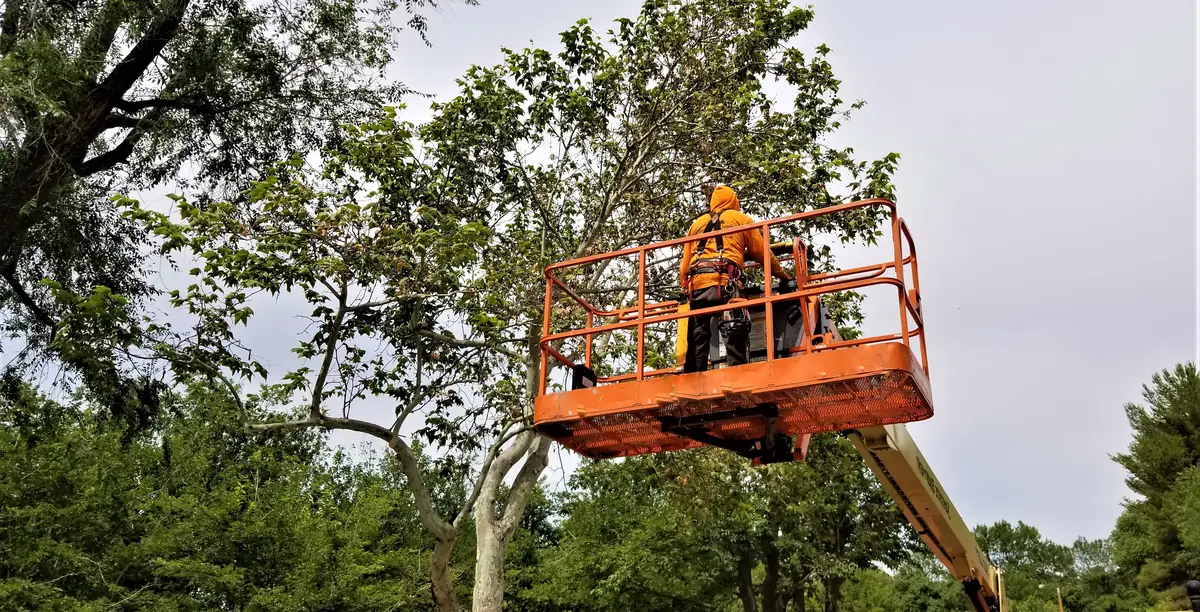
For professional evaluation and appropriate deadwood removal, see tree trimming and pruning. You can also read about types of pruning and our guide to oak tree trimming.
Sprays: why we are cautious
Copper-based products labeled for Spanish moss or ball moss exist, but UF/IFAS notes evidence that copper-based herbicides and fungicides may damage tender new growth on oak trees. Do not spray while oaks are putting out tender new growth. (Texas A&M Forest Service)
Use only a product whose label specifically lists ball moss or Spanish moss, and follow it exactly. Every pesticide label states it is a violation of federal law to use the product in a manner inconsistent with its labeling (EPA pesticide label requirements). Spraying a large oak can also drift onto and damage nearby sensitive plants (UF/IFAS EP485).
Chemical treatment also does not make the dead moss disappear immediately. The treated material can remain hanging in the tree and may still need to be physically removed.
For those reasons, we would not begin with spraying simply because an oak has visible ball moss or Spanish moss. The better first step is to check whether the tree itself has dead wood, a thinning canopy or another health concern. Be cautious of door-to-door companies claiming moss must be sprayed or limbs will break. UF/IFAS Leon County says spraying is not necessary on a healthy, structurally sound tree.
Is It Safe to Remove Moss Yourself?
Low, reachable moss on a small tree is very different from moss high in a mature oak. Once the work requires climbing, an extension ladder or reaching into large branches, the risk changes quickly.
Do not work near overhead power lines. Moss, poles, ladders and branches can all put you too close to electrical hazards, so work around utility lines should be left to qualified professionals.
Large oaks can also hide dead limbs behind thick Spanish moss. Pulling or shaking moss from below may disturb loose plant material or weak twigs overhead.
There is another Florida concern after the moss reaches the ground. UF/IFAS says chiggers are commonly found in Spanish moss lying on the ground rather than moss hanging in trees. Handle fallen moss carefully and avoid assuming it is insect-free. UF/IFAS Gardening Solutions
For a large Tampa Bay oak, especially one near a house, pool cage, driveway or utility line, an arborist inspection is usually more useful than trying to strip the moss yourself. The main goal is to find out whether anything under the moss actually needs attention.
What About Lichens on Oak Bark?
The gray-green crusts on oak bark may be lichens, not moss. Lichens combine a fungus with an alga or cyanobacterium. They can look crusty, leafy or powdery, and they do not harm the tree they grow on. Some lichen is normal on Florida trees, but heavy lichen growth often points to a tree that is already declining, since a thinning canopy lets in more light. (UF/IFAS EP485)
Ball moss and Spanish moss FAQs
Does Spanish moss have chiggers?
Spanish moss hanging in a tree rarely harbors chiggers. UF/IFAS says chiggers are more commonly found in moss and other plant material lying on or near the ground, so use care when handling fallen Spanish moss. UF/IFAS Gardening Solutions
Will moss grow back after removal?
Yes, it can. UF/IFAS advises homeowners that Spanish moss will likely grow back, which is one reason removal is not always worth doing when the tree itself is healthy.
If heavy moss keeps appearing on a thinning oak, focus on the condition of the tree instead of repeatedly treating the moss.
Can ball moss kill my oak tree?
No. Ball moss is an epiphyte, not a parasite, and it does not take water or nutrients from the oak. UF/IFAS EP485
Moss adds very little weight; a limb that breaks under it was usually already weak.
Is moss a sign my tree is dying?
Not by itself. Healthy Florida trees can carry Spanish moss and ball moss without being harmed.
However, unusually heavy growth can be more common on trees with thin canopies, dead limbs or declining health because these conditions allow more light into the branches. If the amount of moss seems to be increasing while your oak is losing leaves or branches, have the tree checked rather than assuming the moss is the cause.
If your oak is heavily covered in ball moss or Spanish moss, our main concern is the tree underneath it. Before Tampa Bay’s storm season, have an ISA Certified Arborist check the canopy for dead limbs, weak branches and other signs that may be hidden by heavy growth.
Book a tree health and risk check if you are unsure about a mature oak near your home. Homeowners looking for tree service in St. Petersburg can also have our arborists evaluate the tree’s condition and explain whether anything actually needs to be done.
You can also request an estimate or call (813) 234-9842.