Table of Contents
- Why Your Tree Stump Keeps Sprouting New Shoots
- How to Kill Tree Stump Sprouts: Herbicide and Nonchemical Options
- Epsom Salt on Tree Stumps: What It Actually Does
- Covering the Stump to Block Light
- Stump Grinding to Prevent Regrowth: When Removal Wins
- Stump Regrowth in Florida: What Tampa Bay Homeowners Should Know
- Choosing the Right Method by Stump Size, Age, and Location
- Follow-Up: How Long to Keep Checking
- Frequently Asked Questions
Why Your Tree Stump Keeps Sprouting New Shoots
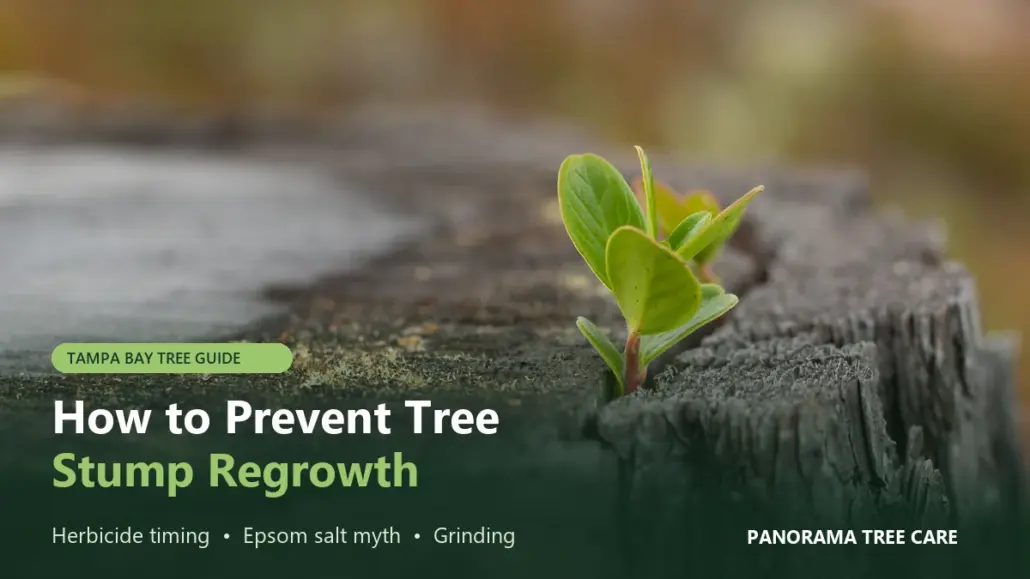
A cut stump does not always die. When you cut a tree down, the root system stays alive underground.
The reason is simple. Cutting the trunk removes the top of the tree, but the roots still hold food reserves.
Some species sprout far more than others. In Florida, UF/IFAS Extension notes that stumps of almost all invasive woody plants will sprout after cutting if they are not treated, including Brazilian pepper, carrotwood, Chinese privet, and Chinese tallow.
So how to prevent tree stump regrowth? You have to kill the living tissue, not just cut it.
A stump only dies when its living tissue and root system die. Cutting alone rarely works, because the roots keep feeding new shoots.
How to Kill Tree Stump Sprouts: Herbicide and Nonchemical Options
The fastest way to stop a stump from regrowing is to treat the cut surface with herbicide right after cutting. Timing matters more than strength.
If you skip chemical treatment, you can still win. Repeated cutting, covering, and drilling all work. They just take longer and need more follow-up.
Here is how the main options compare:
| Method | Best For | Effort | Speed |
|---|---|---|---|
| Herbicide on fresh cut | Fresh stumps, any size | Low | Fast |
| Drilling holes | Older, dry stumps | Medium | Medium |
| Covering with tarp | Small stumps, no chemicals | Low | Slow |
| Repeated cutting | Small sprouts, chemical-free | High | Slow |
| Grinding | Full removal, any size | High | Fast |
Applying Herbicide to a Freshly Cut Stump Surface
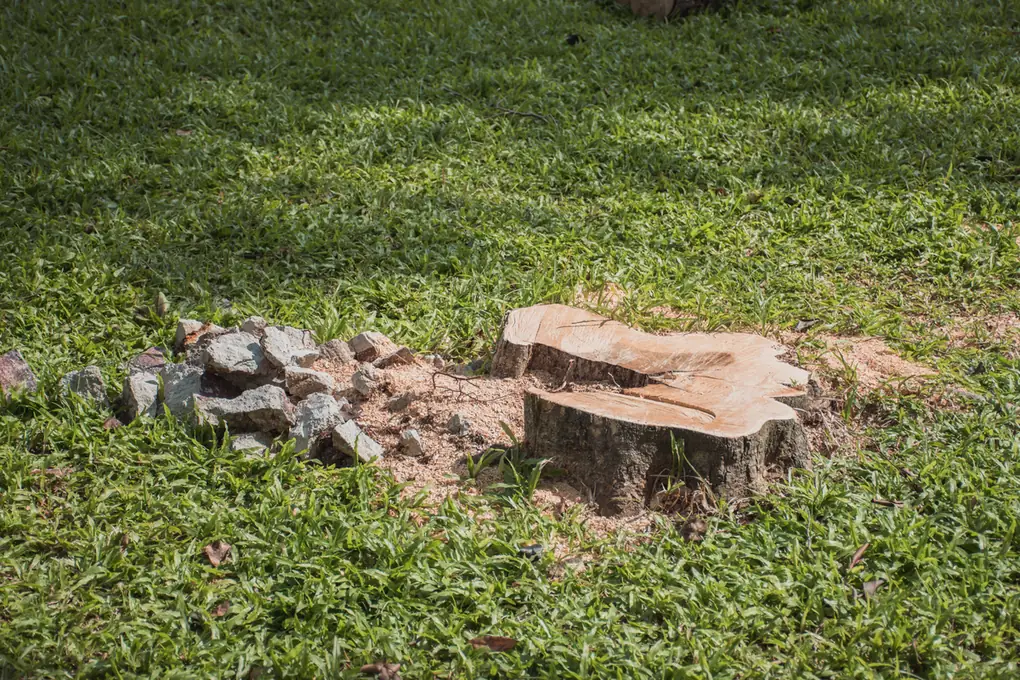
Apply the herbicide as quickly as possible after cutting. A fresh stump is still alive, and UF/IFAS warns that it seals itself very quickly. Use the product at the strength its label gives for cut-stump use.
Cut the stump low and as level as you can so the product does not run off, and brush away the sawdust first. On a large stump, paint or spray just inside the bark. That ring of living tissue carries the herbicide down into the roots. On a small stump, you can treat the whole top.
The EPA’s safe pesticide use guidance reminds users to follow the label exactly. Wear gloves and eye protection, and keep children and pets away until the surface dries.
Drilling Holes for Stump Killer Treatment
For a stump that has already dried out, drill holes into the cut surface first. Space them every few inches around the outer edge. Angle them inward and down.
Fill each hole with a stump-killer product whose label lists this use, at the strength the label gives. The holes let the product reach tissue that a painted surface would miss on a stump that no longer absorbs through the top. Results on old stumps are less reliable than a same-day treatment, so plan to follow up.
Epsom Salt on Tree Stumps: What It Actually Does
Epsom salt is one of the most repeated home remedies for stump removal, and one of the most misunderstood. It is worth separating what it actually does from what people hope it does.
Epsom salt is not the same as rock salt
Epsom salt is magnesium sulfate. Rock salt and water softener salt are sodium chloride. They behave differently in soil and around plants, and neither is a registered stump killer.
- Magnesium sulfate dissolves readily and adds magnesium and sulfur to soil. In high concentrations it can draw moisture out of wood and slow surface decay, but it does not move through the stump into the root system the way a systemic herbicide does.
- Sodium chloride is far harsher on soil. It can raise salinity to levels that kill grass, shrubs, and nearby trees.
Why it rarely kills the stump
A stump dies when its living tissue and root system die. Epsom salt applied to the cut surface or poured into drilled holes affects the wood it touches.
A common pattern reported by homeowners is that the stump looks drier for a few weeks, then sends up new shoots from the outer edge or from surface roots. That is the root system doing exactly what it would do without any treatment.
If you want to avoid herbicides, skip salt too. A light-blocking cover, repeated cutting of every shoot, or grinding will do more, without loading the soil with salt.
Epsom salt and rock salt rarely kill a stump and can damage surrounding soil and plants. Rock salt in particular can leave soil too salty for grass and garden plants for a season or more. Do not rely on either as your main method.
Covering the Stump to Block Light
Blocking light starves new shoots. Cover the stump with a thick black plastic tarp or a light-blocking cover. Without sunlight, sprouts cannot grow.
Follow these steps:
- Cut the stump as low as you can.
- Cover it fully with black plastic.
- Bury or weigh down the edges so no light gets in.
- Leave it in place for many months.
- Check for shoots pushing at the edges.
This method suits small stumps and anyone who wants to avoid chemicals. It is slow, so plan for patience.
Pair it with repeated cutting. Cut every shoot that escapes back to the stump as soon as it appears. UF/IFAS confirms sprouts can be continually cut off as they appear. Over time this drains the root reserves. It is labor-intensive but works on small stumps.
Stump Grinding to Prevent Regrowth: When Removal Wins
Grinding removes the stump below the soil line, which takes out most of the tissue that sends up shoots. It is the best choice when the stump sits near a driveway, foundation, or patio, or when you want the space back for planting or lawn.
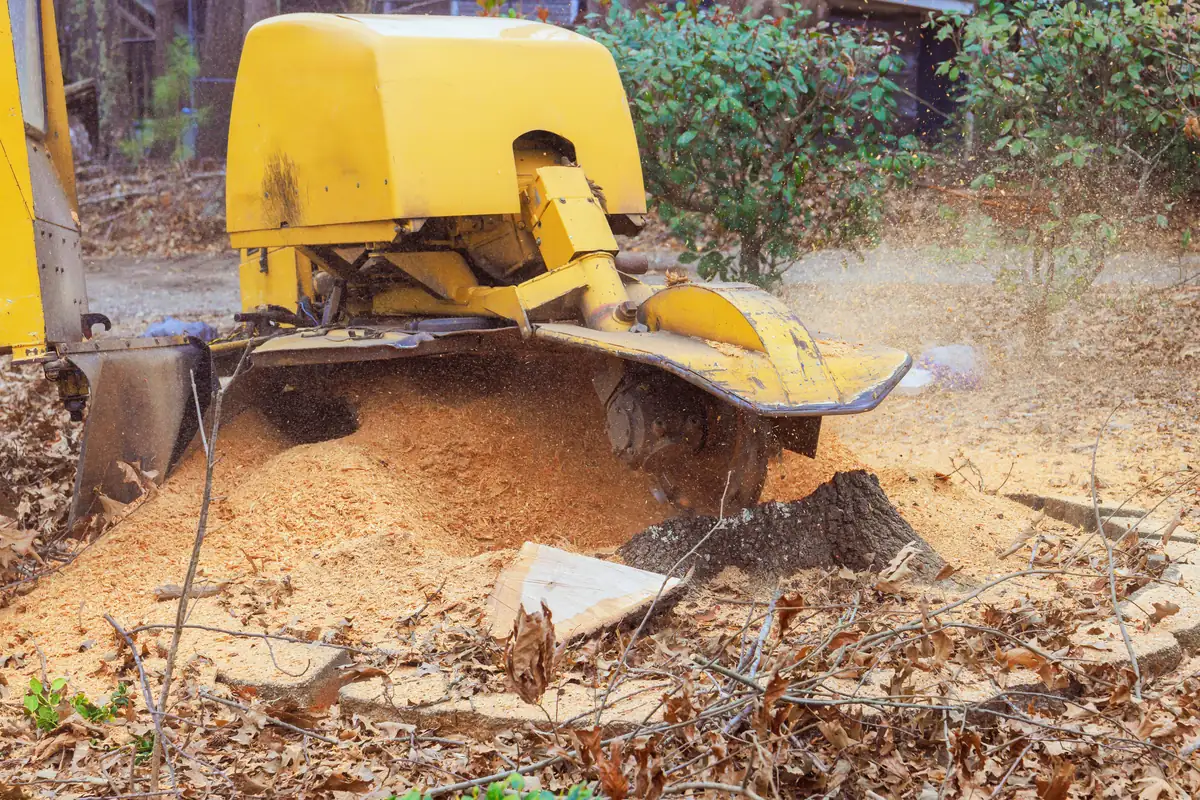
It is not a guaranteed fix on its own. UF/IFAS notes that some species can regrow from what is left of the stump or from lateral roots, and those sprouts can then be treated with herbicide.
For cost, depth, and how grinding compares with full removal, see our guide to stump grinding vs. removal. If you would rather hand it off, our stump removal service covers grinding and cleanup across Tampa Bay.
Stump Regrowth in Florida: What Tampa Bay Homeowners Should Know
- Invasive trees are the usual repeat offenders. Brazilian pepper, carrotwood, Chinese privet, and Chinese tallow all resprout from untreated stumps. UF/IFAS reports that triclopyr- and glyphosate-containing products have been effective on them. If roots are also lifting pavers or invading lines, see our guide to invasive tree roots.
- Florida heat changes product choice. UF/IFAS says triclopyr ester can turn to vapor above 80°F, and is very likely to above 90°F, which can injure nearby plants. It is also not labeled for landscaping. In a home yard, use a product labeled for landscape sites.
- Some products can reach plants you want to keep. Triclopyr can be absorbed by the roots of nearby plants, while glyphosate has little potential for root absorption. Imazapyr is not labeled for home landscapes at all, because it can persist in soil for more than a year and has killed many desirable trees.
- No license is needed on your own yard. UF/IFAS confirms a homeowner can buy and apply these herbicides on their own non-business property, as long as they follow the label.
- Call Sunshine 811 before grinding. Florida law requires contacting Sunshine 811 at least two full business days before you dig, so buried lines can be marked.
- Check permits before you cut. If the tree is still standing, check with your city or county first. Hillsborough County rules are covered in our Florida tree permit guide. Mangroves have their own state rules, covered in our mangrove trimming guide.
Choosing the Right Method by Stump Size, Age, and Location
Most guides tell you to pick a method, but not how to pick it. The right choice depends on four things: how long ago the tree was cut, stump size, what sits near the stump, and whether you want the space back. Work through them in that order.
Start with stump age, not size
Age decides whether the cut surface can still absorb anything.
- Fresh (cut today): The living tissue just inside the bark can still absorb. This is when a cut-stump herbicide works best, so treat it right after the cut.
- Older (cut days, weeks, or months ago): The cut surface has sealed. Painting the top does little. Use a product whose label covers older stumps, drill and fill where the label allows, or plan on grinding.
Then match method to stump size
- Small stumps: A cover or repeated cutting is realistic, and UF/IFAS says you can treat the whole top of a small stump.
- Medium stumps: Herbicide on a fresh cut, or drill-and-fill if the stump is older and the label allows it.
- Large stumps: Grinding is usually the cleanest option. Large root systems hold more stored energy, so a partial kill can mean a long run of shoot-cutting.
Check what is within reach before you treat
This is where most homeowners get into trouble.
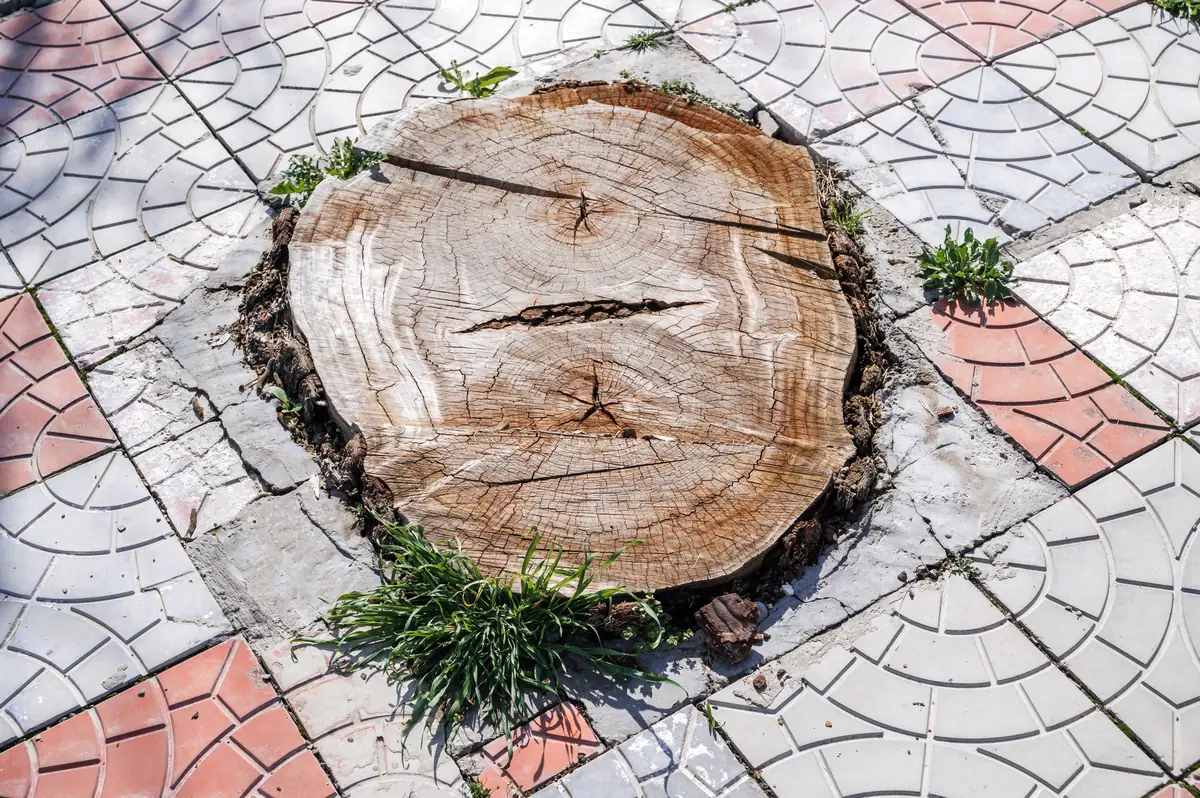
- Near a foundation, driveway, or patio: Grind. Surface roots from aggressive species can lift slabs and crack masonry.
- Near a garden bed or vegetable patch: Skip salt and Epsom salt entirely. They persist in soil and can injure what you are trying to grow. Use a tarp or grind instead.
- Near a utility line, septic field, or irrigation: Contact Sunshine 811 before any digging or grinding. Grinders can sever buried lines, and stump removal near a septic drain field can disturb the soil envelope.
- Near a tree you want to keep: Be careful with herbicide. UF/IFAS warns that triclopyr should not contact the roots of desirable plants. If the stump sits close to a tree you value, grinding is the safer choice.
Use a simple decision path
- Is the stump fresh? If yes, treat the ring just inside the bark today, following the label.
- Is it older? Drill and fill where the label allows, or skip straight to grinding.
- Is it within a few feet of a structure, utility, or tree you want to keep? Grind.
- Is it in a garden bed or near plants you care about? Avoid salt and Epsom salt. Cover or grind.
- Do you want the space back for planting, paving, or lawn? Grind.
- Are you avoiding chemicals entirely? Combine a light-blocking cover with repeated cutting of any shoots that escape.
If you cannot treat a stump the same day it is cut, drill holes before applying anything. A sealed cut surface blocks most absorption, and drilling restores a path to living tissue.
Follow-Up: How Long to Keep Checking
No method is one-and-done. Even a well-treated stump can push out a few shoots, and UF/IFAS notes that root sprouts can appear after grinding too.
Follow-up is where most people slip. Walk out and check the stump every few weeks, and keep checking for at least a full growing season. Cut or treat any new shoot while it is small.
For larger jobs, or stumps near buildings and utilities, professional removal is the safer call. Not sure if it is worth doing yourself? Our stump grinding vs. removal guide lays out the options.
Frequently Asked Questions
What can I put on my tree stump to keep it from growing back?
The most effective option is a cut-stump herbicide containing glyphosate or triclopyr, applied just inside the bark as soon as possible after cutting, at the strength on the label. For a nonchemical approach, cover the stump with a light-blocking tarp. Repeated cutting of new shoots also works but takes months. Choose based on stump size, location, and whether you want to avoid chemicals near gardens or waterways.
What does Epsom salt do to a tree stump?
Epsom salt (magnesium sulfate) can dry out the wood it touches, but it does not travel down into the roots the way a cut-stump herbicide does. It rarely kills a stump, and the roots often send up new shoots. A light-blocking cover, repeated cutting, or grinding works better.
Will grinding a stump prevent it from growing back?
Grinding removes the stump and the root flare, which is where most new shoots emerge. Regrowth is rare. Some species can still regrow from what is left of the stump or from lateral roots. UF/IFAS advises treating any of those sprouts with herbicide. Follow up for a full growing season to catch any stragglers.
When should I call an arborist about stump regrowth?
Call a certified arborist if the stump keeps sprouting after repeated treatment, if you are unsure which species you are dealing with, or if the stump is near a foundation, driveway, or utility line. An arborist can identify whether the roots are causing structural risk, recommend the right removal method, and handle grinding or herbicide safely. For large stumps or multiple stumps on a commercial property, professional removal is usually faster and safer than DIY treatment.
A stump that keeps sprouting is frustrating, but it is a solvable problem. The right method depends on the stump, and the wrong one wastes your time. If you want it gone for good, Panorama Tree Care can help. Our ISA Certified Arborists offer stump grinding, full removal, and free estimates, backed by family-owned service in Tampa Bay since 2000 and a 4.8 rating from 125 Google reviews. Get a free estimate and put that stump behind you.