Laurel wilt is a lethal vascular disease of trees in the laurel family (Lauraceae) caused by the fungus Raffaelea lauricola (recently reclassified as Harringtonia lauricola) and spread by the redbay ambrosia beetle, Xyleborus glabratus. According to UF/IFAS, it has been detected in all 67 Florida counties, including Hillsborough, Pinellas, Pasco, and Polk. The disease has been most visible in South Florida, where it moved through swampbay stands in the Everglades and into Miami-Dade’s commercial avocado groves. Laurel wilt is no longer a distant threat for Tampa Bay. The disease and the beetles that spread it are already established in Florida, meaning susceptible trees in residential landscapes should be monitored for early signs of infection.
What Laurel Wilt Does to a Tree
Laurel wilt kills a mature host tree in 21 days to 3 months from the point of infection. A contaminated ambrosia beetle bores into the xylem, the water-conducting tissue, and inoculates its gallery with R. lauricola. The tree responds by producing tyloses and gums to wall off the fungus, but the fungus keeps advancing into new sections faster than the tree can seal it. The xylem plugs itself shut, water stops reaching the canopy, and the tree wilts from the top down. There is no cure once a tree is infected.
The scale of the damage is documented: more than 300 million redbay trees have been killed in the southeastern United States since the beetle arrived in wooden packing material at Port Wentworth, Georgia, in 2002.
Which Trees Are at Risk in Tampa
More than a dozen tree species in Florida are confirmed hosts. The ones that matter most in Tampa Bay landscapes are:
- Avocado (Persea americana) — Florida has over 600,000 dooryard avocado trees, and 32 cultivars have been documented dying from laurel wilt, including Lula, Choquette, Monroe, Simmonds, and Brogdon. No resistant variety has been identified.
- Camphor (Cinnamomum camphora) — widely planted as a shade tree across central Florida neighborhoods.
- Redbay (Persea borbonia) and swampbay (Persea palustris) — understory trees in the wetland edges, preserves, and drainage corridors that border many Hillsborough and Pasco subdivisions.
- Silk bay (Persea humilis), sassafras (Sassafras albidum), pondspice (Litsea aestivalis), lancewood (Nectandra coriacea), and bay laurel (Laurus nobilis).
Trees outside the laurel family are not susceptible. Oaks, maples, mangoes, sapodilla, and citrus cannot contract laurel wilt. If a live oak in your yard is declining, the cause is something else.
Seven Symptoms to Inspect For
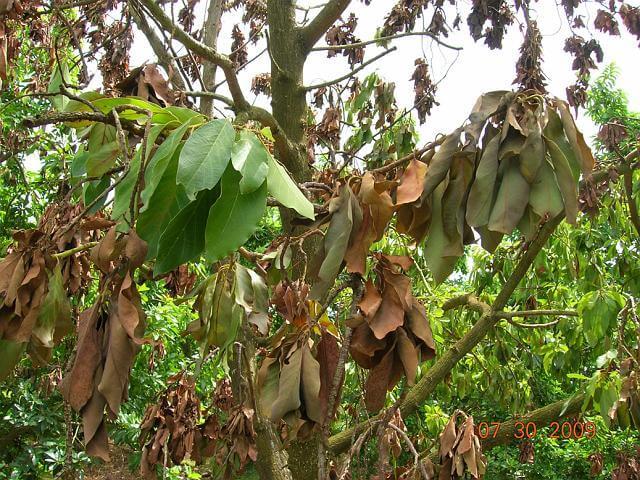
- Wilting of green leaves and green stems, often on one section of the canopy first
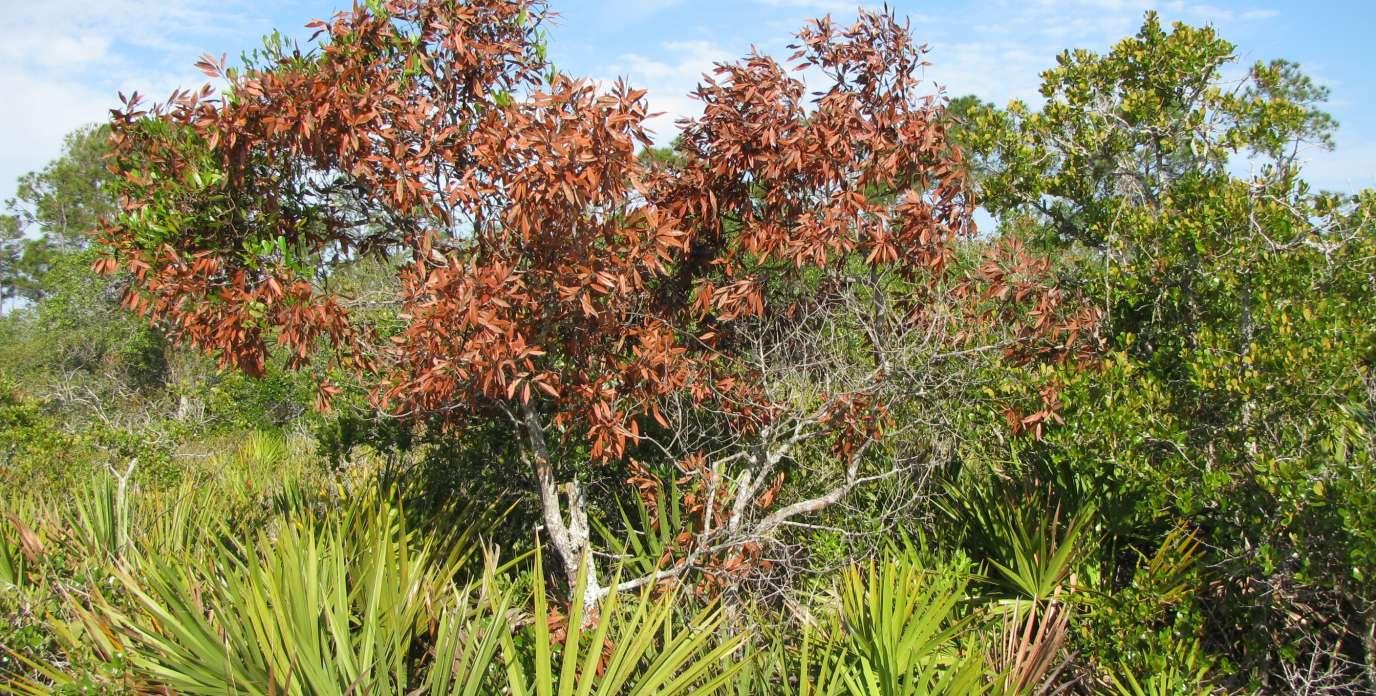
- Leaf color shifting from green to dark purplish or bluish green, then greenish brown, then brown
- Dead, dried leaves that stay attached to the branches instead of dropping
- Progressive stem and limb dieback
- Dried sap on the trunk appearing as a white, crystalline, powder-like material
- Sawdust tubes (frass tubes) protruding from the bark, or fine powdery sawdust at the base
- Dark blue-brown, brown, or black streaking in the sapwood just under the bark, with small dark beetle holes — healthy sapwood is white to yellowish with no staining
Retained brown leaves plus sapwood streaking is the diagnostic combination. Lightning strike, flooding, and severe drought produce similar canopy symptoms, which is why sapwood inspection and lab confirmation matter.
Why South Florida’s Experience Predicts Tampa’s Risk
The Florida timeline shows how the disease travels. The beetle-fungus complex reached north Florida in 2005 and central Florida in 2006, both through movement of infested wood rather than beetle flight. The first dooryard avocado death was confirmed in Jacksonville in 2007. In February 2010, the redbay ambrosia beetle was detected 21 miles north of Miami-Dade’s avocado production area; swampbay mortality in the Everglades was confirmed in 2011, and the disease entered a commercial grove in 2012.
Two spread mechanisms drive that pattern. Natural beetle flight advances the disease 15 to 34 miles per year through wooded areas. Human-assisted movement is faster and less predictable: infested firewood, logs, BBQ smoke-wood, wood-turning stock, unprocessed tree trimmings hauled between properties, and illegal dumping of limbs and brush. As UF/IFAS documents in its redbay ambrosia beetle biology guide, two additional beetles already established in Florida — Xyleborus volvulus and Xyleborus bispinatus — have also been documented carrying and transmitting the pathogen, which widens the vector pool well beyond the original invader.
Tampa’s exposure is therefore a function of host density and wood handling, not distance from Miami. Neighborhoods with mature camphor street trees, backyard avocados, and preserve-edge redbay have all three ingredients.
What Homeowners Should Actually Do
Report suspected trees before removing them. Call the FDACS Division of Plant Industry at 1-888-397-1517, or contact UF/IFAS Extension Hillsborough County. Sapwood samples can be submitted to a UF/IFAS Plant Diagnostic Center for confirmation.
Do not move the wood. Avocado, redbay, camphor, and other host wood should never leave the property as firewood, mulch, smoke-wood, or turning stock — the Don’t Move Firewood campaign exists specifically for this pathway. This single behavior is the most controllable spread factor in an urban county.
Handle removal as sanitation, not just cleanup. A dead or dying host tree becomes a beetle nursery. Research shows chipping infested wood significantly reduces beetle emergence, and the pathogen does not survive in chipped wood. Chip or grind the entire tree, then tarp the debris to the ground for at least 7 days. Burning is not recommended for residents because of permitting and control risks, and composting is prohibited in some municipalities — verify local rules before disposal.
Understand the treatment reality. UF/IFAS states there are no approved fungicide treatments to prevent or cure laurel wilt in dooryard avocado trees. Research on macroinfused propiconazole protected mature redbay from wilt symptoms for roughly 30 weeks, with fungicide retained in stem xylem up to 7.5 months, but mortality appeared in some treated trees in the second year and the approach has not proven cost-effective at scale. Contact insecticides are largely futile because ambrosia beetles spend approximately 90% of their lives inside the tree.
Replanting is safe. The pathogen cannot survive in soil, and beetles are not attracted to small-diameter young trunks, so a new avocado can be planted where one died.
What the Local Record Shows: Hillsborough County
Laurel wilt is not a forecast for Tampa Bay. The state’s own detection map puts it here more than a decade ago, and the City of Tampa has already counted how many of its trees are exposed.
When it arrived
The Florida Department of Agriculture’s county-by-county map of initial detections (FDACS/CAPS, February 2017) records laurel wilt in Polk County in 2010, Pinellas in 2011, Hillsborough and Manatee in 2012, and Pasco in 2013. The Pinellas outbreak was the one that made the news. A single infected tree was found at John Chesnut Park in East Lake in May 2011; by September 2012 hundreds of redbays in the park were dead and the disease was moving into the Brooker Creek Preserve. Dr. Steven Harper of the Pinellas County Environmental Division told reporters at the time that there was no cure once a tree was infected. Brooker Creek’s headwaters preserve sits on the Hillsborough side of the county line in Lutz, which is the corridor the disease used to reach northwest Hillsborough.
How many Tampa trees are exposed
The City of Tampa’s 2016 Tree Canopy and Urban Forest Analysis (USF and City of Tampa) inventoried an estimated 9.3 million trees inside the city limits and ran a pest-risk model against them. Laurel wilt was one of only four pests already present in Hillsborough County that showed up as a threat. The model found it could take 2.2 percent of Tampa’s tree population, roughly 200,000 trees, with a structural value of $16.5 million. Most of that exposure is swamp bay, which makes up 1.8 percent of the city’s trees and grows in the hardwood swamp along the Hillsborough River, the kind of floodplain forest that covers more than half of Lettuce Lake Park. Redbay and camphor each account for another 0.2 percent, roughly 19,000 trees apiece. Avocado is too scarce in the city sample to register as a percentage, which is exactly why a backyard avocado gets no attention from the pest models and no protection from the grove-focused research.
The same city monitoring shows Tampa’s tree canopy has been in continuous decline since 2011, down to 30 percent in the 2021 analysis. Every host tree that dies comes off that number.
Where the host trees actually are
Camphor was planted for shade across Tampa’s older neighborhoods for most of the twentieth century and has since seeded itself into hammocks and park edges. UF/IFAS now lists it as an invasive species and does not recommend planting it in central Florida. In February 2026, UF/IFAS Extension Hillsborough County and county parks staff removed camphor along with Brazilian pepper and Chinese tallow from 1.1 acres of woodland at Carrollwood Village Park. The practical result for a homeowner is that a camphor lost to laurel wilt will not be replaced in kind by the county, and there is no treatment program for it.
Swamp bay and redbay are the native hosts, and they follow the water. The Alafia River Corridor Nature Preserve’s management plan lists swamp bay among the dominant trees of its riverine forest, and redbay is recorded in the nearby Yulee preserve. Lettuce Lake Park, Hillsborough River State Park, the Brooker Creek headwaters, and the Little Manatee River corridor all carry the same floodplain and hammock communities. Subdivisions built up against those corridors in Lutz, Temple Terrace, Thonotosassa, Lithia, FishHawk, Riverview, and Ruskin have host trees on the property line whether or not anyone planted them.
The avocados in Tampa Bay yards are mostly cold-hardy cultivars, since the West Indian types grown commercially in Miami-Dade freeze here. Brogdon, hardy to about 22°F, and Lula, to about 25°F, are the two most commonly sold. Both are on UF/IFAS’s list of cultivars documented dying from laurel wilt.
What has changed since 2012
In 2012 the disease was a preserve problem: hundreds of dead redbays in a county park, with the Times headline warning that thousands more in Pinellas and Hillsborough could follow. The native bays have largely taken that hit already; the swamp bay stands along the Hillsborough River were counted as the city’s largest exposure in 2016. What remains is the residential side, where the hosts are planted trees, no one is monitoring them, and the wood from a removal is more likely to leave the property as firewood or mulch than to be chipped and tarped on site. The state’s guidance for groves has a $5 million USDA research grant behind it. The guidance for a homeowner with one avocado and two camphors is the checklist above.
From the field
Tony Padgett, ISA Certified Arborist FL-9569A, Panorama Tree Care: “The calls we get about a bay, an avocado or a camphor almost always come after the leaves have already turned brown and stayed on the tree. By then the fungus has been in the wood for weeks. What we tell people is the same every time. Report it before you cut it. Don’t let the wood leave the property. Chip the whole tree and tarp the chips for a week. And if the tree next to it is an oak, a maple or a citrus, it’s fine, because they can’t catch this.”
Get an Inspection Before the Canopy Browns
Laurel wilt moves too fast for a wait-and-see approach — a tree showing wilt on Monday can be dead within three weeks. If you have an avocado, camphor, redbay, or bay laurel on your property in Tampa, Brandon, Lutz, Riverview, or Carrollwood, a certified arborist inspection identifies infection while your neighboring host trees can still be protected through proper sanitation. Contact Panorama Tree Care to schedule an assessment and a compliant removal-and-chipping plan.