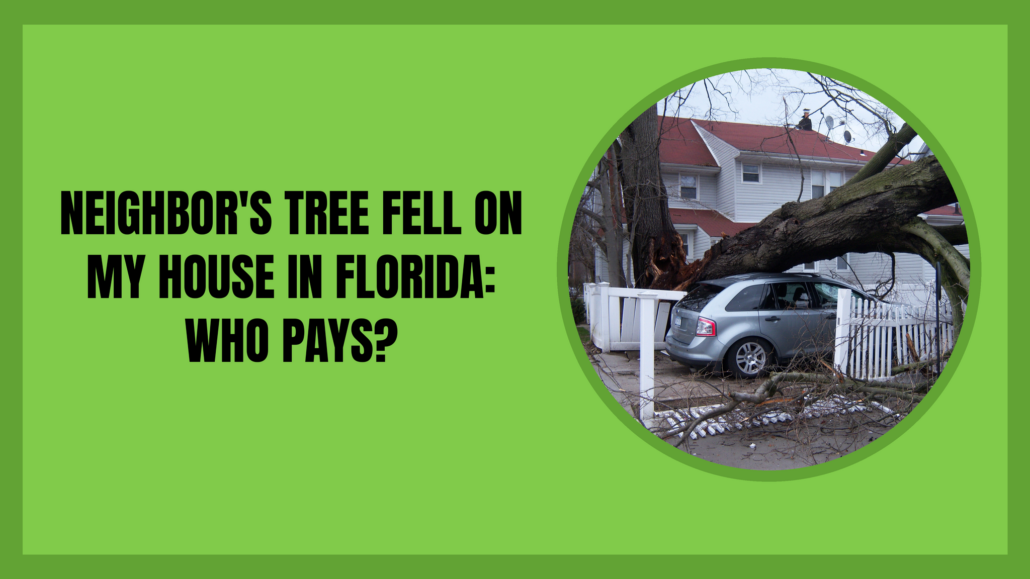
In Florida, the property line is not what decides who pays when a tree falls. The condition of the tree before it failed is. When a healthy tree is pushed over by hurricane winds and lands on your roof, your own homeowners policy covers your repairs and removal, minus the deductible, even if the trunk sat in the neighbor’s yard.
When the tree was already dead, hollow, or clearly failing, and the neighbor knew and did nothing, the cost can move to them and their liability carrier. This guide is about telling which of those two situations you are in, and how to prove it before the wood is chipped and hauled off.
Key Takeaways
- Florida follows the common law rule that the owner of a healthy tree is generally not liable when that tree falls on a neighbor. The loss sits where the tree lands.
- The exception is negligence. If the tree had a visible defect and the owner knew or reasonably should have known, liability can shift.
- You file with your own insurance carrier first, no matter whose tree it was. Your carrier decides whether to chase the neighbor through subrogation.
- Debris removal is usually a small sublimit, often in the $500 to $1,000 range per tree, and it typically only pays when the tree struck something covered.
- Under Florida Statute 627.70132, notice of a property insurance claim is generally barred unless given within one year of the date of loss.
- A written notice sent to a neighbor about a hazardous tree is the single cheapest thing you can do to protect yourself from the next failure.
- The proof that decides almost every one of these disputes is a documented cause-of-failure opinion from a credentialed arborist.
What to Do in the First 48 Hours, Before Anyone Argues About Money
I have walked onto hundreds of Tampa Bay lots where a tree was still on a roof and the homeowner had already lost the argument without realizing it. Not because they were wrong. Because the evidence was gone by the time anyone asked for it.
This is the order that matters.
Assume every downed line is energized. Stay 30 feet back, keep kids and pets inside, and call 911 and TECO before you touch anything. Wire does not have to spark to be live. The full emergency sequence, including utility protocol and county contacts, is laid out in our fallen tree removal guide for Florida.
Photograph everything before a single branch moves. Wide shots from the street, the point of impact, interior ceiling and wall damage, water intrusion, and anything the tree crushed on the way down. Leave the timestamps on. Shoot video walking the whole scene while you narrate what you are seeing.
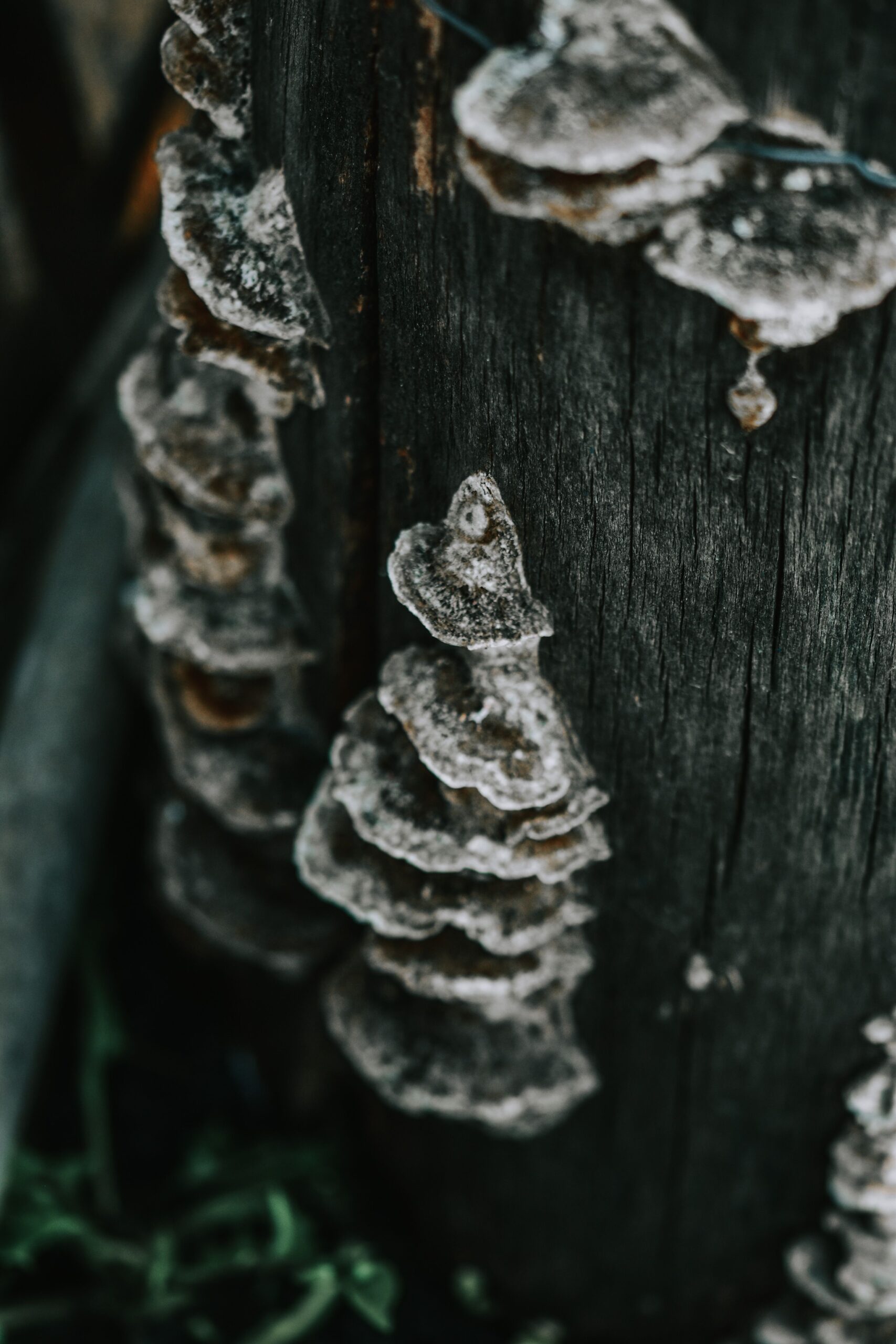
Photograph the failure surface specifically. Almost everyone skips this. Where the trunk broke or the root plate lifted is the physical record of why the tree failed. Get close on the break. Hollow center, brown crumbly wood, fungal conks or mushrooms at the base, short severed roots that pulled up – that is your case. Once a crew grinds the stump and chips the wood, that record is gone for good and nobody can rebuild it from memory.
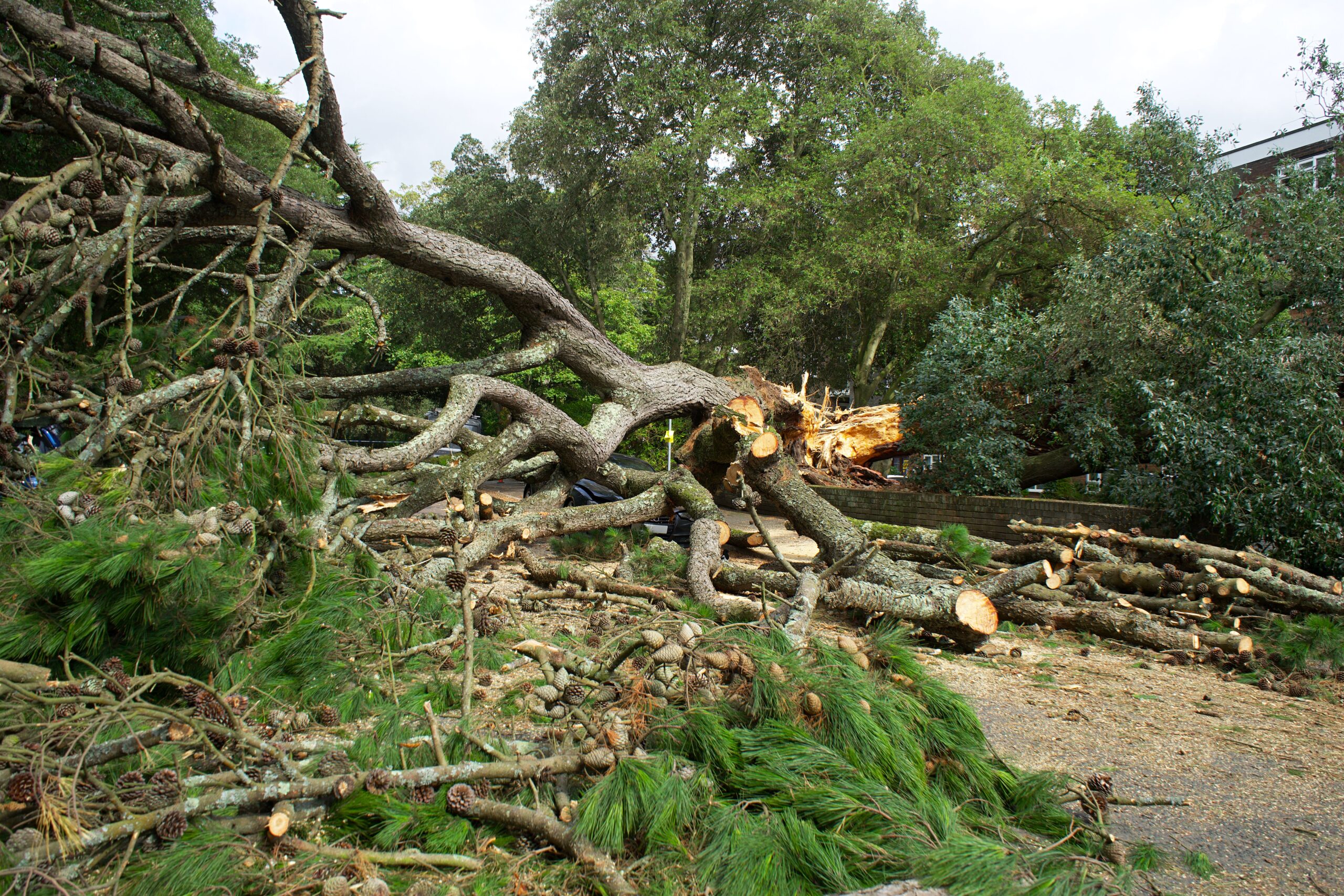
Do only the emergency mitigation your policy requires. Tarp the roof, board a broken window, stop the water. Save every receipt. Do not start a full repair before the adjuster has seen it.
Call your own insurance company. Yes, even if it was the neighbor’s tree. More on why in a moment.
Get a written arborist assessment before cleanup finishes. If there is any chance you will argue this was a defective tree, the assessment has to happen while the trunk, root plate, and failure surface are still on site. Our 24/7 emergency tree service crews document the failure as part of the response.
Do not let the stump and root plate be ground out before someone credentialed has documented the failure. Once it is chipped, the evidence is gone, and with it goes any realistic chance of shifting the cost.
The Florida Default: Your Tree, My Yard, My Bill
This is the rule that surprises almost every homeowner I meet.
Florida follows the common law majority view, often called the Massachusetts Rule. Under it, a landowner is generally not liable to people outside the land for a nuisance from trees and natural vegetation growing on that land. The lead case is Gallo v. Heller, 512 So. 2d 215 (Fla. 3d DCA 1987), where a homeowner sued neighbors over ficus and melaleuca trees whose branches and roots were damaging her roof, cracking her walkway, and shading her landscaping. The court dismissed the claim. Florida appellate courts have held the same line since, including Scott v. McCarty, 41 So. 3d 989 (Fla. 4th DCA 2010) and Balzer v. Ryan, 263 So. 3d 189 (Fla. 1st DCA 2018).
In plain terms: a structurally sound tree that fails in a hurricane is treated as an act of God. Wind is not something your neighbor controls. Where the tree lands is where the loss sits.
The one right the rule does give you runs the other way. It is called self-help. You may cut back branches and roots that cross onto your property, at your own cost, up to the property line. You cannot enter their land, you cannot cut in a way that kills the tree, and you cannot send them the bill afterward.
I know how that lands. It was their tree, on their dirt, and you are the one writing checks. I have had that talk in driveways across Hillsborough and Pinellas more times than I can count. It feels backwards. It is still the starting point, and the whole game is knowing when it flips.
When the Neighbor Does Pay: The Negligence Exception
The rule protects the owner of a healthy tree. It does not protect someone who left a dead one standing over your bedroom for two years.
The Four Things You Have to Establish
To move the cost across the fence, you generally need all four of these, not only the first.
- A defect existed before the failure. The tree was dead, diseased, decayed, structurally compromised, or leaning in a way that signaled root plate movement.
- The owner knew or should have known. This is called notice, and it comes in two flavors covered below.
- They failed to act within a reasonable time. Knowing about a hazard and sitting on it is the heart of the claim.
- That failure caused your damage. Not the storm alone. The defect has to be the reason the tree came down when a sound tree would have held.
Miss any one of those and you are usually back to paying your own deductible.
Actual Notice Versus Constructive Notice
Actual notice means they were told. In practice that almost always means something written: a certified letter with return receipt, a timestamped email, a text thread, or an HOA complaint. Written notice is the strongest evidence in this area of Florida tree law, and it costs about nine dollars to create.
Constructive notice means the defect was so open and obvious that a reasonable owner should have seen it without being told. A hollow trunk with a shelf fungus at the base. A dead crown bare over a shared fence for a full season. A lean that clearly increased over months with soil cracking on the uphill side. If you photographed any of that before the storm, even in the background of a family shot, you may have a constructive notice argument.
Verbal complaints over the fence are the weakest form. Your neighbor will not remember it, their adjuster will not credit it, and there is nothing to put in a claim file. If you are reading this because a tree next door worries you and nothing has fallen yet, skip to the written notice section below and handle it today.
Why “It Was Obviously Dead” Is Not Enough by Itself
This is where these claims quietly die.
The neighbor’s carrier will rarely argue the tree was healthy. They will argue it failed from wind load, and that a sound tree would have failed under the same conditions. That is a real argument, and in a Category 3 event it is often right. Windthrow does not care about a tree’s health history.
Closing that gap takes an arboricultural opinion on the mechanics of the failure. How much cross-sectional area was lost to decay. Whether the root plate was compromised by construction, girdling roots, or soil saturation. Whether the tree had included bark at a codominant union that split under load. Whether removal was the only practical way to bring the risk below moderate before the storm.
A general contractor or roofer cannot write that. It is what a documented tree risk assessment produces, and why our consulting arborist practice sits as a separate line from the removal crews.
Your Carrier or Theirs? How the Claim Actually Moves

Most people think they file against the neighbor first. That is almost never the opening move.
You file with your own carrier. Your homeowners policy covers your dwelling and other structures based on the peril, not on who owned the tree. Wind and falling objects are covered perils on a standard Florida policy. Your carrier pays under your coverage, and you pay your deductible.
Then your carrier decides whether to pursue the neighbor. That process is subrogation. If your insurer believes the neighbor was negligent, it goes after their liability carrier for what it paid. If subrogation works, you often get your deductible back as part of the recovery. That is the practical reason to give your adjuster the failure photos and the arborist report early instead of absorbing the loss quietly.
Going straight at the neighbor’s liability carrier is possible but slow. Without documented prior notice, expect a denial letter citing act of God, and expect it fast.
One honest note. A subrogation demand against the person twelve feet away changes that relationship permanently, and no adjuster will warn you about that. Decide with your eyes open.
Claim Path by Scenario
| Scenario | File with first | Who ultimately bears the cost | Deductible recovery |
|---|---|---|---|
| Healthy tree, storm failure | Your carrier | You and your carrier | Unlikely |
| Dead tree, no prior notice given | Your carrier | Usually you and your carrier | Possible if constructive notice is provable |
| Dead tree, written notice on file | Your carrier | Neighbor and their liability carrier | Likely through subrogation |
| Neighbor uninsured, negligence clear | Your carrier | Recovery through small claims or civil suit | Case dependent |
| Tree on a rental property | Your carrier | Owner, not tenant, in most cases | Case dependent |
What Your Own Policy Actually Pays, and Where It Stops
The deep dive on coverage lives in our Florida tree damage and homeowners insurance guide. Here is only the part that changes the who-pays answer.
Damage to the house falls under Coverage A, your dwelling limit. Fences, sheds, detached garages, and pool cages fall under Coverage B, other structures, which is usually a percentage of Coverage A and is often sublimited further for screen enclosures. Contents fall under Coverage C.
Removal is where the real pain shows up. Debris removal is usually a small sublimit, often $500 to $1,000 per tree with a per-claim cap, and it generally only pays when the tree struck a covered structure or blocked access. Taking a mature live oak off a roof with a crane on a tight South Tampa lot, with rigging and traffic control, can run several thousand dollars. The gap between the real cost and the sublimit comes out of your pocket. Read the declarations page for that line. It is rarely what people assume.
Deductibles do a lot of damage here. Most Florida policies carry two: a standard all-perils deductible and a separate hurricane deductible expressed as a percentage of your dwelling coverage, often around 2 percent. On a $400,000 dwelling that is $8,000 you absorb before anything is paid. A named storm triggers the percentage version. The same tree falling in an ordinary July thunderstorm triggers the flat one. That single distinction decides whether you have a claim worth filing at all.
Citizens Property Insurance policies follow similar logic with their own sublimits and their own claim handling rules.
Watch the clock. Under Florida Statute 627.70132, notice of an initial or reopened property insurance claim is generally barred unless it is given within one year of the date of loss, with supplemental claims running to 18 months. For weather events, the date of loss is tied to the verified storm date, not the day you noticed the ceiling stain.
Your car is not on this policy. A tree on your vehicle is a comprehensive auto claim with your auto carrier and your auto deductible.
Who Pays for What: Damage Type by Damage Type
| What the tree hit | Coverage part | Who pays by default | Flips to the neighbor if |
|---|---|---|---|
| Roof and dwelling | Dwelling (Coverage A) | You, minus deductible | Documented prior notice of the defect |
| Fence on the property line | Other structures | You, for your side | Prior notice, or a shared boundary tree |
| Shed or detached garage | Other structures | You, minus deductible | Prior notice of the defect |
| Pool cage or screen enclosure | Other structures, often sublimited | You, frequently well under actual cost | Prior notice of the defect |
| Vehicle in the driveway | Comprehensive auto | Your auto carrier | Prior notice of the defect |
| Landscaping only, nothing struck | Usually excluded or tightly capped | You | Rarely flips |
| Blocked driveway, nothing struck | Limited debris allowance on some policies | Mostly you | Rarely flips |
| Injury to a person | Liability coverage | Neighbor’s liability coverage in play | Negligence shown |
The fence version deserves its own sentence because it is the most common dispute I get called about, and the answer disappoints people. If your neighbor’s structurally sound tree crushes the boundary fence in a storm, that repair is generally yours. The self-help right to trim encroaching limbs does not create any right to reimbursement. Fences are cheap enough that they usually fall below the hurricane deductible entirely, which means the claim is not worth filing and the check is coming out of your account.
The Part of the Tree Question: Who Removes Which Half
This one confuses almost everyone, and no insurance form explains it.
When a tree fails across a property line, it becomes two jobs.
Debris that landed on your property is yours to handle. It does not matter that the trunk is rooted next door. Once it is on your side, on your roof, across your driveway, it is your removal and your bill or your claim.
What is still standing on their side stays theirs. The stump, remaining trunk, and any hanging material over their yard is their responsibility and their cost.
So one tree, two invoices, two crews, sometimes two companies on the same morning. That is normal and inefficient.
The smarter move is to agree with your neighbor on one contractor for the whole failure in a single mobilization, then split the cost in writing before the saws start. Setting a crane once instead of twice saves real money for both of you. When a large trunk spans both lots, you also need written permission for the crew to access their side for rigging and outriggers. Settle that before the truck rolls, not while a 40,000-pound crane idles in the street. Our tree removal service handles split-property failures like this often, and defining scope up front prevents the second fight.
Ownership Edge Cases That Change the Answer
Boundary Trees and Trunks That Straddle the Line
Ownership generally follows where the trunk is rooted at ground level, not where the canopy spreads. When the trunk itself crosses the property line, the tree is typically treated as jointly owned, and neither owner can remove it on their own. That means a hazardous line tree can sit there for years because two people cannot agree. It is one of the most frustrating situations in Florida tree law and it is exactly the gap recent legislation tried to close.
HOA Common Area Trees
If the tree stands in common area, the association owns it and the maintenance duty sits with the board. Your notice goes in writing to the board or the management company, not to a neighbor. Association records, reserve studies, and prior arborist reports become the relevant documents, and many associations have a standing tree management obligation buried in their covenants. We handle association portfolios through our commercial tree service, including the documentation boards need for architectural review.
City or County Right-of-Way Trees
Municipal trees in the right of way belong to the city or county. Recovering from a government entity in Florida involves sovereign immunity limits and a formal notice-of-claim process with short deadlines that are unforgiving. Start that paperwork immediately rather than after you exhaust the insurance route.
Rental Property, Landlord or Tenant
The duty to maintain trees generally sits with the property owner rather than the tenant, though a lease can shift grounds maintenance obligations. If the hazardous tree is behind a rental, your written notice should go to the owner of record, and you can find that name and mailing address on the county property appraiser website in about two minutes.
Vacant Lots and Absentee Owners
This is the hardest version. Establishing notice against someone who never visits the property is difficult but not impossible. Send certified mail with return receipt to the mailing address listed on the property appraiser record, keep the green card, and send it again if the tree condition worsens. A pattern of unanswered certified letters is itself persuasive evidence of a failure to act.
Is It Worth Going After Your Neighbor?
I would rather give you the straight answer than sell you something.
Run the threshold math first. What you can realistically recover is your deductible plus any removal cost your policy did not cover. If your hurricane deductible is $8,000 and the total loss is $9,500, the fight is over $9,500. If the loss is $3,000 and your deductible is $2,500, you are fighting over $3,000, and that may not be worth a year of tension with the people next door.
Path one: let subrogation do the work. Give your adjuster the photographs, the failure documentation, and any written notice you sent. Your carrier has lawyers on salary and a financial interest in recovering. This costs you nothing and requires no confrontation.
Path two: a demand letter. A written demand to the neighbor and their carrier, backed by an arborist report and proof of prior notice, resolves a surprising number of these before anyone files anything.
Path three: small claims or county court. Florida small claims handles smaller disputes with simplified procedure and no requirement for an attorney. Confirm the current jurisdictional limit before you file, since it has been adjusted over the years, and understand that above that threshold you are in county court with real procedure.
When to stop. If the tree was sound, you never complained, and you have no photographic history of a defect, you are very likely looking at a denial. Chasing it costs money, burns months, and permanently changes a relationship you cannot move away from.
What decides every one of these paths is the same document: a written, credentialed opinion on why the tree failed and whether that failure was foreseeable.
That is a $120 prepaid diagnostic visit if you want a fast expert opinion on your feet, or a $240 Level 2 written risk assessment when the matter is contested, headed to an adjuster, or bound for a courtroom. We also provide expert witness and consulting support for Florida counsel, adjusters, and associations through our consulting arborist service.
Stop the Next One: Putting a Neighbor on Written Notice
If you are reading this because a tree next door worries you and nothing has fallen yet, this is the most useful section on the page.
Written notice is what turns a future act of God into a future negligence claim. It is the difference between absorbing a $30,000 loss and shifting it. It costs about nine dollars and twenty minutes.
What the notice needs to contain:
- The date.
- The specific tree identified clearly by location, species if you know it, and position relative to both properties.
- A plain description of what you observe. Not legal conclusions. “The upper canopy has had no leaves since last spring and there is a large shelf mushroom growing at the base on the south side” beats “your tree is a hazard.”
- Photographs attached, printed, and dated.
- A request that they have it evaluated by a certified arborist.
- Sent by certified mail with return receipt requested. Keep the receipt and the green card in a file with the photos.
What to leave out: threats, demands with deadlines you cannot enforce, and anything that reads as an accusation. The tone that works is concerned neighbor, not opposing counsel. You are creating a record, not opening hostilities.
Attach an arborist assessment and the notice becomes very difficult to argue around later. A signed report from an ISA Certified Arborist saying the tree presents an unacceptable risk, delivered by certified mail, is close to unanswerable eighteen months down the road.
Copy the HOA where one exists. That creates a second independent record.
The Statute That Lets a Florida Homeowner Remove Their Own Hazard Tree
Give your neighbor an off-ramp and your letter reads as helpful instead of hostile. Most people who leave a dangerous tree standing are not being stubborn. They think the city will not let them touch it, or they think a permit will cost them a fortune.
Under Florida Statute 163.045, a local government may not require notice, application, approval, permit, fee, or mitigation for the pruning, trimming, or removal of a tree on residential property when the owner possesses documentation from an ISA Certified Arborist or a Florida licensed landscape architect stating that the tree poses an unacceptable risk to persons or property. A tree poses an unacceptable risk when removal is the only means of practically mitigating its risk below moderate, judged under the tree risk assessment procedures in Best Management Practices, Tree Risk Assessment, Second Edition (2017). The local government also cannot require replanting for a tree removed under this section.
There are limits worth knowing. The exemption does not cover mangroves, which remain under Florida DEP authority, and residential property is defined narrowly as a single-family detached home on a lot actively used for that purpose. The City of Tampa publishes its own interpretation of the statutory exemption and accepts a qualifying assessment in place of its Chapter 13 permit process, including for trees that would otherwise be treated as protected.
So the honest answer to “the city will never let me remove it” is that the city does not get a vote when a TRAQ-qualified arborist documents unacceptable risk. The document that unlocks it is a written tree risk assessment, and it is the same document that protects your neighbor from liability if the tree comes down anyway.
Could Florida’s Rule Change? The Fallen Tree Act
There has been a real push in the legislature to flip this.
Senate Bill 724, nicknamed the Fallen Tree Act, would have made the owner of the property where a tree or shrub is rooted liable for damage when it falls onto a neighbor’s property, without needing to show negligence. It also targeted the straddling-trunk problem by addressing removal of trees growing partly on someone else’s land. Supporters said the current rule is unfair: the victim absorbs the deductible and any premium hit for something they did not control.
Opponents pushed back hard. The Florida Insurance Council warned it would drive neighbor-against-neighbor suits and, downstream, more claims against insurers. Others said hurricanes are outside anyone’s control by definition, and that the change would discourage planting in a state that is already losing canopy.
The bill was postponed indefinitely during budget talks and did not become law.
As of mid-2026, the Massachusetts Rule and the negligence standard still govern in Florida. Do not plan maintenance, insurance, or neighbor talks around a change that has not happened. If it is reintroduced and passes, the math changes completely, and every Tampa Bay owner with a mature tree near a fence line will want a current risk assessment on file.
Frequently Asked Questions
Who is responsible for fallen tree removal in Florida? Generally, the owner of the property where the tree landed. Florida law does not automatically assign responsibility to the tree’s owner. If the tree was healthy and a storm brought it down, you handle removal from your own property through your own policy. Responsibility shifts only when the tree owner was negligent about a known defect.
My neighbor’s tree fell on my house. Do I have to pay the deductible? Usually yes, at least up front. You file with your own carrier and pay your deductible. If your insurer pursues the neighbor through subrogation and recovers, your deductible is often reimbursed as part of that recovery.
Can I make my neighbor cut down a dead tree before it falls? You generally cannot force removal directly. What you can do is create a written record putting them on notice of the hazard, which shifts liability to them if it fails. Certified mail with photographs and an arborist assessment attached is the standard approach.
Does my homeowners insurance cover removing a tree that fell in my yard but hit nothing? Often not. Most policies pay debris removal only when the tree strikes a covered structure or blocks access such as a driveway or ramp. A tree lying harmlessly in the grass is frequently an out-of-pocket removal.
My neighbor’s tree fell on my fence in Florida. Who repairs it? By default, you do. A fence falls under other structures on your policy, and the health-of-the-tree rule applies the same way it does to a roof. Fence repairs also commonly fall below the hurricane deductible, which means no claim is worth filing.
What if the tree was dead and I told my neighbor about it? That is the strongest version of this claim, assuming you told them in writing and kept proof. Dated correspondence plus photographs of the defect plus an arborist opinion on cause of failure is the combination that moves the cost across the fence.
How long do I have to file a fallen tree claim in Florida? Under Florida Statute 627.70132, notice of an initial or reopened claim generally must be given within one year of the date of loss, with supplemental claims allowed up to 18 months. Report it as soon as it is safe to do so rather than waiting.
Can I cut branches from my neighbor’s tree that hang over my yard? Yes, up to the property line and at your own expense. You cannot enter their property, you cannot cut in a way that kills or seriously harms the tree, and you cannot bill them for the work.
Who owns a tree growing on the property line? Ownership follows where the trunk is rooted. When the trunk itself sits on the boundary, the tree is typically jointly owned and neither party can remove it unilaterally without the other’s agreement.
Does the neighbor pay if the tree fell during a hurricane? Generally no. Hurricane winds are treated as an act of God, and a healthy tree failing under those conditions does not create liability. A documented defect plus prior notice can still shift responsibility even during a named storm, but the defect has to be the reason it failed.
What if my neighbor has no homeowners insurance? Your own policy still responds to your damage. Recovery against an uninsured neighbor means pursuing them personally through small claims or county court, and collectability becomes a practical question separate from whether you are right.
Do I need a permit to remove a hazardous tree in Tampa? Not if it qualifies under Florida Statute 163.045. With signed documentation from an ISA Certified Arborist that the tree poses an unacceptable risk on residential property, the City of Tampa cannot require a permit, fee, or mitigation for the removal, and cannot require you to replant.
Get a Cause-of-Failure Opinion Before the Evidence Is Gone
Every one of these disputes comes down to one question only a credentialed arborist can answer in writing: was this tree sound when it failed, and could anyone have seen it coming?
- 24/7 emergency removal off structures, using our own cranes, grapple trucks, and 75-foot bucket lifts, with no waiting on rentals.
- $120 prepaid Level 1 diagnostic visit. An ISA Certified Arborist walks the property and gives you a verbal opinion on cause, risk, and next steps before leaving.
- $240 Level 2 written risk assessment. A documented TRAQ report with photographs, risk ratings, and prioritized recommendations, formatted for insurance carriers, HOA boards, City of Tampa permits, and Statute 163.045 removals.
- Expert witness and consulting support for Florida counsel, adjusters, associations, and property owners, quoted per engagement.
Panorama Tree Care has served Tampa Bay since 2000. ISA Certified Arborist FL-9569A, TRAQ Qualified, ANSI A300 compliant, BBB A+ accredited, with more than 24,000 documented projects across Hillsborough, Pinellas, Manatee, and Sarasota counties.
Call (813) 234-9842. If a tree is on your house right now, call before the cleanup crew arrives, not after.
This article provides general information about Florida law and insurance practice. It is not legal advice. Liability outcomes depend on the specific facts of your situation, your policy language, and local ordinances. Consult a licensed Florida attorney regarding your particular matter. Statutory references and figures are current as of mid-2026.